 17
17
How to Successfully Implement Odoo ERP in the U.S. Market?

 5 min read

Businesses these days can’t avoid ERPs, but that doesn’t mean the journey is painless. Roughly 91% of U.S. firms with revenue above $100M have already traded their spreadsheets for ERP systems, juggling everything from accounting to inventory in one place (source).
Meanwhile, nimble SMBs and mid-market outfits are increasingly drawn to Odoo ERP implementation: open-source and modular (think enterprise power without the sticker shock). But even the best ERP can become a budget black hole if rolled out poorly. Gartner warns that 70% of projects crash without a smart strategy (source).
So choosing the right strategy and an expert implementation partner is no laughing matter; it’s how you avoid turning your upgrade into a circus act.
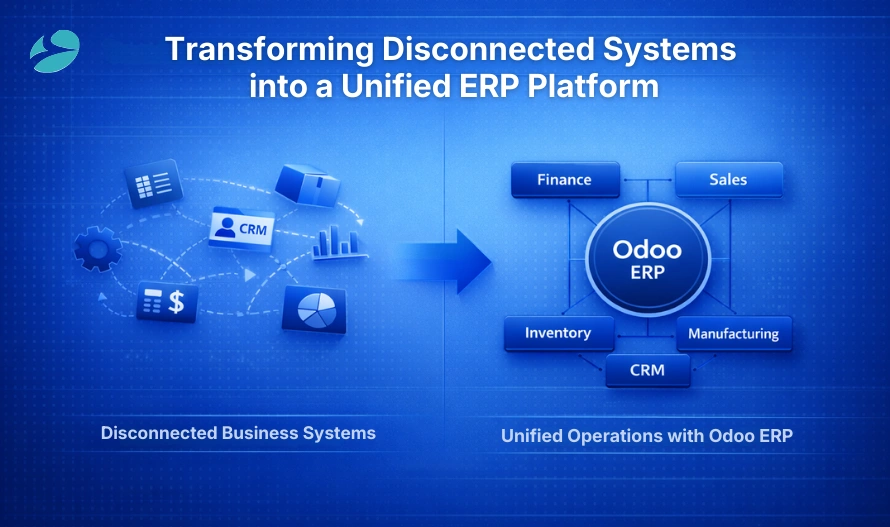
Odoo ERP implementation is the process of setting up the Odoo platform so a business can manage finance, sales, inventory, manufacturing, and CRM from a single system instead of juggling 10 tools and a prayer. It connects daily operations, so numbers stop arguing with each other.
The various functions of a company are divided into six areas: finance handles money matters, while sales teams manage transactions. Inventory systems track stock levels, manufacturing operations control production, and CRM systems maintain organized customer relationships. The present moment marks the beginning of two different choices.
Out-of-the-box Odoo implementation works fast but fits like a standard suit. Customized setups through proper odoo implementation services tailor the system to real workflows. Without that fit the software works, yet behaves like an expensive employee who needs constant babysitting.
Many organizations realize too late that choosing the wrong implementation approach creates more operational headaches than solutions. The right ERP setup should simplify work, not create new layers of complexity.
Are your current systems helping your teams move faster, or are they quietly slowing down every department?
Many U.S. businesses are turning to Odoo ERP implementation because traditional ERP systems often cost an arm, a leg, and sometimes the office coffee machine, too. Odoo keeps costs sensible while still handling serious business operations.
As companies grow, the system grows with them, rather than throwing a tantrum like outdated software that panics at the sight of new users. Its modular structure allows organizations to adapt the platform for specific industry needs, whether managing manufacturing floors or complex sales cycles.
Proper odoo implementation services also help align the system with U.S. accounting practices and tax regulations, so finance teams do not spend nights wrestling with spreadsheets and questionable formulas.
With the right odoo implementation, operations become organized, scalable, and far less chaotic than the average Monday morning meeting.
Despite its flexibility and powerful capabilities, implementing Odoo ERP is not without challenges. From aligning business processes to managing technical complexities, organizations must navigate several critical hurdles during the implementation journey.
Implementing Odoo ERP is not a single event but a structured process that ensures the system aligns with real business operations and delivers measurable results.
Successful Odoo ERP deployments require companies to show their true operational processes instead of their meeting-based process descriptions. The current workflows are being mapped to identify existing operational gaps. This step aligns ERP goals with real business objectives. Skip this stage, and the project turns into a guessing game. Guessing in ERP is a risky sport.
Once requirements are clear, the system design begins. Workflows are configured to match U.S. business operations, so teams do not feel like they are wrestling with software daily. Proper Odoo implementation services also handle accounting and tax localization. Without this step finance teams may start questioning their career choices.
Data migration moves information from legacy systems or spreadsheets into Odoo. Old data often arrives messy and dramatic. It needs cleaning before entering the new system. At the same time integrations connect Odoo with CRM, eCommerce platforms, and other applications so systems finally stop behaving like strangers.
Before launch the system goes through user acceptance testing. This confirms workflows behave as expected. Teams receive role based training so daily tasks feel natural. When the Odoo implementation goes live the transition stays smooth instead of turning into a corporate horror story.
ERP projects do not end after launch. The system uses performance monitoring to guarantee its optimal operational efficiency. The platform undergoes continuous improvements through regular updates which ensure it meets changing business requirements. The system maintains its operational efficiency through ongoing assistance from skilled Odoo implementation services which prevent it from deteriorating into disarray.
A U.S. company came to BiztechCS with operations stitched together by disconnected systems, delayed reports, and manual processes that moved with all the grace of a shopping cart missing two wheels. Sales had one version of the truth, finance had another, and inventory was somewhere in the witness protection program.
BiztechCS stepped in with a structured Odoo ERP implementation that mapped workflows, cleaned data, connected core systems, and replaced scattered tasks with one reliable process. Through focused Odoo implementation services, the business gained faster reporting, better visibility, and fewer human errors, pretending to be business strategy.
The result was a cleaner operation, quicker decisions, and a system that finally worked like a team instead of a group chat full of chaos, excuses, and spreadsheets clinging to life like they paid rent.
Behind every successful Odoo ERP deployment is a set of practical implementation choices that shape how smoothly the system fits into daily business operations.
BiztechCS has spent years in the trenches delivering Odoo ERP implementation projects across industries, and that experience matters when business operations refuse to behave like neat diagrams in presentations. Our team carries out every Odoo implementation through practical methods and detailed project schedules, and our team maintains a critical view of common shortcuts that create future issues.
Our Odoo implementation services handle every aspect from consulting through system design to configuration and integration, so businesses can avoid the chaotic practice of managing multiple vendors. Deep understanding of U.S. accounting rules and compliance requirements ensures the system complies with local regulations rather than fighting them.
After going live, the support does not vanish into thin air. BiztechCS continues to monitor performance, improve workflows, and keep the ERP system running smoothly while chaos politely waits outside the door.
A successful Odoo ERP implementation requires more than software installation, as organizations must dedicate time to system testing. The process needs a structured methodology that analyzes current workflows and streamlines operations by establishing a unified, reliable technology system.
When the strategy is clear, the ERP stops being a fancy expense and starts acting like the operational backbone of the business. A rushed odoo implementation usually turns into a digital headache where spreadsheets refuse to die, and reports arrive late to the party. The smarter route is working with experts who know the terrain.
With practical odoo implementation services, BiztechCS helps U.S. businesses implement ERP the right way so operations run smoothly and chaos finally takes the day off.
A well-planned ERP implementation can transform how teams collaborate, how leaders make decisions, and how efficiently a business scales in a competitive market.
If your business is considering Odoo ERP or struggling with disconnected systems, it may be time to explore a smarter implementation strategy.