
AI in Transportation: Driving the Future of Smart, Connected Mobility

 5 min read
5 min read
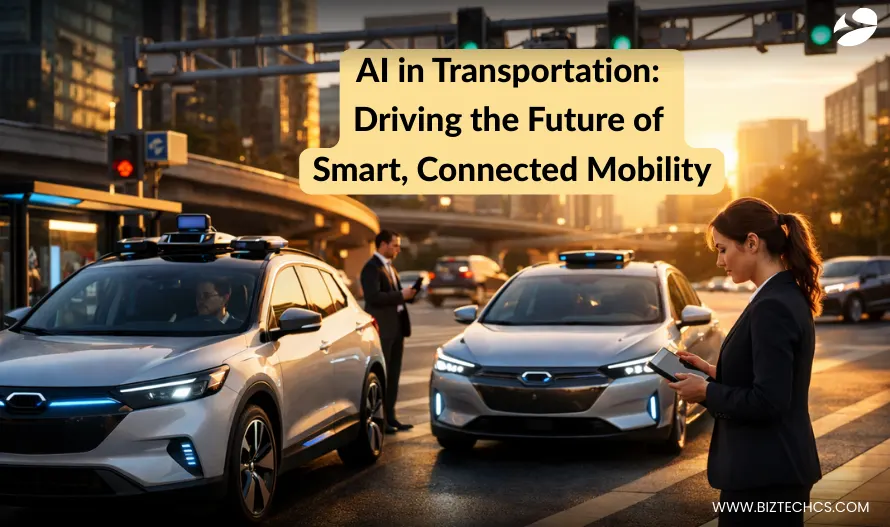
Transportation has progressed faster than boardroom budget approvals can keep up with, from steam engines operating at 30 mph to algorithms that make highway-speed decisions within milliseconds. Today, AI in transportation is no longer a futuristic concept; it’s a real technology businesses can use. The technology has arrived and is dominating the market, even as many organizations still treat it as an optional tool.
According to recent research, AI could generate up to $500 billion in value annually for the global mobility and logistics industries by 2030. This highlights the significant economic potential of intelligent transportation systems and mobility automation (McKinsey & Company, 2025).
While public attention often focuses on self-driving vehicles, AI in mobility handles critical tasks that many people don’t recognize as important work — from optimizing traffic flows to enabling predictive logistics. The lack of AI adoption directly contributes to inefficiencies across global supply chains, resulting in excessive cash losses and rising carbon footprints that are forcing regulators to take emergency measures.
Safety protocols today often lean on preventive methods that inadvertently create obstacles to efficient operations. Meanwhile, the control cabinet at BiztechCS illustrates how organizations particularly those partnering with an AI Development Company struggle with outdated technology stacks that still underpin their AI initiatives for Smart Mobility.
Our strategy focuses on developing operational methods that enable your business to modernize without requiring extensive technological overhauls, helping you unlock the true value of AI-driven mobility solutions while staying competitive in a rapidly evolving industry.
Steam engines gave us speed. Autonomous algorithms are causing us to worry about our driving skills becoming obsolete. That escalated quickly. AI in transportation has jumped from sci-fi fantasyland to the boardroom faster than you can say “Where’s my flying car?”
As of 2025, 57% of operations and supply chain leaders have already integrated AI into selected functions or across their organizations. That number is continuing to climb as digital transformation accelerates investment across the industry (source).
The reality check hits hard. Self-driving vehicles are just the tip of the iceberg. The real game changer lies in Artificial Intelligence in Mobility systems that optimize supply chains, slash carbon emissions, and keep passengers safer than a bubble-wrapped toddler. Route optimization algorithms are saving logistics companies millions. Predictive maintenance prevents breakdowns before your fleet managers have had their morning coffee.
But here’s the kicker. Most transportation companies are still running legacy systems older than some employees. BiztechCS bridges that awkward gap between “we’ve always done it this way” and “holy smokes, our competitors are eating our lunch.” Tailored AI for Smart Mobility strategies help organizations modernize without throwing everything out the window. Because evolution beats revolution when your business can’t afford downtime.
Waiting for a truck to die on a desolate highway is a bold, albeit expensive, way to run a business. Standard reactive maintenance is essentially a game of Russian Roulette with the balance sheet, where the only prize is a massive towing bill.
Artificial Intelligence in Mobility flips this script by moving away from the “if it ain’t broke, don’t fix it” philosophy that has historically led to bloated repair costs and stranded assets.
Is your fleet’s potential being drained by “guessing” when the next breakdown will occur? Many operators find that the cost of reactive repairs is far higher than the investment in foresight.
AI-driven logistics replaces guesswork with real-time intelligence, turning complex delivery networks into continuously optimized systems that balance speed, cost, and reliability at scale—powered by advanced AI/ML development services that transform data into actionable decisions.
Static GPS navigation is about as useful as a paper map in a rainstorm when your delivery windows are tighter than a drum. AI in transportation provides drivers with more than just directions to their next left turn.
The system operates multiple functions by processing current weather conditions, traffic patterns, sudden road closures, and delivery time requirements to determine routes with continuous updates, much like a chess grandmaster who prepares his next twenty moves.
We develop advanced optimization algorithms, including A* and Dijkstra’s, to meet your specific logistics requirements, because standard solutions perform at the same level as using a butter knife to cut steel.
Last-mile delivery costs account for nearly 53% of total shipping expenses, making it the most challenging segment of the supply chain. The Smart Mobility AI system uses delivery sequence optimization, intelligent stop clustering, and drop-off duration prediction to stop this cost problem from continuing.
The algorithms learn from thousands of completed routes, understanding that delivering to apartment complexes takes longer than suburban houses, and that downtown parking is basically a blood sport. Powered by our ai/ml development services, our company creates systems that transform last-mile delivery disorder into an organized, data-driven approach one that treats every delivery point as essential.
The implementation of Artificial Intelligence in Mobility technology reduces fuel waste by decreasing fuel use from vehicle idling and unnecessary travel. The system detects inefficient patterns, reducing backtracking while maintaining optimal speed profiles to achieve fuel efficiency across all routes.
AI analyzes driving behavior to create optimal acceleration patterns while reducing wasteful routing that leads to financial difficulties for accountants. The system enables organizations to maintain control over operational expenses, given that fuel prices fluctuate rapidly throughout the day.
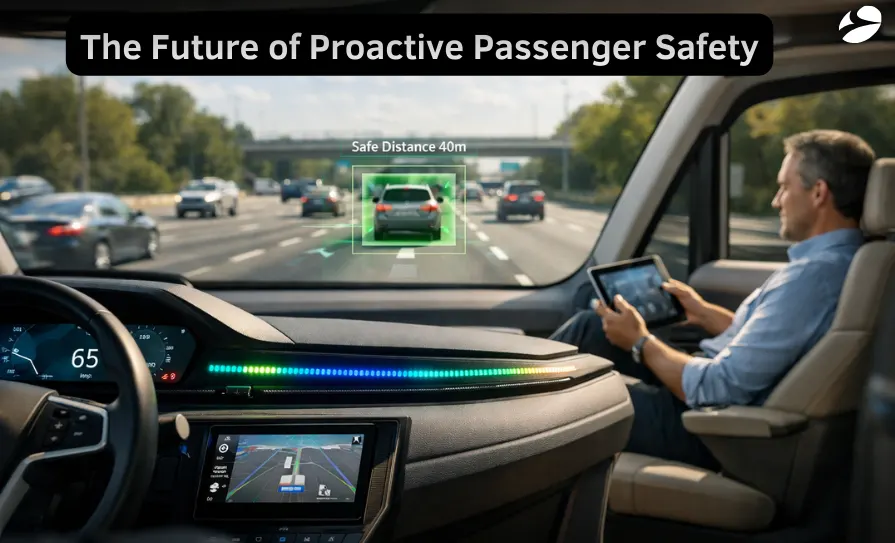
AI is reshaping passenger safety and comfort by transforming vehicles from reactive machines into proactive systems. These systems anticipate risk, support drivers, and personalize every mile of the journey.
The development of Advanced Driver Assistance Systems has progressed from luxury features to essential safety equipment, a status that should have been established earlier.
AI in transportation enables lane departure warnings that prevent vehicles from drifting out of their lanes, while automatic braking systems provide faster reaction times than human drivers. An AI Development Company plays a crucial role in building these intelligent systems, which detect hazards by processing sensor data within milliseconds, enabling them to identify risks before they lead to insurance claims.
Our company implements ADAS technology that not only produces annoying beeping sounds but also serves as an effective accident-prevention system that protects lives while reducing the need for extensive incident documentation.
Commercial drivers face grueling schedules that would break most desk workers, and expecting superhuman alertness is pure fantasy. AI for Smart Mobility monitors fatigue signs, distraction patterns, and health emergencies through intelligent camera systems.
We build computer vision models that detect driver behavior patterns to prevent accidents, analyzing eye movements, head positions, and micro-expressions that signal trouble brewing.
The system alerts supervisors before a drowsy driver becomes a statistic, because catching problems early beats explaining them to lawyers later. This technology keeps drivers accountable without turning vehicles into rolling surveillance nightmares.
Artificial Intelligence in Mobility, powered by advanced ai/ml development services, creates customized travel experiences by using natural language processing voice assistants alongside flexible entertainment systems. Passengers can control everything from climate to entertainment without fumbling through endless menus, like they’re searching for buried treasure.
The system learns user preferences and uses them to suggest routes, allowing users to interact through natural language rather than robotic commands.
As an AI Development Company, we create interfaces that understand user context and intent, enabling people to interact with technology through natural dialogue rather than struggling with malfunctioning software.
Are you ready to move beyond clunky interfaces and provide a travel experience that actually understands your passengers?
AI-powered traffic management replaces rigid, outdated control systems with data-driven intelligence that adapts in real time to how cities actually move.
Smart Cities sound impressive until you realize most traffic lights still operate on timers set during the Reagan administration. AI in transportation changes that by controlling traffic signals based on actual traffic flow, not assumptions.
We develop smart city modules that interface with public infrastructure APIs, turning dumb intersections into responsive systems that adapt every few seconds instead of every few decades.
AI for Smart Mobility analyzes years of historical data to predict when traffic will hit the fan, usually around 8 AM and 5 PM like clockwork.
The system spots patterns faster than a detective on their third coffee, redirecting flow before congestion turns your commute into a parking lot. Proactive adjustments beat reactive panic every single time, keeping vehicles moving when it matters most.
Public transit has earned its reputation for being late more often than teenagers, but Artificial Intelligence in Mobility fixes that. Real-time scheduling updates inform passengers of actual arrival times rather than projected numbers, while demand-based routing routes buses to where people need them.
The system operates in two steps: first, it determines actual resource requirements, and then dispatches vehicles to those locations, preventing empty buses from operating during less busy periods of the day.
Despite its transformative potential, implementing AI in transportation comes with complex technical, financial, and regulatory hurdles that organizations must navigate carefully.
AI in transportation Challenges start with data scattered across systems like confetti after a parade. Fleet management uses one platform, maintenance another, and GPS tracking lives in its own isolated bubble.
The process of obtaining high-quality data from these distributed systems is akin to herding cats through a thunderstorm, and resulting data inconsistencies create barriers to accurate AI predictions that require extensive system integration.
Liability questions around autonomous accidents keep lawyers busy and companies nervous. When AI makes a split-second decision that ends badly, figuring out who pays becomes a legal nightmare that makes tax audits look simple. Transparency requirements add another layer of complexity because explaining how neural networks make decisions is like explaining why your teenager made questionable choices.
AI for Smart Mobility demands significant upfront investment, which makes smaller enterprises break out in cold sweats. The technology, infrastructure, and expertise don’t come cheap, creating a barrier to entry higher than an Olympic pole vault bar. ROI eventually justifies costs, but convincing finance departments requires patience and very persuasive spreadsheets.
Hacker groups use connected vehicles as testing grounds because organizations fail to implement adequate security protections. A single security flaw can disrupt an entire vehicle fleet, making security measures an essential requirement that organizations must follow regardless of implementation costs.
The success of AI in transportation depends as much on execution and expertise as on technology, making the choice of an implementation partner a critical decision.
The transition from pilot programs to full implementation requires a detailed execution plan that organizations must follow. Most organizations become trapped in testing limbo because they run endless pilot programs that never reach operational status.
As an AI Development Company, we provide a comprehensive 5-step roadmap, from data auditing to ethical AI deployment, enabling your business to maintain its competitive edge through proof-of-concept validation. The roadmap transforms AI in transportation from an experimental hobby into an operational reality.
The initial performance of off-the-shelf solutions appears perfect until actual business needs emerge, at which point they collapse. Generic software fails to account for the specific constraints of complex logistics environments, leading to costly solutions that address non-existent issues.
We create custom systems that align with your unique operational requirements, fleet details, and existing challenges without creating unnecessary obstacles. Businesses that implement standard solutions for initial cost reduction will incur high costs when these solutions fail in essential business functions.
AI in transportation isn’t a luxury anymore; it’s the difference between staying competitive and becoming a cautionary tale in someone else’s business school presentation. For any AI Development Company working at the intersection of mobility and innovation, the writing is on the wall, written in big, bold letters that spell out “adapt or get left behind, eating dust.”
Organizations that maintain legacy systems while competitors use advanced technology for route optimization, failure prediction, and cost reduction will face operational challenges.
The transportation landscape has changed, and organizations should stop pretending that their old methods will suffice.
The gap between those who innovate and those who hesitate is widening every day. Does your current technology stack have the horsepower to carry you into the next decade, or is it holding you back from the efficiency your business deserves?