
 1126
1126
Odoo for Fashion Retailers in the UAE: Managing Inventory, Orders, and Customer Experience
 5 min read
1126
5 min read
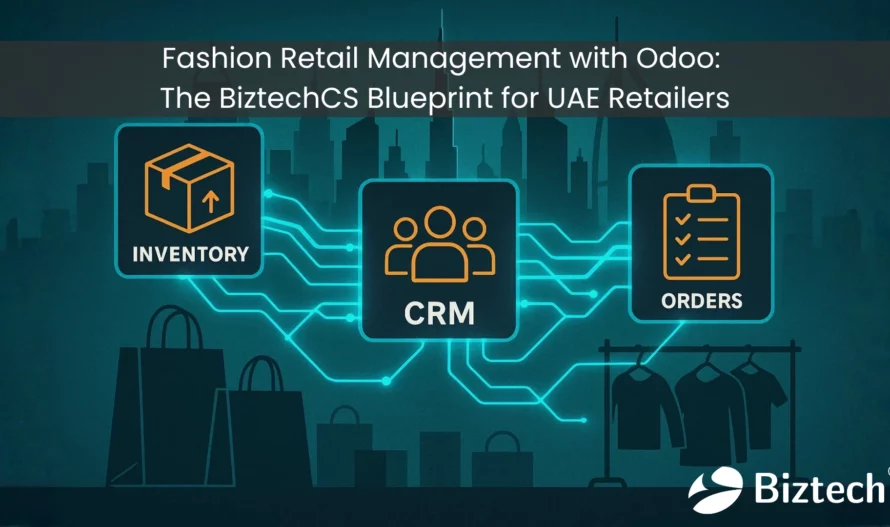
The fashion industry is one of the most fascinating industries. From new trends to pop-up collections, the industry sees a shift every few months (or, in some cases, every other month). And, the UAE’s ever-evolving retail scene is moving even faster.
With influencer campaigns, flash eCommerce sales, constantly changing collections, and whatnot, retailers are coming up with unique ways to ensure customer retention. They are making this happen by embracing technology just like they welcome new trends.
But the scene looks different for growing retailers. They are finding it challenging to match the pace with this current system. Their brick-and-mortar infrastructure barely keeps up with the online channels; imagine what an influx of large-scale orders will do to that.
The two separate sales channels for online and offline sales, an inventory management system, and a separate CRM platform make it difficult for them to handle everything efficiently. With so many systems, retailers find their employees juggling spreadsheets and email rather than actually working.
They believe their ancient management practices are still the best way to handle their operations, and this contributes to the brand value (which, spoiler alert, it doesn’t). What they need right now is a resilient ERP that consolidates their scattered data into a centralized management system.
If you have tried different ERPs, you know that not all of them can handle the complexities of the UAE demographic. These platforms are either not very flexible or require additional feature add-ons, which means a greater financial investment.
Research predicted that by 2030, the UAE fashion technology market would generate approximately USD 11,422.7 million in revenue, but retailers find it hard to believe. Their failed attempts with numerous ERPs and CRMs give the impression that these solutions are built only for enterprises.
This is where Odoo comes into the picture. With the right Odoo ERP software development approach, Odoo ERP for fashion retail—when implemented with precision, phased discipline, and region-specific localization—can completely transform how fashion retailers operate.
One of the most common GCC retail challenges stems from manual inventory tracking across multi-channel operations. These retailers use a standalone Shopify setup to manage their eCommerce store and POS software for in-store transactions. And, the cherry on top is an isolated CRM for managing customer support tickets.
This setup may seem to work on a surface level, but it limits the visibility. Retailers fail to see the whole picture and often face stockouts due to overselling online. This delays order fulfillment, with the customer support team having limited to no knowledge of the current situation.
COOs of retail businesses often ask us, “How do we currently track inventory and sales across online and physical stores — and are these systems integrated at all?”
The answer lies in a centralized system that brings all the (currently fragmented) processes together. That means, no separate POS or eCommerce plugin, or Excel sheet reconciliation. It improves the process efficiency through information accessibility and real-time visibility.
Odoo for fashion retailers does just that. It unifies inventory, sales, and CRM into a single dashboard, which allows the team to have live stock visibility and eliminates redundant updates. Odoo integration can take your processes from a collection of disparate working systems to a cohesive system that works in sync with each other.
At BiztechCS, we engineer operational transformation through modular Odoo deployments. Considering the UAE demographic, compliance requirements and local demands, and unique business challenges, here’s how we approach Odoo implementation:
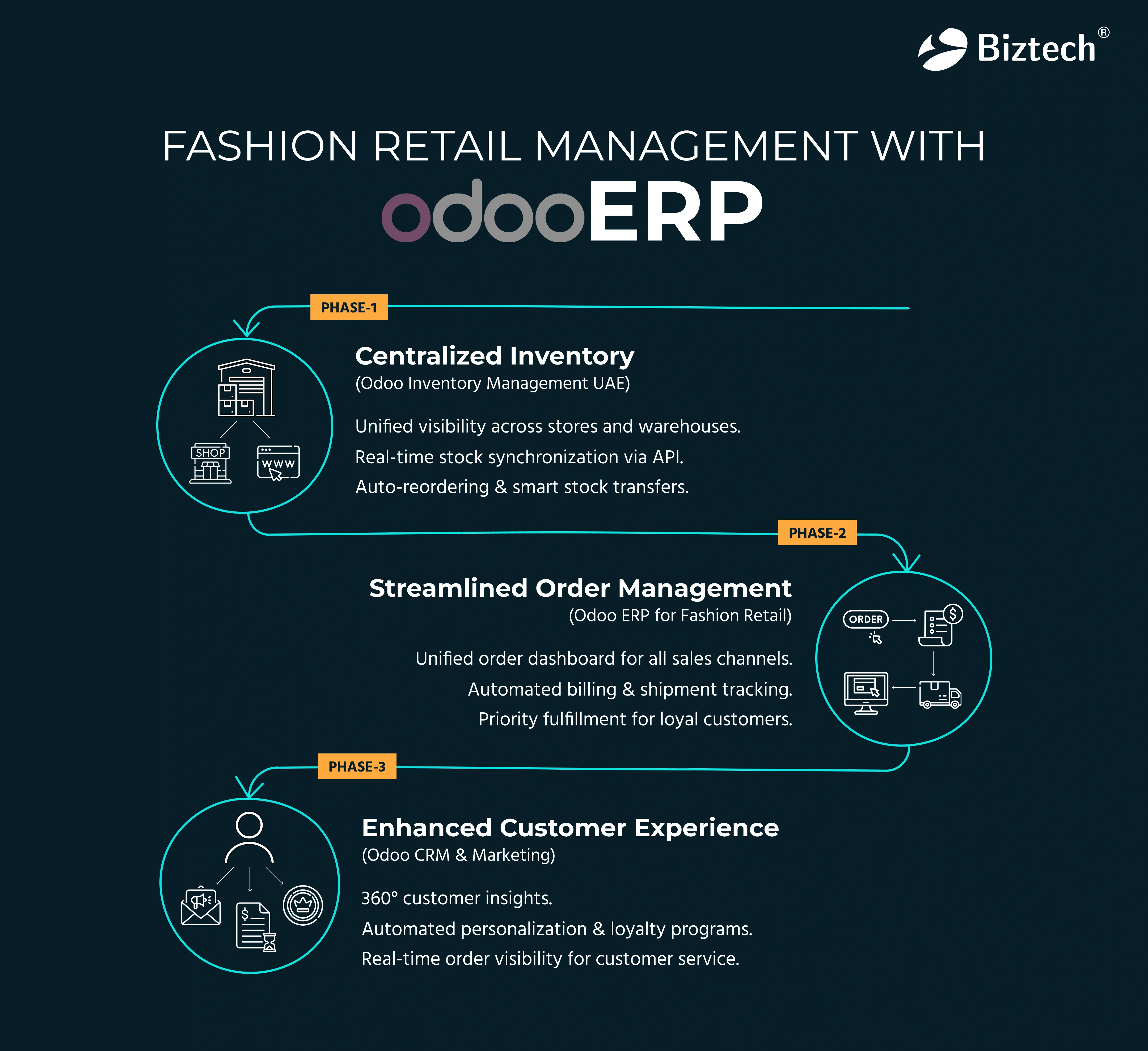
The first challenge is to bring the inventory, warehouse, and sales channels into one synchronized environment. We configure the Odoo ERP for fashion retail to track stock movements and automatically sync product availability between in-store POS systems and the Shopify website.
It also enables stock transfers between locations (if multiple) based on forecasted data and triggers auto-reordering when certain items drop below a threshold. Investing in Odoo ERP will provide you with real-time visibility across stores and online channels through API integration.
It will provide you with immediate updates on stock levels in real time across all your stores and warehouses. This level of visibility helps you implement better decisions based on factual information about sales, inventory management, and get insights into actual stock requirements.
After tackling the stock visibility, BiztechCS focused on streamlining the order workflows. That is, orders from multiple channels, like eCommerce, physical POS, and phone inquiries, would be directed towards one “Odoo Sales” channel. It will bridge the gap between inventory and accounting.
Our team will integrate a unified order dashboard for all the orders, automate invoice generation, and payment reconciliation. It will also centralize the shipment tracking by syncing it with the delivery partner’s location (during working hours).
Another benefit of fashion retail management with Odoo is priority-based fulfillment. We can customize your solution so you can offer express deliveries to your loyal, long-term customers as a reward.
Odoo ERP for fashion retail is the ideal solution, as it can manage both in-store and online sales. Your teams will be able to operate on a single unified platform. Once implemented, retailers can expect order fulfillment to be over 30% faster and a 25% reduction in order stockouts.
Fashion retail needs personalization to thrive. Remembering things like customers’ size, preferred colors, and brands are some of the little things that add huge value to customer experience. With Odoo ERP implementation in a UAE fashion retail store, they can provide their customers with such phenomenal services and more.
The Odoo CRM and email marketing module that BiztechCS integrates enables retailers to gain a comprehensive view of customer purchase histories and in-store transactions. So, you can categorize your customers by spending capacity, product preferences, and location.
What’s more? You can also automate personalized emails, new arrivals, and loyalty rewards to further strengthen your connections with the customers. Last but not least, this Odoo module will provide your customer service team with real-time visibility into orders and stock status. So they can provide your customers with conclusive evidence rather than the usual fluff.
Some experts ask us, “How can Odoo actually help us understand and serve our customers better?”
And the answer to this is by converting the data into actionable insights. Odoo automatically profiles customers based on their purchases. It identifies patterns, purchasing power, and their favorite products. The marketing team can gather this data and use it to better target your customers, rather than relying on guesswork.
If you want to know how fashion retail management with Odoo can benefit you, our experts may be able to help. Discover how an Odoo ERP tailored to your specific needs can be a transformative solution for your business.
In the UAE, ERP implementation is never just about features, it’s about compliance readiness. We understand that. This is why BiztechCS configures a module that aligns with:
With proper localization, Odoo can easily automate UAE VAT and customs charges. This is why BiztechCS deploys UAE VAT localization, so every invoice, for online or offline sales, reflects compliant VAT computations and audit trails.
Always validate your VAT configuration against a sample invoice when implementing Odoo ERP for fashion retailers. This will help you assess the output and make any necessary adjustments (if needed) before going live.
Once all the modules go live, BiztechCS will integrate the retailer’s Shopify store, in-store POS, and warehouse operations into a single, Odoo-backed omnichannel ecosystem. Doing so will synchronize and update inventory details in real time to prevent overselling and stockouts.
With everything coordinated through a single system, you can offer customers the flexibility to order online and return or replace items in-store. And, if you want to add promotional codes and gift cards, your CRM can handle that as well.
Another benefit that Odoo’s modular nature offers is efficient upscaling. So if you plan to expand your franchise partners or add more stores, your existing ERP grows with you—without needing to rebuild its entire architecture. With our expertise in odoo erp software development, BiztechCS can simply activate multi-company or multi-warehouse setups whenever you need them, ensuring your operations scale smoothly and effortlessly.
Odoo ERP implementation in a UAE fashion retail store sets the foundation for growth powered by an optimal management system. Retailers access all relevant information and prepare for the peak sales season using predictive analytics.
They can utilize the historic dataset and purchasing trends to prepare themselves and their teams accordingly. Our team can also integrate AI-powered replenishment tools and loyalty gamification into your Odoo architecture.
This kind of integration leads to not just an operational but a cultural transformation as well. From multiple systems in place to manage sales, warehouse, and customer support, you shift to one centralized system.
What makes Odoo for fashion retailers better than other ERPs is that it adapts to your business model. So whether you are managing five outlets or scaling across the GCC. Your Odoo ERP will evolve with your fashion business.
Let us optimize your fashion retail operations with Odoo, one module, one region, one growth phase at a time.
Artificial Intelligence (AI)
 57
57

By Nandeep Barochiya
Odoo
59

By Uttam Jain
Odoo
61
By Uttam Jain