

How Can Manufacturers Use AI to Bridge the Imagination Gap for Customers?
 5 min read
5 min read
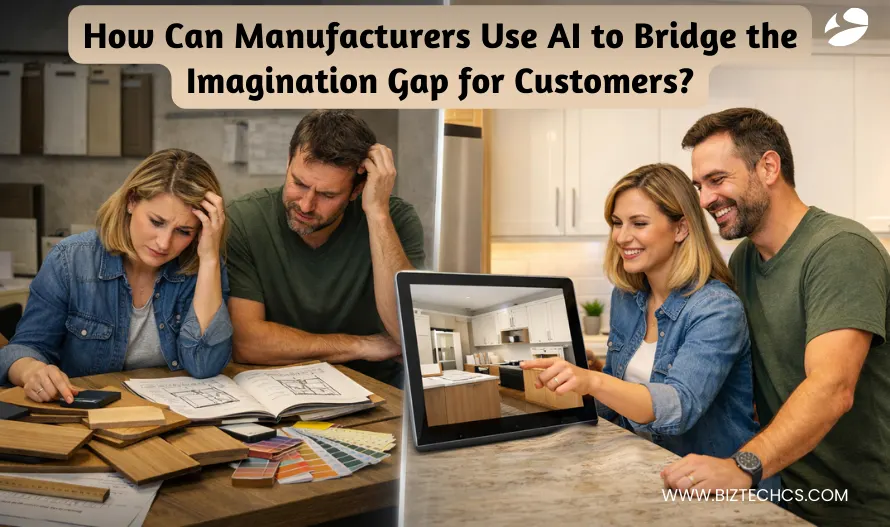
Europeans treat the kitchen like a sacred temple of caffeine and gossip. It is the one room where life actually happens between bites of sourdough. Yet, choosing cabinets feels less like a design dream and more like a descent into madness. Most people start with high hopes and end up staring at a pile of wood samples like they are solving a Rubik’s Cube in the dark. It is a classic case of biting off more than one can chew.
Statistics underscore just how stressful home renovations can be for homeowners. About 87% of homeowners report challenges during home renovations. Nearly half experienced significant delays. These issues highlight the confusion and stress that often accompany decision-making, especially for detailed choices like cabinetry and finishes (source). The gap between the designer’s vision and the finished product is where the money allocated to the project is lost.
However, the time when people had to rely on luck is long gone. The time-consuming, complex process of AI-based kitchen design and 3D cabinet visualizations is now complete. These tools connect a not-so-clear idea and an ideal layout.
A custom kitchen configurator eliminates the need for guesswork or costly mistakes. Technology is making a stressful process much easier. The present-day migration towards AI in interior design ensures that the most important part of the house will be data-driven rather than a product of imaginary deductions.
These challenges stem from a mix of visual uncertainty, space constraints, rising personalization demands, and the high financial stakes tied to every design choice.
Operating a hotel without a unified system is like trying to paint a masterpiece in a pitch-black room while wearing mittens. Management often buys into software promises only to find the reality is a disjointed mess of spreadsheets and broken dreams.
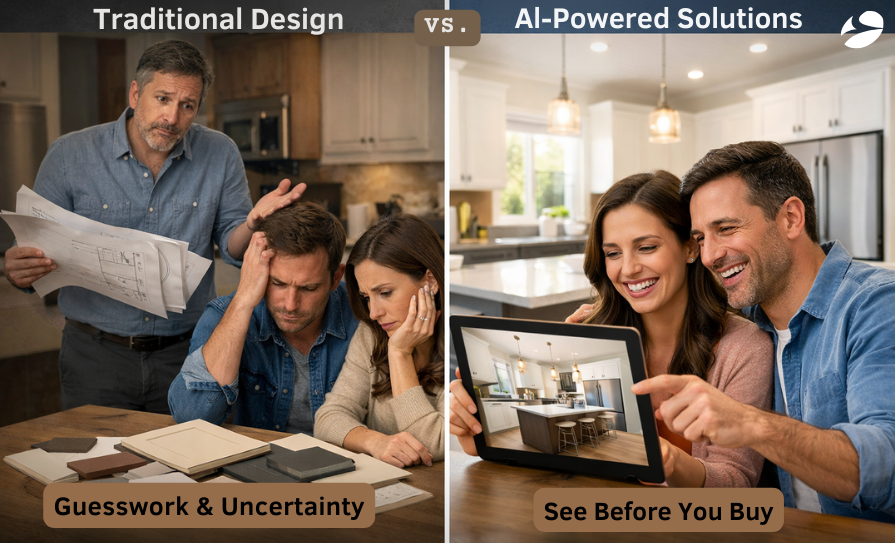
3D cabinet visualization in a kitchen context solves the “seeing is believing” problem, and similarly, AI’s real-time dashboards allow for a transparent view of the entire property before a single guest checks in. But for those steering the company ship, a vital question arises: Can high-fidelity visualization actually shorten the sales cycle? Absolutely. By removing the “imagination gap,” customers move from contemplation to commitment much faster, as the psychological barrier of visual uncertainty is eliminated instantly.
Modern travelers expect a boutique experience even when staying in a room the size of a shoebox. Balancing high-density occupancy with personalized luxury requires a level of precision in room management that rivals a custom kitchen configurator.
AI handles these tight constraints by automating room assignments and seasonal pricing, ensuring every square inch of the property generates maximum revenue without making guests feel like sardines.
The hospitality world is currently being squeezed harder than a lemon at a seafood bar to provide hyper-personalized stays. Just as AI-driven interior design tailors a home to a specific soul, it’s CRM and loyalty modules track guest preferences to ensure their favorite pillows and drinks are waiting upon arrival. If the brand fails to deliver this level of detail, the guest will jump ship faster than a rat on a sinking luxury liner.
There is nothing quite like the cold sweat of a CFO realizing they have invested in a legacy system that talks to nobody. This fear of wrong implementation is a nightmare that every boardroom faces, but the AI kitchen design method proves that if decisions are based on data, the “oops” factor is eliminated.
AI provides a safety net by merging POS, accounting, and housekeeping into one source of truth, thereby ensuring that the only surprises at checkout are pleasant ones.
Are you tired of losing potential sales to the “imagination gap” and seeing customers hesitate at the finish line? It’s time to replace uncertainty with interactive clarity that builds instant confidence.
Relying on static 2D renderings is basically asking a client to see a masterpiece in a smudge of charcoal. These flat sketches offer zero depth, leaving everyone to play a dangerous game of “guess the kitchen” until the hammer hits the wall. Hours vanish into thin air during endless in-person consultations that could have been an email if the industry weren’t stuck in the Stone Age.
Using outdated configuration tools is equivalent to being clad in lead boots while the competitors who have 3D kitchen design software run ahead in a marathon. This outdated approach makes a simple renovation a ridiculous mistake where only a heap of frustration is produced instead of a beautiful cabinet.
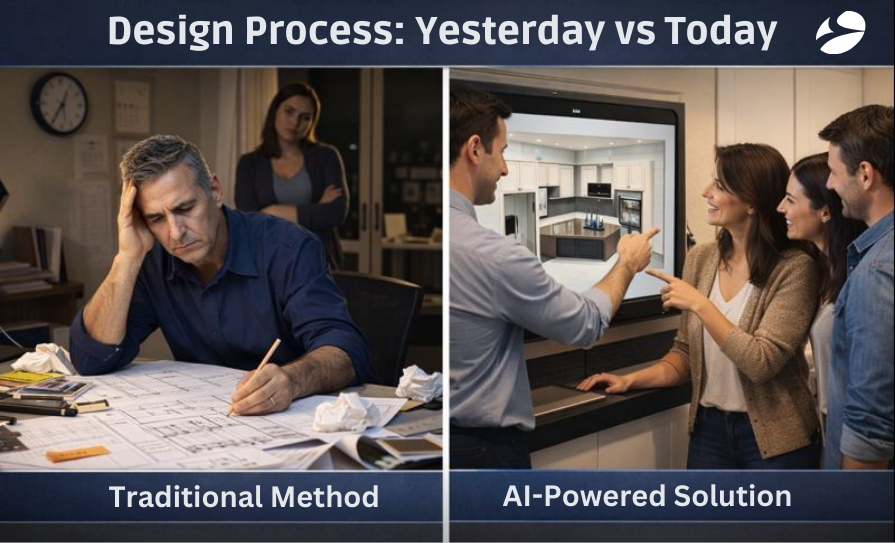
This leads many operations directors to ask: Will adopting these tools require a complete overhaul of our existing legacy databases? The answer is no. Modern 3D configurators are designed to act as an agile layer that sits atop your current ERP or CRM, pulling existing product data and pushing order specifications without disrupting your established workflow.
Moving from static drawings to immersive reality is like trading a horse and buggy for a rocket ship. We at BiztechCS can implement these cutting-edge 3D configurators that seamlessly blend AI intelligence with visual brilliance. Our team can develop custom drag-and-drop interfaces that make complex design decisions feel intuitive.
These portals allow for real-time material switching, so clients stop guessing if marble clashes with their poor life choices. Automated conflict detection stops drawers from smashing into ovens because we believe physics should be respected. We ensure dynamic pricing updates keep the budget from ballooning into a national debt crisis.
Every click generates export-ready technical documentation to keep builders from scratching their heads in confusion. This AI-powered kitchen design approach means we build a custom kitchen configurator that actually works for the real world. By utilizing 3D kitchen design software, BiztechCS turns a chaotic renovation into a masterclass of precision.
A successful MVP focuses on rock-solid fundamentals that deliver real value fast, without drowning users in unnecessary complexity.
Building a platform that crashes more often than a toddler on a sugar high is a recipe for disaster. We at BiztechCS can build your MVP with a phased approach, starting with core functionality and scaling based on real user feedback and usage patterns. Our team develops stable web-based portals that ensure AI-powered kitchen design stays accessible on any browser without making the hardware smoke.
Giving dealers and customers different toys to play with requires a delicate touch. We can implement tiered access levels within a custom kitchen configurator so everyone stays in their own lane. This setup prevents customers from accidentally ordering ten thousand neon green hinges while allowing dealers to finalize the technical nitty-gritty.
It is all fun and games until the factory receives a design that is physically impossible to manufacture. We can develop synchronization logic that connects the 3D cabinet visualization directly to the production line. This ensures that what the customer sees on the screen is actually what the saw cuts on the floor. At this stage, a savvy product manager might wonder: How do we ensure the AI doesn’t suggest ‘creative’ designs that are impossible to ship? We solve this by embedding “Manufacturing Constraints” into the AI’s DNA. The system is programmed with your specific shipping dimensions and structural tolerances, ensuring every custom design remains logistically viable.
Stuffing a platform with every bell and whistle is a great way to confuse users into a coma. We focus on balancing complex 3D kitchen design software features with an interface that does not require a PhD to navigate. Our goal is to keep the experience smooth so users actually finish their designs instead of throwing their laptops out the window.
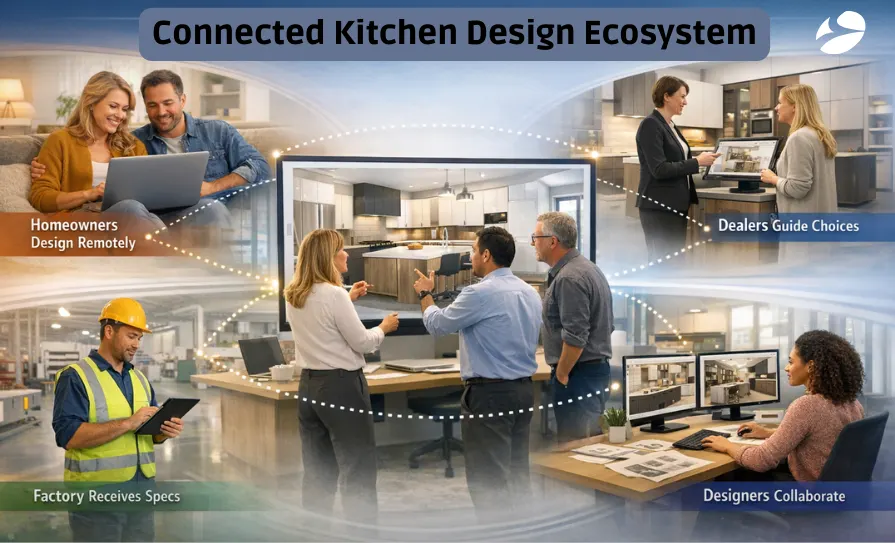
Future-ready kitchen platforms demand an architecture that balances visual power, system intelligence, and long-term scalability from day one.
Building a digital kitchen on a shaky foundation is a great way to watch your tech stack collapse like a souffle. A proper front-end uses WebGL or Unity to ensure 3D cabinet visualization looks sharp enough to cut glass. Behind the scenes, a headless CMS and GraphQL APIs keep data moving without the typical back-end constipation.
The AI layer employs rule engines to prevent users from placing a sink in the middle of a hallway. Real-time ERP integration ensures the system knows exactly what is in the warehouse, so nobody sells ghosts.
A system that dies the moment ten people use it at once is just an expensive paperweight. Scalability means the custom kitchen configurator should handle a sudden rush of users without breaking a sweat or blowing a fuse.
We design these architectures to grow alongside the business so the software does not become obsolete by next Tuesday. Using cloud-native structures ensures the platform stays upright even when the traffic gets heavy. It is about being prepared for the long haul instead of just putting out fires. Still, stakeholders often ask: Is the cost of maintaining a cloud-based 3D engine justifiable for mid-sized manufacturers? When you factor in the massive reduction in manual drafting hours and the elimination of “remake” costs due to order errors, the system typically pays for itself within the first few quarters of full deployment.
Loading bars are like slow-moving snails – nobody has the time and patience to see one crawl across their screen. Happy users and smooth frames depend on clever asset compression for high-performance 3D kitchen design software.
Our main aim is to optimize the rendering pipeline so that AI-powered kitchen design is going to be a magic trick rather than a boring task. If the speed of the platform is not like lightning, users will leave their carts quicker than a ship that is sinking. Clean code and light assets are the only ways to maintain the lead.
Turning ambitious kitchen design ideas into production-ready platforms requires more than tools. It demands deep domain expertise, precision engineering, and disciplined execution.
Most off-the-shelf software treats your unique cabinet lines like a generic pile of lumber. BiztechCS can develop a modular custom kitchen configurator that actually respects your specific design language and hardware specs.
We can implement a system where every hinge and handle reflects your actual inventory rather than a pipedream. This means your sales team can stop making excuses for why the software does not match the catalog. Our team builds the logic so your digital presence finally stops looking like a high school art project.
We ensure the interface is slick enough to impress even the most cynical buyer. This tailored approach keeps your brand identity intact while moving into the future. It is about putting your best foot forward without tripping over bad code.
Watching a website struggle to load a simple kitchen layout is a special kind of torture. BiztechCS can implement a 3D cabinet visualization engine that runs smoothly on a dusty showroom kiosk or a modern smartphone.
We develop high-fidelity rendering that does not require a supercomputer to operate. This ensures that customers can swap finishes in real-time without the screen freezing into a block of ice. We make sure the visual quality is top-notch so the wood grain looks real enough to touch.
Our engine bridge the gap between a browser tab and a physical room effortlessly. We handle the heavy lifting of optimization so your sales floor stays fast and efficient. It is high-definition reality delivered without the typical lag.
Left to their own devices, most people would design a kitchen that violates every law of physics and safety. BiztechCS can develop AI-powered kitchen design rules that act as a digital bodyguard against bad decisions.
We can implement automated compliance checks that ensure a stove is never placed directly under a velvet curtain. The system learns customer preferences over time to offer suggestions that actually make sense. This AI-driven interior design layer stops expensive mistakes before they reach the production floor.
We build the intelligence that tells a user when a drawer will hit a dishwasher. It is like having a master designer looking over the shoulder of every customer. We make sure the designs are as functional as they are beautiful.
Trying to manage a global network on a local server is like trying to fuel a jet with a lawnmower tank. BiztechCS can develop a scalable cloud architecture that supports your entire dealer network across every time zone.
We can implement a backbone that keeps data synchronized, whether a user is in Berlin or Bangkok. This ensures that a price change in the main office does not take three weeks to reach the showroom. Our team builds for growth, so your system does not have a nervous breakdown during a holiday sale.
We ensure the infrastructure is robust enough to handle thousands of simultaneous sessions. This global reach means your brand stays consistent everywhere on earth. We take the headache out of expansion by providing a solid digital foundation.
Software projects often turn into bottomless pits because people cannot stop adding useless buttons. BiztechCS can help you avoid this trap by starting with your top five cabinet layouts as a solid base.
We can implement an iterative approach that evolves based on actual usage heatmaps and user feedback loops. This ensures we are building what people actually use rather than what looks good on a whiteboard. We develop the platform in stages to keep the project on track and under budget.
Our team monitors how users interact with the 3D kitchen design software to refine the experience. This prevents the “kitchen sink” syndrome where too many features spoil the broth. We focus on what moves the needle for your business first.
Sticking with static blueprints in a world moving at light speed is a one-way ticket to obsolescence. The transition from boring sketches to dynamic, immersive reality is not just a trend but a survival tactic.
We can implement high-end systems that understand the delicate balance between human taste and cold, hard logic. BiztechCS can develop a custom kitchen configurator that stops your clients from wandering into a forest of confusion. Waiting for the perfect moment to upgrade is a fool’s errand because your competitors are already halfway there. We can help you build 3D kitchen design software that makes your brand the talk of the town for all the right reasons. Our team ensures your technology understands spatial awareness better than a distracted contractor.
We can develop the tools that turn “maybe next year” into “let’s buy it now.” It is time to stop playing with crayons and start using AI-powered kitchen design to move the needle. Let us map out a journey that transforms your sales funnel from a leaky bucket into a fine-tuned machine. Reach out to us for a personalized consultation on your 3D cabinet visualization strategy before your current system becomes a prehistoric relic.
Ready to bridge the gap between your customers’ imagination and your manufacturing reality? Let’s build a digital experience that turns complex custom designs into seamless, high-velocity sales.

Artificial Intelligence (AI)
 20
20

By Devik Gondaliya

Artificial Intelligence (AI)
18
By Devik Gondaliya

Artificial Intelligence (AI)
67

By Nandeep Barochiya