
How Does AI-Powered Monitoring Prevent Business Disasters Before They Happen?

 5 min read
5 min read
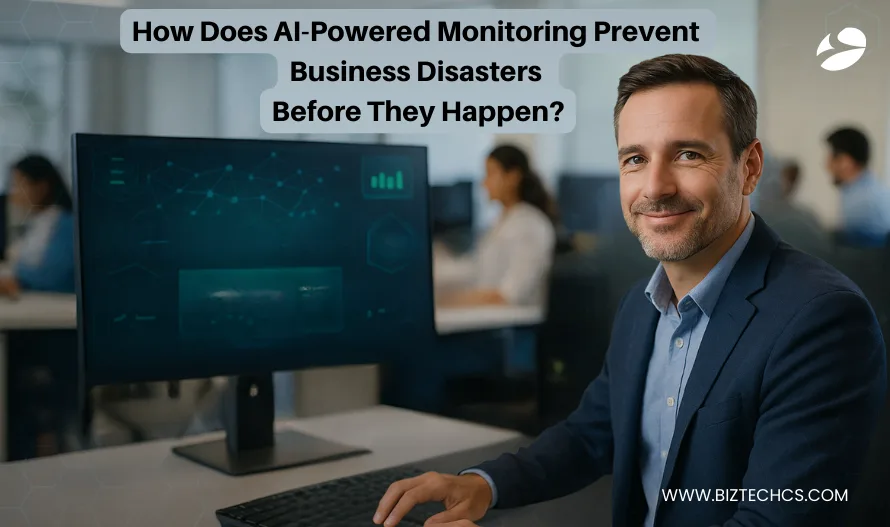
Every business owner knows that sinking feeling when the server crashes during peak hours. Now multiply that feeling by infinity and add bankruptcy papers to the mix. The cruel joke is that small and medium enterprises face the same catastrophic risks as their Fortune 500 counterparts.
Hackers don’t discriminate based on company size; they’re equal-opportunity destroyers. Natural disasters don’t check your annual revenue before flooding your server room. Yet while large corporations build digital fortresses, SMEs often protect themselves with strongly worded emails and crossed fingers.
But the game has changed. AI-powered disaster recovery and cloud disaster recovery solutions have democratized business protection. These aren’t fancy toys for Silicon Valley anymore — they are practical, affordable lifelines for SME business continuity.
The stakes are real: according to FEMA, approximately 43% of small businesses never reopen after a disaster (source: Forbes).
But here’s what business leaders often ask: “If AI-powered solutions are so effective, why aren’t more SMEs using them already?” The answer lies in a knowledge gap, not a technology gap.
Most executives assume these solutions require Silicon Valley budgets and NASA-level technical expertise. The reality? Modern AI-driven disaster recovery is as accessible as your accounting software, with implementation costs a fraction of those for traditional solutions.
This guide breaks down how AI-driven risk mitigation actually works without technical mumbo-jumbo. You’ll get real strategies, actionable implementation steps, and solutions that won’t require selling your soul to venture capitalists. Because crossing your fingers isn’t a disaster-recovery plan; it’s a business obituary waiting to be written.
SMEs simply regard disaster recovery drafting as the case of a dentist visit; “it’s widely acknowledged, and everyone knows they have to do it, but they’ll wait until something is rotting before taking action.”
The stark reality is that limited finances force business owners to choose between paying salaries and preparing for disasters that may or may not occur. Guess which one wins every time. This financial tightrope walk means that as of 2025, only 54% of organizations have an established, company-wide disaster recovery plan (source).
There’s also this charming delusion that disasters are picky about their victims. News flash: ransomware doesn’t check your employee count before encrypting everything. Traditional disaster recovery solutions don’t help either — they often require the technical expertise of mission control and budgets that would make venture capitalists weep.
Most SMEs have that one person who “knows computers” handling everything from password resets to server maintenance. Asking them to architect SME business-continuity plans is like asking a family doctor to perform brain surgery with a Swiss Army knife.
What’s the cost for such negligence? Downtime hits hard. According to recent industry data, business outages now cost small businesses an average of US $1,410 per minute of downtime. That’s not pocket change — that’s “sell the company car — and possibly a kidney” money.
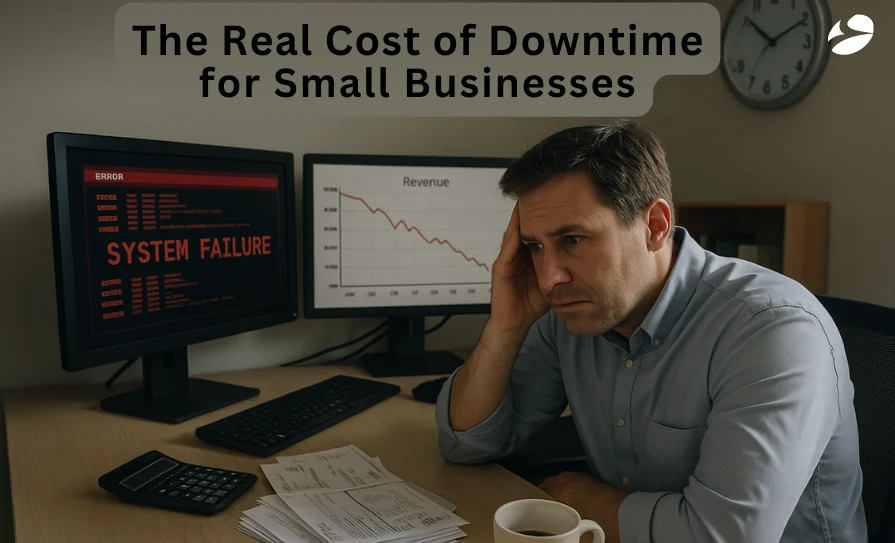
C-suite executives frequently wonder: “What’s the actual ROI on disaster recovery investment versus the cost of potential downtime?” The math is surprisingly straightforward. A comprehensive AI-powered recovery solution typically costs less than 48 hours of downtime annually.
When you consider that the average SME experiences 140 hours of downtime per year, the investment pays for itself within the first incident prevented. It’s not spending money on disaster recovery; it’s buying insurance against bankruptcy.
Wondering what your actual downtime could cost per hour and whether AI-powered recovery makes financial sense for your specific business? The numbers might surprise you.
Traditional disaster recovery comes with layers of hidden challenges. They pile up quickly, making it far more complicated and costly than most small businesses can realistically manage.
Conventional disaster recovery requires redundant servers, storage arrays, and networking equipment that cost more than most SMEs’ annual holidays combined. A staggering sum of $50,000 to $100,000 is just the initial outlay and does not include connectivity yet.
It is like being told that you must buy an extra house if your first one gets burnt down, but the spare house should also have a replica of the furniture and the same odd smell in the basement.
Setting up traditional disaster recovery requires IT specialists who speak fluent acronym: RPO, RTO, SAN, WAN, and other three-letter combinations that sound like rejected boy bands. These experts don’t come cheap, commanding salaries that would make your accountant develop a nervous twitch.
Most SMEs end up with Bob from accounting, who “fixed a computer once” trying to configure enterprise-level backup systems, which works about as well as performing surgery after watching medical dramas.
Traditional systems need constant babysitting, regular testing, and updates that occur precisely when you have zero time for them. Testing disaster recovery traditionally means shutting down operations, which is like practicing fire drills by actually setting the building on fire.
The maintenance alone requires 20-30 hours monthly, time that SMEs would rather spend on literally anything else, including root canals or tax audits.
Traditional disaster recovery consumes office space like a digital black hole, requiring dedicated rooms with specialized cooling, power redundancy, and security measures. Small businesses often end up converting break rooms into server rooms, because nothing says “employee satisfaction” like eating lunch next to humming servers.
The irony is paying premium rent for space that houses equipment you hope never to use, like buying insurance for insurance.
Different disasters require different recovery approaches, and traditional systems make you plan for each one individually, like you’re directing a choose-your-own-adventure book from hell. Managing scenarios for fires, floods, cyberattacks, and human errors separately becomes a full-time job nobody signed up for.
It’s essentially juggling flaming chainsaws while blindfolded, and someone keeps adding more chainsaws because why not make things interesting.
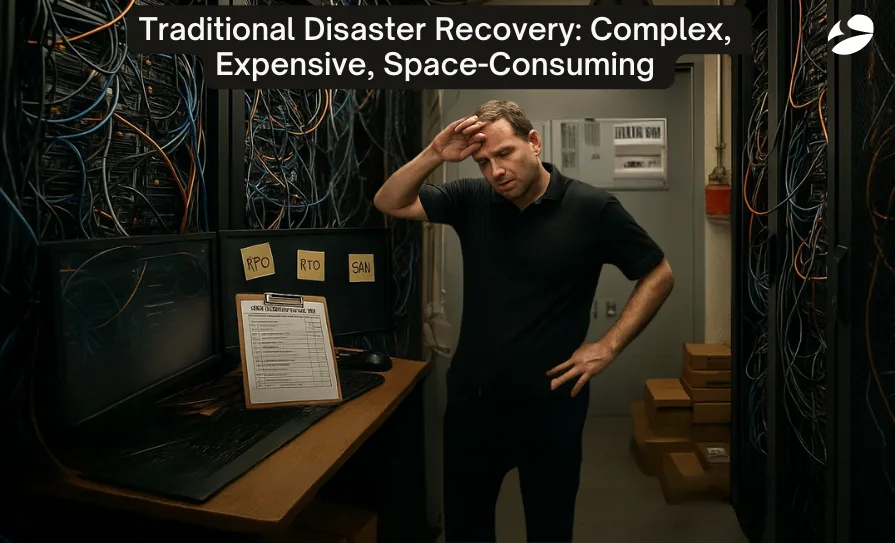
While traditional recovery resembles building a fortress with your bare hands, cloud disaster recovery solutions work like having a safety net that appears exactly when needed. Modern AI-powered disaster recovery eliminates hardware costs, reduces complexity to a few clicks, and handles SME business continuity without requiring a PhD in computer science.
The difference is stark: traditional approaches drain resources like a vampire at a blood bank, while cloud solutions offer AI-driven risk mitigation that actually aligns with small business realities and budgets.
Tired of disaster recovery solutions that seem designed for Fortune 500 companies with unlimited budgets? There’s a smarter approach that fits your actual needs and resources.
Modern cloud and AI innovations are reshaping disaster recovery into a faster, smarter, and more accessible safeguard for small and midsize businesses.
AI-based disaster recovery behaves like an omniscient IT department that can predict and avert problems even before they occur, without needing a crystal ball or the incense lit at the mysterious location.
These systems evaluate huge amounts of data every second and, in doing so, filter out anomalies that even the most attentive and caffeinated human might not detect with a magnifier.
Cloud disaster recovery solutions have turned the old “buy everything twice” model into “pay for what you use,” a revolutionary shift for SME business continuity. Scale up during peak seasons, scale down when things are quiet, and access everything from anywhere without maintaining a server room that sounds like a jet engine convention.
The cost savings alone could fund your expansion plans or at least upgrade from instant coffee to something that doesn’t taste like regret.
Machine learning doesn’t just recognize threats; it learns your business’s unique rhythm like a digital detective studying your every move, but in a helpful way, not a creepy stalker way.
BiztechCS can develop custom ML models that learn from your specific business patterns to optimize recovery processes, turning your disaster recovery from reactive panic to proactive protection. These systems get smarter over time, unlike traditional solutions that remain as dumb as the day you bought them.
A common concern from management teams: “How long before these AI systems actually understand our unique business patterns well enough to be effective?” Surprisingly fast. Most AI-powered disaster recovery systems achieve 80% pattern recognition accuracy within the first 30 days and reach near-perfect optimization by day 90.
Unlike human learning curves that plateau, these systems continuously refine their understanding, catching subtle anomalies that would slip past even your most experienced IT staff.
With the help of artificial intelligence risk mitigation techniques, 24/7 monitoring is offered, which indicates being awake all the time, taking no coffee breaks, and not being unavailable due to sickness on Monday mornings.
The systems are constantly monitoring and thus detecting the issues quicker than you’d say “system failure.” You could say that an IT “medical team” was permanently attached to your infrastructure, except that they are preventing heart attacks rather than merely responding to them.
Predictive analytics transforms disaster recovery from fortune-telling to science, identifying vulnerabilities before they become tomorrow’s emergency meetings. BiztechCS can integrate predictive analytics dashboards that provide actionable insights about your system vulnerabilities, showing you exactly where disasters might strike next.
Instead of waiting for things to break, you’re fixing problems that haven’t even happened yet, which is either brilliant planning or time travel, and honestly, both work.
Cloud-based disaster recovery is built on several key components that work together to keep data protected, systems running, and downtime to a minimum.
Modern cloud disaster recovery solutions are like paranoid squirrels preparing for nuclear winter. They run automated backups 24/7 and constantly synchronize data across multiple locations without any human intervention.
Continuous data synchronization occurs every few minutes, and incremental backups capture only modified files to save bandwidth. Multi-location storage then spreads your data across different geographies like a digital insurance policy against nature’s calamities.
Your data no longer gets the old “backup tape in the manager’s car trunk” treatment. Instead, it lives in highly secure data centers that make Fort Knox look like a garden shed.
Being able to switch over immediately means that when a disaster occurs, systems can transition to backup faster than the staff can refresh their social media pages. Recovery Time Objective (RTO) optimization lowers downtime from days to minutes.
At the same time, Recovery Point Objective (RPO) minimization ensures you lose only seconds of data rather than hours. Losing a whole day’s work is exactly how office riots begin.
These mechanisms work together to ensure SME business continuity happens automatically. It doesn’t rely on three emergency meetings and 17 phone calls to suppliers who suddenly can’t be reached.
AI-powered disaster recovery uses anomaly detection that spots problems like a helicopter parent at a playground, catching every tiny deviation from normal behavior before it becomes a crisis.
Predictive maintenance identifies failing components before they actually fail, while automated threat response neutralizes dangers faster than you can spell “ransomware.” This AI-driven risk mitigation doesn’t just watch your systems; it actively protects them. Think of it as a digital bodyguard with a computer science degree and anger management issues.
Meeting compliance requirements for GDPR, HIPAA, or PCI-DSS becomes automatic, rather than requiring a lawyer and three consultants who charge by the minute. Data is protected with military-grade encryption during transmission and storage.
Access control management further secures systems by allowing only authorized personnel to access them. It keeps out both hackers and the intern who thinks he’s “good with computers.”
These features turn the whole compliance process from a nightmare of checkboxes and audits into something that just happens in the background, like breathing, but more expensive.
AI-driven disaster recovery delivers major advantages across multiple sectors, especially those where uptime, data protection, and compliance are non-negotiable.
E-commerce platforms going down during Black Friday is retail’s equivalent of cardiac arrest during a marathon. The difference is that the marathon is made of money and everyone is watching you die.
AI-powered disaster recovery not only protects inventory systems and customer data. It also keeps your online store running even when servers act out like toddlers refusing candy.
One of the leading retailers cut downtime by half after implementing cloud disaster recovery solutions. This helped save millions in lost sales and prevented customer anger from escalating into a small revolution.
BiztechCS can develop industry-specific recovery templates that address unique regulatory requirements. After all, nothing says “professional retail operation” like systems that actually work when customers want to give you money.
Healthcare providers handle Electronic Health Records with the delicacy of juggling nitroglycerin. One system failure could mean the difference between prescribing aspirin and accidentally suggesting arsenic.
HIPAA compliance automation, powered by AI-driven risk mitigation, ensures patient data remains protected while medical device systems maintain continuity. This prevents scenarios where life-support systems decide to take unscheduled coffee breaks.
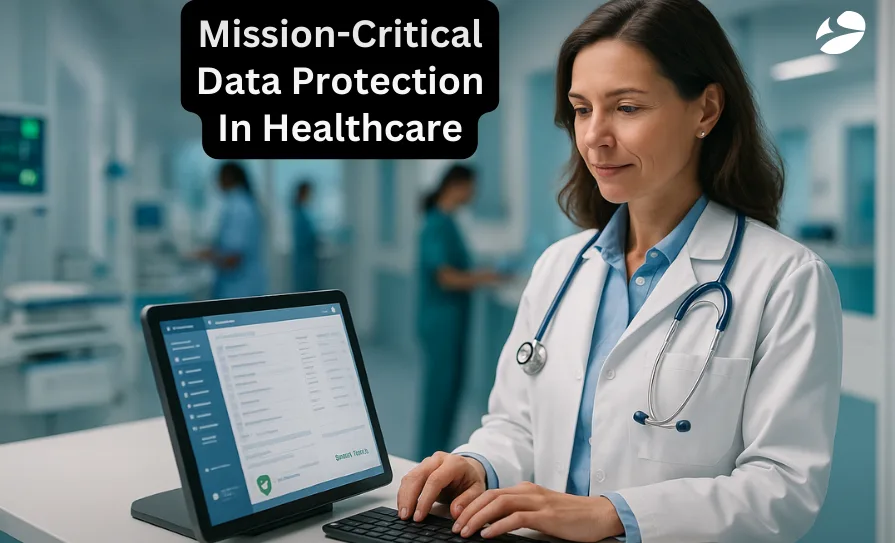
BiztechCS can implement specialized recovery protocols for mission-critical applications in your sector. That way, when disaster strikes, the only thing flatlining is your stress level—not your entire patient management system.
Financial institutions need transaction data protection that’s tighter than a miser’s wallet, because losing even a single microsecond of trading data costs more than most people’s annual salaries.
SOX and PCI-DSS compliance becomes automated through AI systems that detect fraud patterns faster than criminals can spell “cryptocurrency.” In contrast, real-time financial system recovery ensures market operations continue even if the building catches fire.
The integration of fraud detection with disaster recovery creates a double-layered defense that makes Fort Knox look like a lemonade stand’s cash box. It protects both data integrity and SME business continuity in the financial sector.
Does your industry face unique disaster recovery challenges that generic solutions can’t address? Industry-specific AI-powered recovery strategies make all the difference.
Building a scalable, reliable disaster recovery solution starts with a structured approach, and we follow a proven framework designed specifically for SME needs.
BiztechCS can conduct infrastructure audits that dig deeper into your systems than a detective investigating tax fraud. We examine every server, application, and even that ancient printer everyone’s afraid to unplug.
We can perform industry-specific risk assessments because a law firm’s disasters look different from those of a bakery. Of course, both can end up with servers catching fire—which happens more often than you’d think.
Our team can deliver business impact analysis with clear recovery priorities, showing exactly which systems need resurrection first when everything goes sideways. We can identify critical systems, data dependencies, and compliance requirements, mapping them out like a battle plan. After all, this war is against Murphy’s Law—and Murphy always fights dirty. This phase reveals the truth about your infrastructure, and sometimes the truth hurts worse than stepping on Legos barefoot.
We can design disaster recovery strategies that fit your business like a custom suit, not like those one-size-fits-all solutions that fit nobody properly. We can develop clear RTO and RPO targets based on actual operational needs, not fantasy numbers pulled from vendor brochures written by people who’ve never seen a real disaster.
We can create multi-tiered recovery plans addressing different scenarios because fires, floods, and ransomware each require different responses, like bringing different weapons to different fights.
Our experts can provide transparent cost models and ROI projections showing exactly what you’re paying for and what you’ll save when disaster strikes, no smoke and mirrors involved. The strategy we can build becomes your roadmap through chaos, turning “we’re doomed” into “we’ve got this handled.”
We can implement cloud-native architecture using AWS, Azure, or Google Cloud, whichever makes most sense for your needs and doesn’t require selling company assets to afford.
We can develop automated backup workflows tailored to your data patterns because your business doesn’t operate like everyone else’s, despite what generic solution vendors claim. Our team can integrate AI-powered disaster recovery systems with your existing infrastructure without requiring you to replace everything you own. That’s a stark contrast to vendors who insist you need their entire ecosystem to function.
We can build custom failover mechanisms ensuring SME business continuity happens automatically, faster than your competition can say “system failure.” BiztechCS can configure real-time replication and synchronization processes to keep data current across locations. After all, yesterday’s backup during today’s disaster equals tomorrow’s bankruptcy filing.
We can conduct disaster recovery drills that simulate actual disasters without causing actual disasters, which sounds obvious, but you’d be surprised how many companies skip this step.
BiztechCS can implement automated testing protocols that run without disrupting operations, such as practicing fire evacuations without actually setting the building on fire. We can develop performance dashboards that provide continuous monitoring and show system health in real time. You’ll see issues before something’s already broken, and crying won’t fix it.
Our specialists can train your team on recovery procedures because knowing what to do beats panic every single time. This phase transforms your staff from deer-in-the-headlights to disaster recovery ninjas, ready to handle whatever chaos comes their way.
We can manage production deployments with zero downtime because taking systems offline for disaster recovery is like closing the hospital to install emergency equipment. We can provide round-the-clock monitoring and alert management, ensuring someone’s always watching, even at 3 AM when disasters love to party.
Our team can deliver regular performance reports and optimization recommendations, keeping your cloud disaster recovery solutions running at peak efficiency. They won’t degrade like abandoned gym memberships. We can ensure continuous compliance with evolving regulations automatically because regulations change faster than fashion trends, and nobody has time to track them manually.
The AI-driven risk mitigation we can implement keeps getting smarter, learning your environment better than employees who’ve been there since the company started. It ensures your business stays protected no matter what fresh hell tomorrow brings.
Disaster recovery planning separates businesses that survive from those that become Wikipedia footnotes under “Corporate Failures of the 2020s.” The harsh reality is that 93% of unprepared businesses collapse within a year of major disasters. They join the graveyard of companies that thought “it won’t happen to us” was a valid strategy.
Modern cloud disaster recovery solutions have democratized survival, giving SMEs access to enterprise-grade protection without enterprise-grade bankruptcy. AI-powered disaster recovery transforms potential company-ending disasters into manageable hiccups. Meanwhile, your competitors are still searching for backup tapes in storage closets nobody’s opened since 2015.
BiztechCS’s proven 11-week implementation roadmap delivers real-world SME business continuity through AI-driven risk mitigation that works, not just in vendor PowerPoints.
Contact us today for a free consultation and disaster recovery assessment. Waiting for a disaster to strike before planning recovery is like buying car insurance after the crash—technically possible, but financially stupid.
Still wondering if your current backup strategy would actually save your business when disaster strikes? Most SMEs discover critical gaps only when it’s too late.