

How ERP & AI Are Transforming Education and Nonprofit Operations?
 5 min read
5 min read
Running a school or charity requires only two tools: staff members’ spreadsheet software and their determination to manage daily operations. Most organizations currently run their operations using multiple software programs that fail to communicate with each other.
Manual data entry has become a full-time job for people who actually have souls to save or minds to mold. Stakeholders now demand a level of transparency that makes a glasshouse look opaque. Compliance requirements are piling up faster than laundry in a frat house.
Recent data reveals a stark “efficiency plateau.” While 92% of nonprofits have adopted AI tools as of 2026, 93% of those organizations report they have yet to see any major transformation in their overall capability. This is primarily due to fragmented data and a lack of an integrated strategy [Source: 2026 Nonprofit AI Adoption Report].
The operational disorganization prevents progress by causing paperwork to accumulate at the office. The only way to stop the bleeding is by bringing in the big guns. An education ERP system or specialized nonprofit ERP software acts as the central nervous system the organization desperately needs.
When you inject AI into nonprofit organizations, the system stops being a passive filing cabinet and starts working like a hyper-competent assistant. Businesses must adopt AI-driven ERP systems to achieve organizational stability. The mission of the organization requires protection because staff members will become occupied with an office machine that needs repairs.
Educational institutions that play a vital role in developing future leaders face difficulties because they still depend on outdated technologies and uncoordinated operational systems. The existing problems reduce operational effectiveness while decreasing organizational visibility and student assistance services.
Running a campus with manual admissions is basically a slow-motion car crash of paperwork and lost applications. Staff members waste their lives fixing timetable conflicts while hoping the ink on the master schedule doesn’t smudge. Fee collection delays turn the finance office into a polite collection agency that never actually gets paid on time.
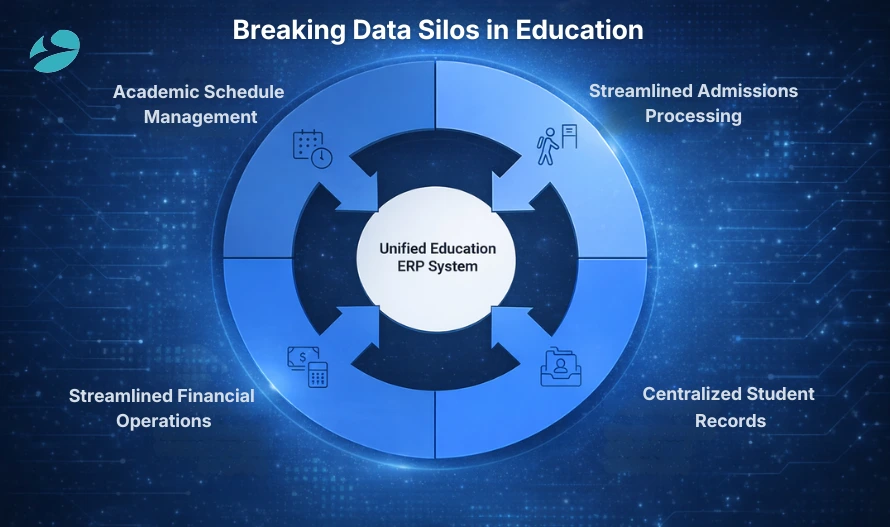
An education ERP system stops the bleeding by automating the grunt work that currently eats up forty hours a week. Without a streamlined ERP for education, the administration is just one lost spreadsheet away from total structural collapse.
Information usually lives in isolated silos that are guarded more fiercely than a medieval fortress. Student records are scattered across departments that refuse to acknowledge each other’s existence. This makes reporting capabilities a complete joke, because pulling together a coherent number feels like an archaeological dig.
When data is trapped in these digital dungeons, decisions are based on wild guesses and sheer luck. Integrating AI in education helps break these barriers by spotting patterns that a human eye would definitely miss while drowning in Excel.
The need for mental health services among students keeps increasing, while the counseling staff has to manage more students than they can handle. People who want to help others emotionally while also handling their work duties will end up exhausting themselves.
The cracks in the system are becoming canyons because the staff is overburdened by administrative trivia and meaningless busywork. An AI-powered ERP allows for early warning signs to be flagged before a student completely checks out of the program. It is high time to stop treating mentors like filing clerks and let them actually save lives.
| Want to see how modern ERP solutions actually eliminate these operational bottlenecks? Discover how Odoo streamlines admissions, fee management, and timetables in real-world educational institutions. |
The operational demands nonprofit organizations face today make it difficult for them to maintain their budgetary procedures and provide full public disclosure of their activities.
Donors are increasingly tired of throwing their hard-earned money into a digital black hole while receiving nothing but a generic thank-you card in return. The organization appears suspicious because it lacks transparency, giving the impression that it has something to hide. Poor financial reporting makes every board meeting a terrifying experience because the numbers don’t match.
Without a robust nonprofit ERP software to track every cent, the credibility of the mission is basically dead in the water. Trust is the only currency that actually matters, and losing it is a permanent exit from the sector.
Tracking grant money manually is a special kind of masochism that usually ends in a compliance nightmare or a legal meltdown. Relying on sticky notes to manage millions of dollars is beyond reckless and puts the entire foundation at risk. Most teams are drowning in a sea of restricted funds that must be used for specific tasks, or the auditors will have a field day.
An ERP for nonprofits ensures the right money goes to the right place without a human having to second-guess every transaction. This automation keeps the organization from being blackballed by donors who demand surgical precision.
Herding volunteers with a broken system is like trying to organize a riot in a dark room. The entire system breaks down because people lack awareness about their designated locations and their assigned tasks. Impact measurement becomes impossible when the data is scattered across five platforms that hate each other. This total chaos makes it impossible to prove that the work is actually moving the needle.
A proper AI-powered ERP creates a single source of truth for every resource the organization owns. Without these tools, the best intentions are just a shortcut to total burnout and failure.
| Struggling with donor trust and financial transparency isn’t uncommon. Take a closer look at why many Indian NGOs are losing credibility despite rising CSR funding—and what can be done to fix it. |
Most organizations function today as they operate as a group of fighting siblings who refuse to share their toys with one another. An Enterprise Resource Planning system acts as the only functioning adult in the room. It provides centralized data management to ensure that the left hand finally knows what the right hand is doing.
Process automation kills off the soul-crushing manual entry that makes the staff want to walk into traffic. Real-time reporting stops the guessing games by delivering hard facts before the metaphorical building burns down. Integration across departments means the bursar and the registrar finally speak the same language.
For schools, an education ERP system handles the absolute chaos of admissions and timetables, as well as finance. Meanwhile, nonprofit ERP software keeps a sharp eye on donor management and grant tracking to keep the auditors at bay. Research shows that around 62% of companies reported cost reductions after implementing ERP systems, particularly in purchasing and inventory control (Source).
When you throw AI in education into the mix, the software stops being a passive box and starts spotting trends before they become disasters. An AI-powered ERP is essentially the only way to keep the wheels on the bus. It turns a fragmented mess into a single source of truth that actually stays true. Transitioning to an ERP for nonprofits is the difference between making an impact and just shuffling papers.

Educational organizations experience a fundamental transformation as ERP systems eliminate manual tasks through unified, data-driven systems, thereby increasing operational efficiency and supporting better decision-making.
The admissions process operates at a pace similar to a car crash, which unfolds slowly as it requires processing one thousand paper documents while parents work to handle their anxiety. An education ERP system digitizes this nightmare, so the staff can stop playing a frantic game of hide-and-seek with missing applications. It moves the entire process from a chaotic pile of folders to a clean, functional digital pipeline.
Most schools currently sit one lost email away from an enrollment disaster that would make any sane person weep. Automation ensures that no prospective student falls through the cracks just because a physical document got lost behind a radiator.
Chasing tuition payments is an exercise in futility that usually ends with the finance department having a collective breakdown. An ERP for education handles the awkward conversations by automating reminders and tracking every cent with surgical precision.
It effectively eliminates the “check is in the mail” excuse that has been stalling institutional budgets since the dawn of time. Financial transparency is no longer a pipe dream when the software does the heavy lifting of reconciliation. Without this level of control, the institution is basically a glorified piggy bank with a massive hole in the bottom.
Creating a master timetable without modern software is the academic equivalent of playing 3D chess while blindfolded. An AI-powered ERP looks at the available classrooms and teacher schedules to ensure two groups of people aren’t fighting over a single whiteboard.
It prevents the embarrassing scenario in which a chemistry lab is mistakenly booked for a literature seminar. Resource scheduling becomes a logical exercise rather than a seasonal bloodbath between department heads.
Schools using advanced scheduling systems are seeing measurable gains, with resource utilization improving by up to 30% through optimized scheduling and smarter allocation of classrooms and faculty (Source).
Fragmented student records are the silent killers of institutional sanity and operational efficiency. Centralizing this data means the registrar doesn’t have to call three different offices just to find out a kid’s GPA or health records. Integrating AI in education into this database allows for spotting academic red flags before the student actually fails a class.
The system creates an up-to-date, reliable information database that maintains real-time synchronization throughout all campus operations. Organizations that maintain their data in separate storage locations have adopted an outdated practice that should be preserved as a historical artifact, alongside dial-up internet and floppy disks.
Still relying on scattered systems to manage critical student data? That fragmentation could be holding back smarter decisions and better outcomes.
The lack of proper tools makes it impossible to operate a mission-driven organization, as it feels like trying to control energetic squirrels while blindfolded. The situation results in total confusion, which produces no successful outcomes. Implementing a robust ERP for nonprofits turns that mess into a streamlined machine where data actually makes sense for once.
Stop treating donors like ATMs that only get a “Thank You” note once a year. An AI-powered ERP tracks every interaction so the team knows exactly who gave what and why. It beats digging through ancient spreadsheets or Gary’s questionable memory. Personalized outreach becomes the bread and butter of the operation, which keeps supporters from feeling like just another line item on a budget report.
Grant tracking becomes an organizational nightmare, leading to both deadline oversights and frantic searches for lost documents. Nonprofit organizations use ERP software to track their progress, as it allows them to monitor their achievements with minimal effort.
The system handles all compliance needs and generates reports that protect the organization from potential compliance issues with foundations. The organization maintains proper financial management through effective system maintenance, which prevents financial interruptions caused by clerical errors.
Auditors are like dental exams; they are painful but necessary. A solid education ERP system provides a clear paper trail that makes financial scrutiny feel like a walk in the park. Every penny is accounted for in real time, which builds massive trust with stakeholders. In fact, ERP implementations typically deliver between 150% and 400% return on investment, with payback achieved within 12 to 36 months, proving that being organized actually pays the bills (Source).
Relying on volunteers is great until five people show up for a two-person job and nobody has the keys. ERP for education and nonprofits syncs schedules and skills so the right people are in the right place.
The system prevents “too many cooks” problems by maintaining workforce motivation while eliminating employee frustration. The organization achieves its mission through efficient operations that advance it rather than getting stuck in administrative tasks.
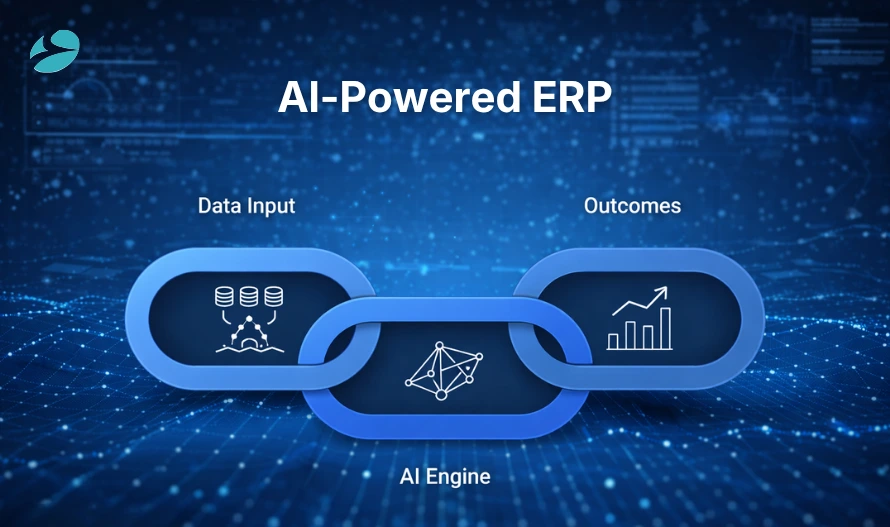
Advanced AI-powered ERP systems now operate as intelligent systems that forecast outcomes, handle tasks, and assist users with smart decision-making.
Staring at old data and hoping for a miracle is not a strategy. Predictive analytics turns a boring education ERP system into a functioning crystal ball that actually hits the mark. It identifies which donors are about to ghost the organization or which students might drop out before they even pack their bags.
Research shows that AI-powered personalization can significantly improve donor retention and engagement by predicting donor behavior and enabling proactive outreach (source). This tech ensures the mission stays on track rather than flying off a cliff.
Most staff members spend their existence doing repetitive chores that would bore a housefly to tears. Intelligent automation takes over the heavy lifting of an AI-powered ERP by handling data entry and basic scheduling without human intervention.
This is not just a fancy macro. It is a system that learns from mistakes, keeping the gears turning 24/7. Using AI in nonprofit organizations means the team can finally stop acting like glorified filing clerks. It returns the focus to the actual cause rather than the paperwork.
Standard reports are usually about as clear as mud and twice as thick. Smart dashboards take the chaos of an ERP for nonprofits and turn it into a visual story that makes sense in seconds. These live feeds highlight exactly where the money is leaking or where the big wins are happening without the fluff.
An education ERP system with smart reporting tells the truth even when it is uncomfortable for the board to hear. It puts a permanent end to the era of presenting vague guesses during important meetings.
Making a massive strategic move based on a “gut feeling” is just a professional way of admitting to a guess. AI-driven decision support analyzes millions of data points within an AI-powered ERP to provide options grounded in cold reality. It suggests the best way to allocate a dwindling grant or how to stagger classes to save on utility bills.
This technology acts as the smartest person in the room, without an ego or a hidden agenda. Relying on AI in education ensures that every choice is backed by evidence rather than optimism.
AI in education is going far beyond basic automation by actively enhancing student support, engagement, and personalized learning experiences.
Human counselors are usually buried under paperwork while trying to talk students off a metaphorical ledge. Expecting them to be available at 3 AM for a midterm panic attack is just cruel and unusual punishment. An education ERP system with integrated bots can handle the heavy lifting of active listening and resource sharing. This ensures the staff is not wasting time on basic FAQs when they should be handling actual crises.
Waiting until a student stops showing up to realize they are failing is like checking the weather after a tornado has leveled the building. Integrating AI in education allows the system to analyze attendance patterns and falling grades before the kid considers quitting.
An AI-powered ERP flags these red zones so mentors can step in while there is still a chance to save the semester. It is about preventing a life from going off the rails because nobody was paying attention to the data.
The old model of teaching everyone as if they were identical bricks in a wall is a spectacular failure that everyone keeps repeating. By pulling data from an ERP for education, the system can identify exactly where a specific student is hitting a wall. It provides a roadmap for teachers to tailor their approach rather than screaming into the void of a lecture hall. Personalized insights turn a generic curriculum into a surgical tool that actually hits the mark for every individual.
Students have a habit of needing help at the most inconvenient times possible, like Sunday mornings or holiday breaks. A standard office schedule is about as useful as a screen door on a submarine when a student needs urgent administrative answers.
Round-the-clock support through an education ERP system ensures the institution remains helpful even when the lights are off. It removes the friction that usually makes the academic experience a total slog.
| Curious how AI chatbots are transforming student counseling beyond basic support? Explore how they step in when traditional systems fall short and provide timely, scalable assistance to students in need. |
AI is empowering nonprofits to make data-driven decisions that enhance fundraising effectiveness and deliver measurable impact.
Stop treating every donor like a generic ATM that spits out cash on command. AI in nonprofit organizations tracks exactly what makes a benefactor tick, so you can stop sending spam they hate. It identifies who is truly committed versus who just wanted to look good at a gala once. Using nonprofit ERP software to analyze these patterns keeps the relationship from turning into a bad breakup.
Running a fundraiser without data is basically screaming into a hurricane and hoping for a response. An AI-powered ERP fine-tunes your message so it actually lands in the right inbox at the right time. It kills off the guesswork that usually leaves marketing budgets in a pile of smoldering ash. This ensures the organization isn’t just throwing spaghetti at the wall to see what sticks.
Waiting for a miracle is a terrible way to manage a budget that people depend on for survival. Predictive models within an ERP for nonprofits can spot a funding gap months before it becomes a catastrophe. It highlights which major donors are likely to increase their gift or walk away forever. Being one step ahead is the only way to keep the mission from stalling out in the middle of nowhere.
Producing a manual impact report is a special kind of torture that usually results in creative fiction rather than facts. Automated reporting ensures that every stakeholder gets a clear view of where their money went without anyone having to sweat over a spreadsheet for a week. It provides the cold, hard truth that builds a rock-solid reputation for transparency. Without this, the organization looks like a disorganized mess that nobody should trust with a nickel.
Are your financial systems strong enough to stand up to scrutiny at any moment? Transparency isn’t optional—it’s the foundation of trust.
Operating without a unified system is basically begging for a total institutional meltdown while everyone points fingers at each other. An education ERP system provides the rigid structure needed to stop the data from leaking out of the building.
When you add AI in education, the software finally grows a brain and starts offering actual intelligence instead of just acting as a digital filing cabinet. This combined impact leads to better decision-making that is actually based on reality rather than a collective gut feeling during a long lunch.
Improved operational efficiency means the staff can finally stop doing the work of three people for the pay of one. Enhanced stakeholder trust is the inevitable result of showing donors and parents that the organization isn’t just a disorganized circus. An AI-powered ERP creates a foundation for scalable growth so the mission can expand without the infrastructure snapping like a dry twig.
Using nonprofit ERP software ensures that every expansion is sustainable rather than a desperate gamble with the foundation’s future. It is high time to quit playing small and embrace a system that actually keeps its promises.
ERP for education & nonprofits is no longer fancy upgrades sitting on a wishlist while teams wrestle with spreadsheets that behave like rebellious teenagers. An education ERP system paired with AI in education finally puts operations on a tight leash and stops chaos from running the show.
AI in nonprofit organizations adds clarity where guesswork once ruled and turns donor trust from fragile glass into solid ground. An AI-powered ERP does the heavy lifting without whining or missing deadlines. It keeps data honest and decisions sharper than a well-aimed arrow. The result is simple. Less firefighting, more impact, and a system that actually pulls its weight.
Still relying on disconnected tools while your organization grows more complex by the day? The longer you wait, the harder it becomes to scale without breaking things.

Odoo
 154
154

By Uttam Jain

Odoo
128
By Uttam Jain
Artificial Intelligence (AI)
279

By Nandeep Barochiya