 24
24
Odoo 20 AI Agents: How Autonomous Task Execution Is Changing ERP Forever

 5 min read
24
5 min read
40%
Share of enterprise applications Gartner predicts will include task-specific AI agents by 2026, up from less than 5% in 2025 — the shift Odoo 20 is built around (Gartner, 2025)
Over 40%
Share of agentic AI projects Gartner predicts will be canceled by the end of 2027, driven by escalating costs, unclear business value, and inadequate risk controls — why governance and readiness matter more than the agent (Gartner, 2025)
$58.7B
Projected AI-in-ERP market size by 2035, up from $7.33 billion in 2026 at a 26% CAGR, the wave Odoo 20 agents are riding (Precedence Research, 2026)
25 to 45%
Cost savings McKinsey associates with deploying AI agents in service-desk operations, an early proof point for agent ROI in a support function much like Odoo Helpdesk (McKinsey, 2025)
For a couple of years now, AI inside ERP has meant a helpful assistant. You ask it something, it answers. You hand it one small job, it does that one job, then waits for you again. Useful, but it never stopped being a tool you had to pick up.
Odoo 20 is where that changes. The pitch is agents that act on your live data instead of just talking about it: an agent that runs a whole quarter of finance checks on its own, one that hunts down neglected leads and reassigns them, another that drafts the helpdesk reply before you’ve finished reading the ticket. That’s a real shift, and it’s the reason “agentic” is the word stamped on every Odoo 20 preview right now.
Here’s where it’s worth pumping the brakes, though. Most of the coverage sprints straight past it. Autonomous doesn’t mean unsupervised, and the question that actually keeps a finance director up at night isn’t whether the AI can do the work. Of course it can. It’s the other stuff. What does your team do now, once the agent has it handled? And what has to be true before you’ll let software act on real business data without flinching every single time? That’s the half worth your attention. So that’s where we’re headed.
One honest note before we start. Odoo 20 isn’t out yet. It’s unveiled at Odoo Experience 2026 in late September, and everything specific below comes off a roadmap Odoo itself calls provisional. So treat the agents as direction, not a shipped spec.
Start with the plain version. An AI agent is software you give a goal to, not a click. Instead of you walking it through every step, it figures out the steps, carries them out across the system, and comes back with the result.
The cleanest way to feel the difference is to put the two generations side by side. Odoo 19’s AI was assistive. You ask a question, it gives an answer. You tell it to do a single thing, it does that single thing. Odoo 20’s AI is meant to be agentic. It watches a process, flags you when something’s off, and runs a multi-step job from start to finish without being walked through each move.
So “autonomous task execution” really just means this: the agent strings several actions together toward an outcome, on its own, using the data already sitting in your Odoo. The audit agent doesn’t ask you which account to reconcile next. It works through the list. That’s the leap, and for the repetitive, high-volume work that eats your team’s week, it’s a genuine one. These are the kinds of AI agents in ERP that move the human out of the doing and into the deciding.
Here’s what Odoo has previewed, grouped by where it lands. Keep that roadmap caveat in mind as you read: some of this will ship close to as described, some will shift, and the final list is only confirmed at release.
Finance gets a virtual controller. The headline agent is an accounting audit agent that behaves like a junior financial controller. It works through a quarter’s checklist on its own, reviews bank statements, checks reconciliation, and surfaces the anomalies it thinks you should look at. The promise is that you get the findings without needing deep accounting expertise to dig for them.
Sales gets a lead wrangler. An agent that scans the CRM for unwon or neglected leads sitting under one rep and reassigns them in bulk by rules you set. Less pipeline rot, less manual cleanup.
Projects build themselves from a brief. Hand an agent a technical design document as a PDF and it spins up the project, with stages and tasks already laid out, ready for you to refine instead of build from scratch.
Helpdesk gets a sidekick. A per-ticket assistant that summarizes a long chatter thread, drafts a context-aware reply, and pulls solutions from similar tickets you’ve already solved.
The website gets an editor. Describe a multi-step change in a chat prompt, images included, and the website assistant makes the edits rather than handing you a to-do list.
Timesheets fill themselves in. An agent that suggests entries from what it can actually see you doing, your time in Project, your messages, your activity, so the Friday timesheet stops being a memory test.
And underneath all of it, a database-wide natural-language search, so “show me the latest purchase order from this supplier” or “summarize this week’s ticket complaints” is a question, not a report you build.
Notice the pattern. None of these is “the AI runs your company.” Each is a narrow, bounded agent pointed at one repetitive job. That’s not a limitation to apologize for. It’s exactly why they’re useful, and, as we’ll see, exactly why they’re governable.
Wondering which of these actually fits your workflows?
This is the part the previews skip, and it’s the part that matters most if you’re the one signing off.
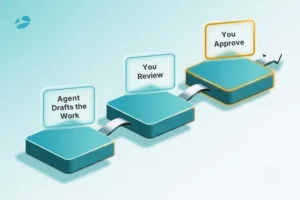
An agent doing the work doesn’t remove the human. It relocates them. Your accountant stops manually ticking through reconciliations and starts reviewing the exceptions the audit agent flagged. Your sales lead stops redistributing stale leads by hand and starts checking the reassignment the agent proposed. Odoo’s own framing is that the AI does the brunt of the work and leaves the final review and approval to people. The job didn’t vanish. It moved up a level, from doing to governing.
That’s a better job, mostly. But it’s a different one, and it only works if a few things are true. The person reviewing has to actually understand what the agent did and why. There has to be a clear line for what the agent may decide alone versus what needs a human yes. And when something goes wrong, and at some point it will, you need to be able to trace what happened.
Which is why the uncomfortable number belongs right here, not tucked away near the end. Gartner reckons more than 40% of agentic AI projects get killed off by the close of 2027. Read the reasons and none of them are “the model wasn’t smart enough.” It’s cost that ran away. Value nobody could quite pin down. Risk controls that were never really there to begin with. The projects that die, in other words, are the ones that treated the agent as the whole job and figured governance was something they’d sort out later.
Here’s the reassuring bit, and the insight almost nobody writing about Odoo 20 mentions. The controls you need aren’t some new thing Odoo has to invent for agents. They already shipped in 19.
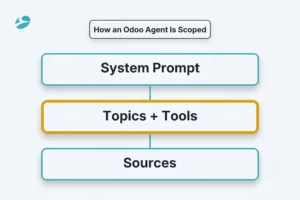
In Odoo’s agent setup, every agent is built from three pieces. There’s a system prompt, which is its role and mission in plain language. There are topics, which are the specific instructions plus the tools the agent is actually allowed to use, like creating a lead or opening a particular view. And there are sources, the material it’s allowed to draw on, with a switch to restrict it to only those sources.
Now here’s the line that should reset how you picture the whole thing. In Odoo’s own words, an agent that hasn’t been assigned any topics can only provide information. It cannot complete tasks or change your database. Read that twice. An agent isn’t autonomous by default. It’s inert by default. Whatever it can do, a human handed it, one tool and one topic at a time, and all of that still sits on top of the normal Odoo access rights that already decide who gets to touch what.
Flip that around and the scary question quietly dissolves. You stop asking “what might this AI do to my data?” and start asking the version you actually control: what, exactly, did I let this agent do? That’s the whole game, right there. An Odoo agent is only as autonomous, and only as safe, as the permissions you bothered to scope for it. And scoping that well, before an agent goes anywhere near live data, is precisely the kind of unglamorous work our Odoo customization services team does first.
A fair caveat, in the interest of being straight with you. Odoo’s published documentation today covers this permission and tool model well; it’s lighter on formal approval workflows, scheduling, and audit logging for what an agent executes. So part of getting ready, for now, is designing those review and audit checkpoints around the agent deliberately, rather than assuming the platform hands them to you out of the box.
An agent runs on your data and acts through your permissions. Which means your readiness has very little to do with the AI and almost everything to do with the house it’s moving into. Before you switch one on in anger, walk this list:
Shaky on most of them? That’s not a reason to wave off agentic AI. That list is the project. AI agents in ERP live or die on this groundwork, not on how clever the model underneath happens to be. The companies that pull real value out of Odoo 20 AI agents will be the ones who did the boring parts. The ones who wash up in that 40-plus percent of canceled projects will mostly be the ones who didn’t. So start narrow. One task. Scope it tight. Review it like you mean it. Then widen.
If this list is exposing gaps, that’s worth a conversation before you roll anything out.
1
Think of them as AI that does, not AI that answers. Rather than reply to a question, an agent picks up a whole multi-step job and runs it against your live Odoo data, running the quarter’s accounting audit, say, or clearing out stale leads, or drafting helpdesk replies. Each one is deliberately narrow, one job apiece. And they’re roadmap features shown off ahead of Odoo 20’s late-2026 release, so the exact lineup is still provisional.
2
Odoo 19’s AI waits to be asked. You pose a question, it answers; you hand it one task, it does that task and stops. Odoo 20’s AI doesn’t wait around. It keeps an eye on a process, nudges you when something looks off, and carries a multi-step workflow all the way through. You go from operating a tool to supervising an agent.
3
Only as far as you let it. Odoo’s model leaves final review and approval to people, and an agent can only use the specific tools you grant it through its topics. An agent with no topics assigned can only provide information, not change your database. Practically, you decide which actions an agent completes alone and which wait for a human yes./span>
4
Through three things: its topics and tools (the exact actions it can take), its sources (what it can read, with an option to restrict it to those only), and your normal Odoo access rights, which the agent inherits. Scoping these deliberately, to the minimum each agent needs, is the core of using agents safely, and it’s the part worth getting professional help with.
5
Some agents will work close to out of the box for standard processes. The value, and the safety, comes from configuring them to your actual workflows, data, and approval rules, which is where Odoo customization services earn their place. The agent is generic; your business isn’t.