

How Odoo Inventory Management Can Be a Game Changer for Your Business

 7 min read
7 min read
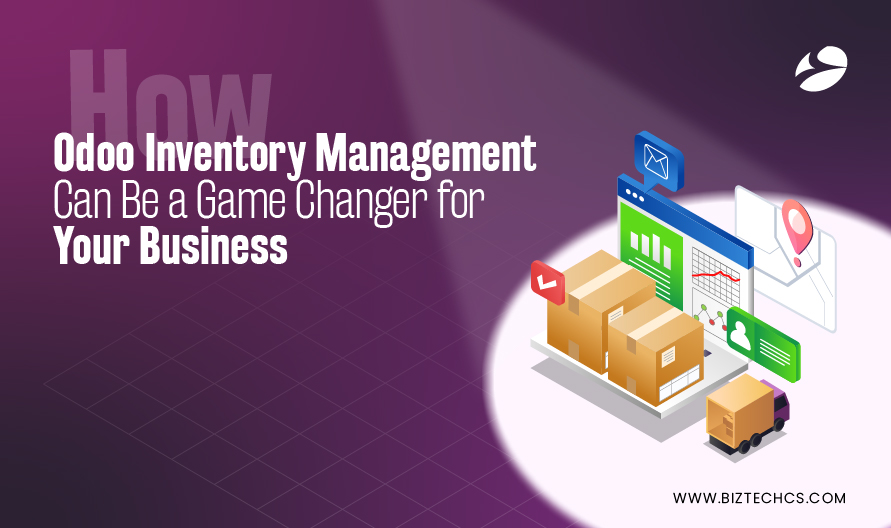
A customer journey begins with researching brands, skimming through reviews, and comparing prices. Once these all get done, a customer hits the “order” icon. But what if they receive the message that “the order is out of stock?” You may not want to give that experience to your customers. That’s where you need Odoo Inventory Management software!
Strategic inventory management is important to avoid stockouts and overstock. It helps eliminate lousy customer experience and fosters optimized profitability. Inventory management includes many components, such as inventory tracking, warehouse management, demand forecasting, reordering, and replenishment. Odoo inventory management helps you perform these all easily.
With its rich set of features and modules, Odoo ERP makes inventory control easier. In this guide, we’ll analyze the features of Odoo ERP and how it will be the right choice for your inventory management needs. It’ll give you a detailed knowledge of how Odoo can efficiently manage your inventory.
Inventory management is the process that includes managing, controlling, and optimizing the level of the product in stock. The primary goal of inventory management is to meet customer demand on time while avoiding overstocks for profitability and enhanced customer experience. The following are the key components of inventory management:
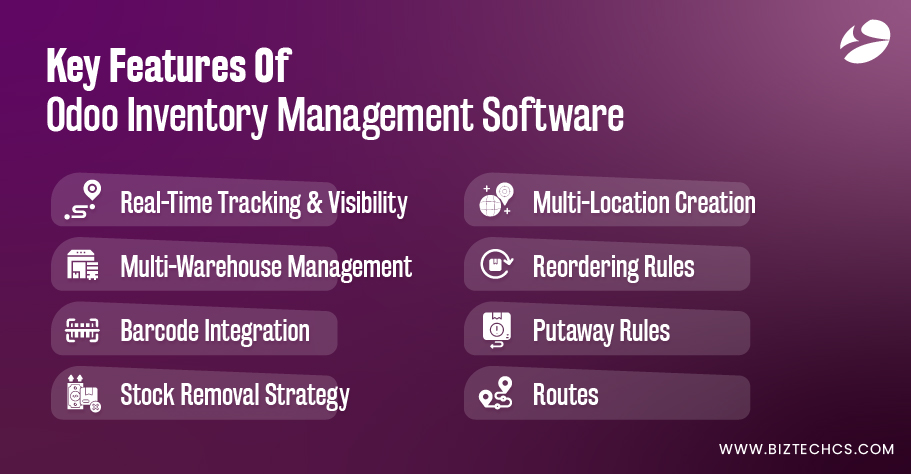
Odoo inventory management provides different features and modules that help businesses efficiently manage inventory, mastering inventory management. It makes Odoo the best ERP for eCommerce. The following are the key features of Odoo ERP:
Real-time tracking capability is one of the significant features of Odoo Inventory Management. Odoo provides many tools and modules that help businesses track their inventory levels, product movement, and stock locations with exactitude. This real-time information helps them make informed decisions to reduce stockouts and overstocks, eliminating any chance of financing losses.
Does your company have different warehouses in multiple places? Inventory control with Odoo helps you manage the inventory of multiple warehouses from a single platform. It enables you to monitor and manage the movement of products throughout the processes. You can keep track of products from vendor delivery to the customer’s doorstep where the final delivery occurs.
Barcode integration significantly enhances the efficiency of inventory management. It allows accurate and accelerated tracking of products, maintaining stock levels, and speeding up processes such as restocking, auditing, and order fulfillment. Barcode integration eliminates the manual entry requirements and chances of errors. After enabling it to your inventory, you can scan products through a connected barcode scanner device.
Stock removal strategy is used in inventory operations to select products based on certain criteria like finding the best product, and moving products with the closest expiration dates as priority. Odoo Inventory Management provides you with many stock removal techniques including FIFO, LIFO, FEFO, Closest Location, and Least packages.
Odoo can provide excellent inventory control, as these stock removal strategies help you manage product stocks efficiently.
Odoo ERP offers the alternative of creating multiple locations. Warehouse locations in Odoo refer to specific areas of the warehouse, like a shelf or floor. Locations can’t be linked to warehouses; however, we can create many locations associated with each warehouse.
Odoo’s Inventory Management software allows you to set reordering rules for all available products. It helps your company reduce stockouts. In Odoo ERP, warning messages are enabled to get timely information about low stock levels. You can simply remove the stocking rules from the product menu when you don’t want to continue with a product. Automated procurement can be configured using minimum stocking rules. The warehouse recording rule in Odoo allows users to set the minimum as well as maximum stock count of products.
The Putaway Rule defines a warehouse assignment strategy for incoming stocks. It aims to prevent the products from getting stored incorrectly. Putaway helps you place the products in the most appropriate location once they are received from shipment. Businesses rely on it to achieve this organizational state of products. Remember that the Putaway Rules are only applicable when you have different warehouse locations.
With routes in the Odoo Inventory Management software, you can configure and create routes of operation for product movement for sales orders, purchase orders, and manufacturing processes. These routes are completely tailored to the specific strategies followed by the company. Besides, push and pull rules are used in the different routes to perform essential actions.
Efficient inventory management is crucial for many reasons like avoiding stockouts, and overstock to keep the available products in proportion to the orders. It helps businesses prevent losses caused by a lack of inventory measurements. When it’s stockout, you face a lousy customer experience, and when you’ve overstock you have to bear a huge financial loss if demand falls down. In both of the situations, you face loss. But with Odoo Inventory Management, it’ll no longer be the issue.
Odoo ERP software has many features, such as real-time tracking and visibility, multi-warehouse management, barcode integration, stock removal strategy, and so on. These user-friendly features ensure benefits such as enhanced report and analysis, flawless replenishment, easy customization, quality management, and improved productivity. Efficient inventory management increases your business’s profitability!
If you’re a business owner looking for inventory control with Odoo ERP, you can hire Odoo developers from Biztechcs. We’re an Odoo Ready partner, providing comprehensive Odoo development solutions to businesses of all sizes. Be it Odoo development or consulting, our seasoned Odoo developers assist businesses in getting appropriate Odoo solutions. Contact us to discuss your requirements and get the solution you deserve!
Odoo Inventory Management is one of the best ERP solutions for small to medium businesses due to its scalability and comprehensive features. It provides real-time tracking, multi-warehouse management, automated reordering, and barcode integration in a single platform. Unlike enterprise solutions like SAP or Oracle requiring significant upfront investment, Odoo offers flexible pricing starting at $24.90 per user/month. Its modular structure lets you start with core features and expand as you grow, making it particularly effective for eCommerce businesses that need to prevent “out of stock” messages and manage multiple sales channels efficiently.
Preventing stockouts and overstocks requires three critical capabilities: real-time inventory visibility, automated reordering rules, and demand forecasting. Odoo provides live tracking across all locations, configurable min/max stock thresholds that trigger automatic purchase orders, and analytics to anticipate demand. The system sends warning alerts when stock falls below optimal levels and uses strategies like FIFO, LIFO, and FEFO to move inventory efficiently. This eliminates losing customers due to unavailable products (stockouts) and tying up capital in unsold goods (overstocks)—both directly impacting profitability.
Inventory management software costs vary significantly: basic cloud solutions start at $50-200/month for small operations, while enterprise systems exceed $10,000/month. Odoo offers cost-effective flexible pricing with the Community (open-source) version free, and Enterprise starting at $24.90 per user/month with inventory management included. Key cost factors include users, warehouse locations, transaction volume, and integrations. Odoo’s modular structure means you only pay for features you use. ROI typically comes from eliminating stockouts (lost sales), reducing overstock (freed capital), and improving efficiency (reduced labor costs).
Yes, Odoo provides seamless integration with major eCommerce platforms including Shopify, Amazon, WooCommerce, Magento, and eBay. This integration enables automatic inventory synchronization across all channels (when a product sells on Shopify, stock updates everywhere in real-time), centralized order management from multiple platforms, unified product catalog (update once, sync everywhere), and automated reordering when combined sales trigger low stock. This multi-channel capability makes Odoo one of the best ERP solutions for eCommerce, eliminating manual work and preventing the costly problem of overselling products you don’t have in stock.

Artificial Intelligence (AI)
 145
145

By Nandeep Barochiya
Odoo
118

By Uttam Jain
Odoo
116
By Uttam Jain