
 751
751
Odoo for Manufacturing in the UAE: Streamlining Production and Supply Chain

 5 min read
751
5 min read
You know, the interesting and maybe one of the most complex things about upscaling is that it reminds you how an outdated system can very easily go from “comfort zone” to “the biggest roadblock”.
As an example, take a manufacturing company in the UAE that wants to expand its business horizons and capabilities. But their outdated system continues to hinder the growth they seek. They have their very own capable digital infrastructure, alright. So what is the problem?
Their system works better by itself than working together. Imagine an inventory system showing full stock, but the production team can’t find the raw materials. And somehow, the procurement team is on a completely different tangent, ordering all the materials except what is actually needed.
Sounds frustrating, right? That’s the story of almost every manufacturing company in the UAE, which was promised efficiency through ERP integration. In reality, they are now handling three different platforms that display three different pieces of information, and nobody knows which one is accurate.
But this is a problem that can be resolved by integrating Odoo ERP for the manufacturing industry. With the right odoo erp software development approach, you can centralize processes, enable real-time updates, and move from manual operations to a fully digital management system. Odoo not only streamlines workflows but also enhances transparency, visibility, and reduces mundane data-entry tasks.
The issue is that using different systems, such as phone calls for procurements, Excel sheets for warehouse data management, and other systems for production, scatters your data. This makes it difficult to track progress and identify operational gaps.
Therefore, if the raw material goes out of stock, the procurement team will receive the information late, i.e., after the production lines have stopped due to a lack of resources. And if the procurement team orders the raw material based on a guess that the stock might run out soon, it will arrive too early and take up warehouse space.
So do you see the problem here? When people cannot access actual data, they start guessing, and planning turns into an arrow shot in the dark. This is chaos in itself, and it severely impacts the company’s image due to unreliable responses and delivery delays.
A lot of business owners say, “We have tried multiple ERPs, one for inventory, another for finance management, and one more for production. What difference will Odoo make? Can it resolve our concern without disrupting everything?”
The difference between all your other ERPs and Odoo’s Manufacturing ERP software UAE is that, unlike them, Odoo’s modular architecture creates a centralized ecosystem. It lets you add modules for inventory, procurement, and production management. The integrated workflow will give you complete control and visibility.
This means the purchase order will be generated automatically if the stock drops. The production schedule will align with your material availability, and clarity will drive your operations even further. Also, the best part would be that your process will not be disrupted during the transition.
At BiztechCS, we understand that the complex UAE demographic doesn’t need just another piece of technology thrown at them. What these businesses need goes beyond some exceptional features. They want a solution that fits right into their working structure, not the other way around.
To ensure the successful integration of Odoo for manufacturing companies in the UAE, we divide the process into three phases. This one thing helps our team understand and address the operational complication, while allowing the staff to get used to the new management system.
First things first – we tackle the chaos in production planning. Our team doesn’t implement a generic template. We configure the whole Odoo production management system for your workflow.
Picture this: Monday morning, sales orders come in. Previously, someone would manually check inventory, create a production schedule in Excel, and email procurement to request what’s needed. Now? Odoo handles it. Production orders are generated automatically based on actual demand and current stock levels. This is what makes Odoo ERP for the manufacturing industry one of the best in the market.
Next up – inventory management. The old system requires the staff to physically count everything monthly and hope that the numbers match, which, spoiler alert, rarely happens. But with Odoo, your inventory and procurement module will work together to track every new update.
So, when you get new material, the information gets logged in. Whenever the production team begins work, the logs will be updated. And finally, the cycle will close off when final products are shipped out. Everything is recorded accurately in real-time. No guesswork needed.
Some operational managers often say, “We have too much of some material, and at the same time, we’re running out of others. At times, it feels like we don’t even know what is happening in the inventory until production stops. Can Odoo’s Manufacturing ERP software UAE, backed by expert odoo erp software development, prevent this from happening?”
Odoo for manufacturing UAE businesses intelligently automates the ordering process. It generates purchase orders before your inventory hits zero on regular days. And if there is a sale season, or festive days spike the order, it adjusts the schedule and quantity accordingly to prevent stockouts. Odoo analyses patterns and adjusts the process to accommodate the dynamic flow of your business.
Here’s where it gets interesting. We set up dashboards that actually mean something. Not fancy charts nobody understands, but practical, actionable information.
This will enable supply chain managers to have a comprehensive view of what is happening throughout the organization. This means they won’t have to make call after call just to know if they have the bandwidth to fulfill another big order. Sounds convenient and hassle-free, right?
For instance, if the procurement lead notices that Supplier B consistently delays the delivery of raw materials by two days, they can make an informed decision to either order from someone else or place an order in advance.
The Odoo ERP implementation isn’t just about keeping data, but about having the right data when you need it. Production supervisor need to check material availability? Two clicks. CFO want to see procurement spend trends? It’s there. Sales wants to promise a delivery date? They can actually check the capacity first.
The UAE manufacturing business entails dealing with international suppliers, local regulations, extreme weather conditions, and customers who demand premium services. This is the reason why generic ERP fails to resolve all the business problems.
Odoo ERP solution, unlike other ERPs, adapts itself to your business model. Whether you want to track shipments or manage multi-currency transactions with different suppliers, you can handle it all with Odoo.
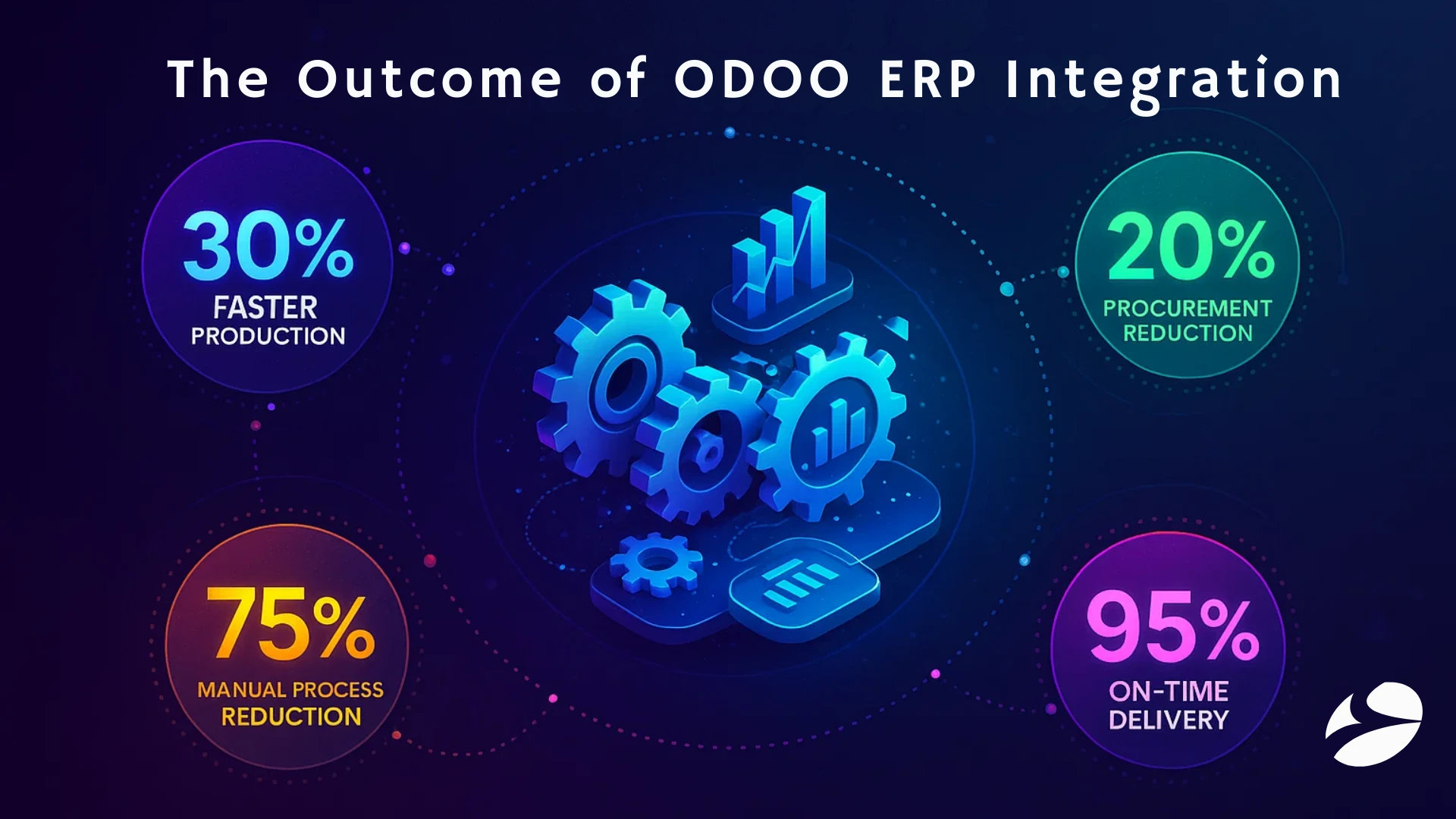
To explain it in terms of figures, here’s how you will witness the better processes post-Odoo ERP implementation:
How is your manufacturing process going? Are you still managing production with spreadsheets? Is your procurement team still drowning in paperwork? Or are you still busy matching the inventory count? You are not alone, many of your competitors are probably doing the same thing.
But with a successful Odoo ERP for manufacturing industry implementation, you can actually get past the competition curve while securing your position in the future markets. And at BiztechCS, we’ve helped dozens of UAE manufacturers like you transform their operations with Odoo.
We know what works here, what doesn’t, and how to make the transition as smooth as possible. No massive upheaval, no year-long implementations, just practical solutions that deliver results.
Fed up with systems that don’t talk to each other? Let’s chat about how the Odoo production management system can transform your manufacturing operations.

Artificial Intelligence (AI)
 31
31

By Devik Gondaliya
Artificial Intelligence (AI)
25
By Devik Gondaliya
Artificial Intelligence (AI)
73

By Nandeep Barochiya