
 16
16
The Complete Guide to Healthcare Digital Transformation
 5 min read
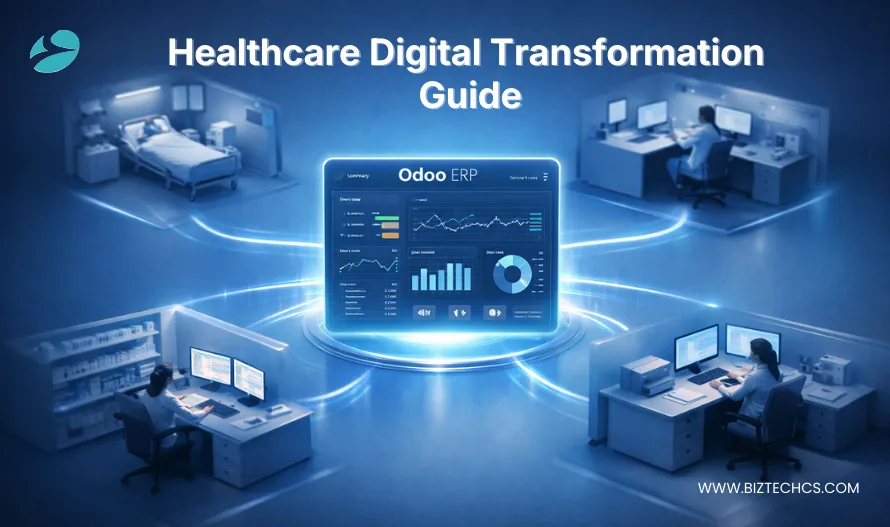
Updating outdated technology systems in an age when everything moves at high speed is like using a lawnmower to compete in drag races. The process of healthcare digital transformation requires more than replacing an old filing cabinet with a tablet that users cannot operate. It is the fundamental rewiring of how a medical facility breathes and operates.
This evolution moves the entire organization away from manual data entry marathons that leave staff feeling like zombies. Shifting toward healthcare ERP systems allows for a unified brain that manages everything from the supply chain to the patient’s bedside. Relying on paper trails and broken communication channels is no longer just an inconvenience. It is a financial suicide mission in a market that demands instant results and absolute precision.
Regulatory pressures are tightening their grip while patient expectations have shifted toward a “delivery app” level of convenience. People now expect their medical history to be as accessible as their social media feed. Patients will choose to visit another clinic across the street if a clinic fails to deliver an effective digital experience.
The UAE market demonstrates strong competitive activity because its advanced technology requirements function as basic entry standards for companies. Incorporating AI in healthcare helps stay ahead of this curve by predicting needs before they become expensive crises. It turns a reactive, exhausted business model into a proactive, profitable powerhouse.
The stakes are far too high to keep playing the “we will update it next year” game with aging infrastructure. Research shows that about 70% of healthcare leaders say investing in digital technology platforms is critical for their organizations’ future, reinforcing how essential digital transformation has become for improving patient outcomes and operational efficiency (Source: Deloitte 2025 Global Health Care Outlook).
Ignoring this shift is essentially inviting obsolescence to dinner. True integration ensures that the clinical side and the back office are finally reading from the same script. It is about creating a resilient foundation that handles the chaos of modern medicine without breaking a sweat.
The only way to escape the administrative chaos we face today is through digital transformation as the path to future technological success.
Clinics today need to update their outdated systems because the current healthcare industry demands both effective operations and precise patient treatment.
Traditional healthcare setups often feel powered by steam engines and good intentions. The daily workflow is completely blocked because manual data entry, combined with physical paper charts, creates an obstruction that exceeds the intensity of a rush-hour traffic jam.
Operational bottlenecks create conditions in which basic work activities take multiple hours to complete rather than just a few minutes. Modern clinics should eliminate the practice of waiting for files to be moved between desks, as it is an outdated process. System performance issues cause all operational processes to stop functioning completely.
The system requires medical experts to perform duties that exceed their actual job requirements. The transition to digital pathways removes obstacles between medical procedures and patient treatment, thereby maintaining process efficiency.
Having patient data scattered across five different software platforms is a recipe for a clinical disaster. Disconnected tools are the primary reason why doctors often have to ask the same question three times during a single visit. This fragmentation leads to a “broken telephone” effect where critical information falls through the digital cracks.
Modern healthcare ERP systems serve as a single source of truth, tying every department into a cohesive unit. It stops the guessing games and ensures that the right hand actually knows what the left hand is doing. Centralized data is the backbone of a sane medical environment. It prevents the frustration of searching for lab results hidden in another database.

Asking a nurse to spend half their shift clicking through non-responsive menus is a great way to guarantee a resignation letter. Administrative inefficiency is a silent killer of morale, draining the energy from even the most dedicated teams. When the tech is an obstacle rather than a tool, burnout becomes an inevitability rather than a risk.
Digital transformation aims to remove the “soul-crushing” repetitive tasks that make the workday feel like a marathon in lead boots. Automation handles the boring bits so the staff can actually use their brains for what they were trained to do.
A happy team is an efficient team. Reducing the friction in their daily tasks is the kindest thing a provider can do for their workforce.
Is your medical staff spending more time fighting with software than treating patients? Reclaiming their time starts with a system that actually works.
The billing department must end its reliance on manual reconciliation processes, as they continue to drive significant financial losses. Revenue leakage occurs primarily when organizations fail to capture unbilled consultations and abandoned follow-up appointments.
Manual systems create multiple opportunities for human error, resulting in frequent claim denials and chronic payment delays. AI technology enables healthcare organizations to detect these discrepancies before they become permanent financial losses, ensuring every service provided is accurately reflected on the balance sheet.
According to a 2025 report by Grand View Research, organizations implementing AI see a rapid return on investment, generating $3.20 in value for every $1.00 spent within 14 months. Ultimately, digital accuracy has proven to be an exceptionally profitable habit for the modern healthcare enterprise.
The medical field must provide precise medicine as a fundamental requirement, rather than treating it as an exclusive privilege. Digital systems deliver immediate data, enabling quick decision-making in critical situations that demand instant responses.
Higher data accuracy removes the “oops” factor from prescriptions and treatment plans, which is generally preferred by people who enjoy being alive. Patients show better engagement when they can view their results and schedule appointments without needing to make a twenty-minute phone call.
The clinical operation depends on these supporting points, which function as essential components that maintain its efficiency. Trust between parties creates a virtuous circle that results in operational efficiency gains for all stakeholders.
Establishing a healthcare company on unstable digital infrastructure is like building a skyscraper on unstable, swampy ground. Organizations need scalable systems that maintain operational capacity as demand from new patients rises and they expand into additional sites.
Modern platforms allow providers to add modules and capacity as needed without reinventing the wheel every six months. It provides the flexibility to pivot and expand into new markets or specialties with total confidence.
A scalable tech stack is the ultimate insurance policy for an increasingly unpredictable future. It turns growth from a terrifying challenge into a natural progression of a healthy business.
Healthcare systems achieve operational efficiency through advanced technologies that modernize their processes, link multiple operations, and improve patient treatment.
Managing a modern medical facility without a central brain is a one-way ticket to a monumental headache. Think of healthcare ERP systems as the skeleton that prevents the entire organization from collapsing into a puddle of administrative goop. It is the core engine that handles everything from the surgical gauze in the supply closet to the paycheck of the person who cleans the floors.
When these modules for financials, human resources, and procurement are all speaking the same language, the magic finally starts to happen.
| Many healthcare clinics in the UAE are already making this shift. Instead of relying on traditional patient management systems, they are adopting Odoo to unify operations, improve efficiency, and gain better control over their processes. |
The process of locating a lost purchase order no longer requires people to search through dusty file cabinets or yell through office spaces.
The entire team uses a single central database, which serves as the sole reference point for their work. The system transforms disorganized spreadsheet data into an organized process that monitors every financial transaction and inventory item.
The business outcomes of getting this right are enough to make any finance lead weep with joy. Reduced administrative overhead means the staff can actually do their jobs instead of wrestling with broken data entries.
Better financial transparency ensures that the budget is not just a collection of wild guesses and optimistic prayers. Faster reporting allows for real-time adjustments rather than waiting three months to realize the pharmacy is hemorrhaging cash. It is about moving away from the “hope for the best” model and toward a structure built on cold and hard data. When the operations are this clean, the clinical side can finally breathe easy.
Connecting different workflows is the only way to stop a medical center from feeling like a group of strangers who happen to share a building. Integration is the glue that binds the ERP to the electronic health records, the CRM, and the telehealth tools.
Without this digital handshake, the data just sits in silos, getting dusty and useless. Seamless data flow ensures that when a patient finishes a video call, their billing record updates automatically, and the pharmacy receives a notification.
| Healthcare providers are already seeing the impact of integrated systems in action. By connecting workflows across billing, patient records, and communication tools, clinics are improving revenue capture while significantly boosting staff productivity. |
It removes the need for manual intervention, which is usually where human error throws a party. This level of cross-functional intelligence means the system is actually working for the staff rather than the other way around.
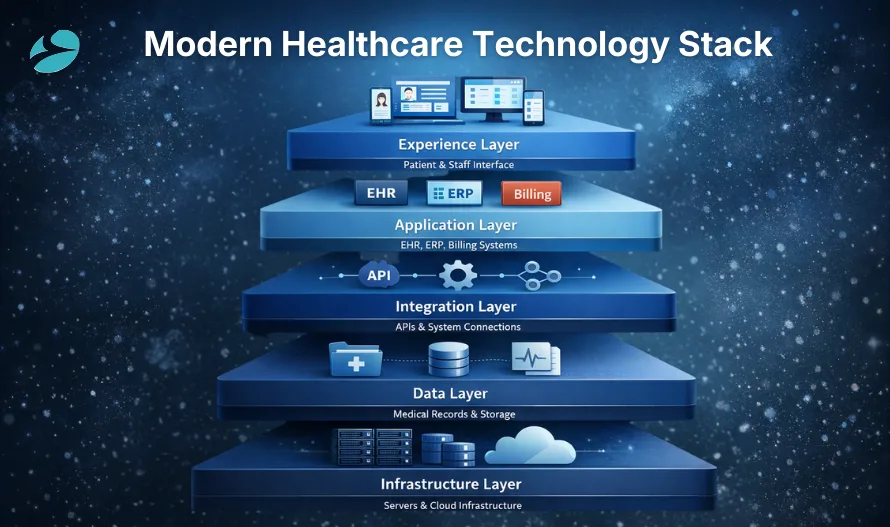
The key business wins here are not just marginal improvements; they are total game changers for the bottom line. Higher clinic revenue becomes a reality when no consultation goes unbilled, and no follow-up is forgotten. Increased staff productivity results from the team not wasting 40% of their day on digital detective work. Fewer operational errors mean fewer lawsuits and a much higher level of patient safety, which is generally a good goal.
According to a 2026 report by Grand View Research, the global healthcare IT market is expected to grow at a 16.2% compound annual growth rate through 2033, as providers rush to address disconnected systems and adopt advanced revenue cycle solutions.
Throwing AI at a problem in healthcare is not about building a robot army to replace nurses. It is about using high-level math to solve the problems that make humans want to pull their hair out. On the operational side, this means workflow automation that handles the soul-crushing monotony of data entry.
Smart scheduling can predict exactly when a patient is likely to flake on an appointment, so the slot can be filled before it becomes a scheduling hole. Predictive analytics can analyze historical data and tell the facility exactly how many staff are needed on a Tuesday morning in November. It is about having a crystal ball that actually works and helps keep the lights on without the usual guesswork.
| AI-driven personalization is already transforming how users engage with digital health platforms. From intelligent recommendations to behavior-based insights, AI-powered systems are proving far more effective than traditional methods in driving consistent engagement and better outcomes. |
The other half of the coin is patient engagement, which is where the real personalization happens. Modern systems use recommendation engines to send intelligent nudges that remind patients to take their meds or book a screening.
These are not generic spam messages that get deleted instantly; they are tailored suggestions based on actual health data. Retention-focused features ensure that the patient feels like a person rather than a number on a chart. This level of care creates a bond that keeps people coming back because the system actually seems to know them.
Sustainable growth in healthcare depends not just on attracting patients, but on intelligently engaging and retaining them through personalized, data-driven experiences.
Hunting for new patients while ignoring the ones already in the database is like trying to fill a sieve with a garden hose. Customer acquisition costs in the medical world are astronomical and usually involve throwing mountains of cash at digital ads that people mostly ignore anyway.
Retention is where the actual profit lies because a patient who returns trusts the clinical outcome. Most facilities treat patient departure like a mysterious act of God rather than a fixable technical failure. This is where behavioral analytics come into play, identifying exactly when a person begins to disengage from their treatment plan.
If the system knows that a patient hasn’t opened their health app in three weeks, it can fire off specific retention triggers to bring them back into the fold. These are not annoying spam messages but timely interventions that show the facility actually gives a hoot about their recovery. Recommendation engines then suggest the next logical step in their care journey, helping them avoid wandering off to a competitor.
Failing to keep a patient is essentially throwing away all the hard work and money spent to get them through the door in the first place. High churn rates are a symptom of a broken process that no amount of fancy marketing can fix. It is much cheaper to keep a seat warm than to find a new person to sit in it.
Keeping a human being focused on their own health is surprisingly difficult in a world full of distractions and cat videos. AI in healthcare acts as a digital shepherd, keeping the flock moving in the right direction without being a total nuisance.
The architecture relies on sophisticated feedback loops that learn from every single interaction a patient has with the platform.
| This kind of engagement doesn’t happen randomly. It is built on a structured retention architecture that uses feedback loops, behavioral tracking, and smart triggers to keep patients consistently engaged over time. |
If a person responds better to evening reminders than morning ones, the system adjusts itself automatically without a human having to lift a finger. This level of personalization is handled by recommendation engines that serve up relevant content and health tips based on real-time data.
Behavioral analytics monitors for signs of frustration or confusion so the staff can intervene before a patient gives up entirely. These systems also sync seamlessly with healthcare ERP systems to ensure that clinical data and engagement efforts are always fully aligned. Retention triggers are set up to go off at the exact moment a patient reaches a milestone or misses a crucial check-in.
It creates a supportive environment where the patient feels seen and understood rather than just being another number on a spreadsheet. This digital hand-holding ensures that people stay on track with their chronic disease management or post-op recovery. Engagement is not a one-time event but a continuous conversation powered by smart algorithms.
Wondering if your patient engagement strategy is reactive rather than proactive? Modernize your retention architecture to keep your patients within your care network.
Digital transformation creates financial benefits by enhancing revenue streams, reducing operational losses, and improving financial management systems.
Health systems often struggle with the “leaky bucket” syndrome, where patients vanish into the void after a single visit. Boosting revenue per patient is not about upselling unnecessary heart surgeries, as if they were extended warranties on a toaster. It is about continuity.
By implementing healthcare ERP systems, providers can track the entire patient journey without losing data in a digital abyss. The system successfully performs its function by alerting doctors to patients’ follow-up appointments and screening requirements.
The system guarantees that patients obtain all necessary medical services through its active management process. It turns a fragmented series of chaotic encounters into a streamlined clinical pathway.
This approach keeps the schedule full and the billing consistent. It also beats the old method of hoping a patient remembers their own appointment while staring at a post-it note on their fridge.
Insurance companies seem to enjoy rejecting claims more than a grumpy bouncer at an exclusive club. Claim denials are a massive drain on resources and usually stem from tiny human errors made by a tired staff member at 4:00 PM on a Friday.
Using AI in healthcare allows for a preemptive strike against these rejections. These systems can sniff out errors and missing codes before the claim ever hits the payer’s desk. It stops the endless back-and-forth “paperwork dance” that costs more in administrative labor than the claim is actually worth.
Reducing leakage means keeping patients within the network instead of letting them wander off to a competitor because a referral was lost in a broken fax machine. It is high time to stop treating revenue like a suggestion and start treating it like a priority.
Running a hospital without modern tech is like trying to win a Formula 1 race on a tricycle. The overhead from manual data entry and redundant paperwork is a financial nightmare. Digital transformation cuts the fat by automating the boring stuff that humans are historically terrible at doing quickly.
Direct communication between systems enables staff members to dedicate their work hours to patient care rather than searching for lost documents. Organizations achieve cost reductions through higher operational efficiency, which eliminates obstacles that cause work processes to halt.
The result reduces expenses for correcting preventable errors, enabling more funds to remain in financial reserves. If the goal is to stop burning cash to maintain outdated silos, then merging data into a unified platform is the only logical exit strategy.
Predicting the financial future of a healthcare facility usually involves more guesswork than a weather report in a hurricane. Without a clear view of incoming payments, a balance sheet looks like a work of fiction. Digital tools provide a crystal-clear lens into the billing cycle so the math finally adds up.
Accurate forecasting means knowing exactly when the money will land, rather than crossing fingers and wishing upon a star. This level of visibility allows for smarter investments and better resource allocation. It moves the organization away from “crisis mode” budgeting and into a state of actual financial stability.
When the data is real-time, the strategy can be proactive rather than a desperate reaction to a shrinking margin.
A no-show is not just an empty chair; it is a giant hole in the daily profit margin. The practice of having patients remember all their scheduled appointments amid widespread distractions creates a situation that leads to failure.
The waiting room remains occupied because automated reminders, combined with simple rescheduling options, serve as digital nudges. These systems do the heavy lifting of confirming slots so the front desk staff can stop playing phone tag all day.
The system becomes more effective at preventing appointment-related forgetfulness by interacting with users in their current environment. The process of filling these gaps ensures that clinical staff members remain occupied during periods when operational costs continue to accumulate.
Waiting months for a claim to clear is a great way to develop an ulcer. Manual billing is a slow-motion car wreck of typos and delays that keeps capital tied up for far too long.
Automating the reconciliation process means the system does the math and matches payments to accounts without a human having to squint at a spreadsheet. This speed kills the “lag time” that usually haunts the accounts receivable department.
Faster processing puts money in the pocket sooner and keeps the lights on without the stress of a pending collections list. It turns a clunky, bureaucratic nightmare into a well-oiled machine that actually respects the bottom line.
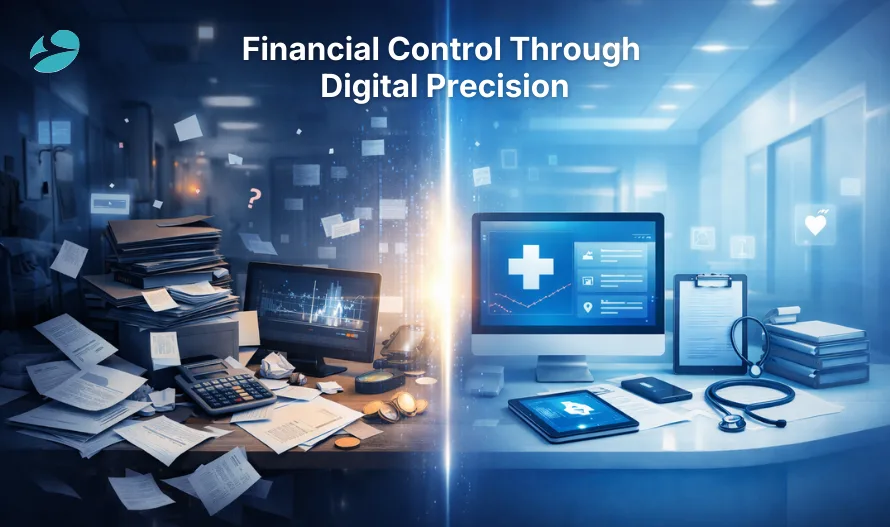
Digital transformation generates its business value through real-world outcomes that improve patient treatment, employee performance, and financial growth.
No one prefers to spend time in a lime-green waiting area where they must read a 2012 magazine while their existence goes unnoticed. The most effective way to convert satisfied patients into dissatisfied reviewers on Google is to cause them to experience extended wait times. Modern systems flip the script by streamlining check-ins and providing instant access to records.
When patients feel like the facility actually values their time, satisfaction scores skyrocket. Real-world data shows that digital engagement tools can lead to a 20% increase in patient retention. Keeping people happy is significantly cheaper than constantly hunting for new ones to replace the ones who walked out in frustration. It turns out that not treating humans like cattle in a holding pen is actually quite good for the bottom line.
Most clinical teams are currently buried under a mountain of digital paperwork that would make a tax auditor weep. Burnout is not just a buzzword; it is a literal drain on the payroll when talented nurses spend half their shift clicking through broken menus.
Implementing healthcare ERP systems removes the friction from daily workflows by automating the soul-crushing repetitive tasks. Facilities often see a 30% reduction in administrative time once they finally ditch the manual-entry marathons. This shift lets the staff actually focus on the patients instead of fighting with a database that hates them. Efficiency is the difference between a smooth operation and a chaotic circus where everyone is juggling fire while trying to find a misplaced patient file.
Money has a funny habit of disappearing when the billing process is a mess of disconnected spreadsheets and hope. Integrating a unified financial platform ensures that every single aspirin and consultation is actually accounted for in the final bill. Organizations that embrace these upgrades often report a 5% to 10% revenue lift simply by capturing what they were already doing but were not charging for.
It stops the “charity by accident” model that many under-equipped clinics accidentally run. Revenue growth comes from accuracy rather than just hiking prices on an unsuspecting public. According to Deloitte’s 2026 US Health Care Outlook, hospitals implementing AI-driven documentation and revenue cycle upgrades have already reported tangible gains.
These include a $13,000 increase in reimbursement per clinician, driven by improved coding accuracy and reduced documentation gaps (source).
Throwing AI at a problem in healthcare is not about replacing doctors with shiny metal robots that have no bedside manner. It is about using advanced algorithms to predict which patients are likely to miss an appointment or which claims are likely to be denied. High-level metrics indicate that AI-driven scheduling can reduce no-shows by nearly 40% in some specialty clinics.
This predictive power allows for a level of precision that a human brain simply cannot manage while also dealing with a ringing phone. The impact is felt in the reduced stress of the accounting department and the healthier state of the bank account. It is about working smarter because working harder has already failed everyone in the industry.
The healthcare sector needs a specialized approach that aligns with established objectives and provides sustained support to achieve successful digital transformation.
Treating a hospital as a collection of separate islands is a recipe for a fiscal shipwreck. The pharmacy and the billing office need to communicate because their current inventory knowledge in the surgical department is causing financial losses for everyone involved. True transformation requires a roadmap that connects every single dot across the facility.
It is about breaking down those stubborn walls that keep data trapped in 1995. This unified strategy ensures that any new software actually solves a problem instead of just adding another expensive icon to a desktop. A cohesive plan prevents the “Frankenstein” effect, where different departments buy conflicting tech that refuses to play nice together. It is much easier to steer a ship when everyone is actually looking at the same map.
Vague goals are the graveyard of good intentions and expensive budgets. Success cannot be measured by a “feeling” or a polite nod from a board member. Every digital shift needs cold and hard metrics that prove the investment was not a total waste of time.
Whether it is cutting the time for patient intake or slashing the claims error rate, the numbers must be front and center. Project costs become unnecessary expenses when they lack a definite financial advantage demonstrated through accounting records.
The team maintains focus on their work because they have established benchmarks that confirm whether the technology functions as intended. Data does not have an ego, and it does not lie about whether a system is actually working.
Handing a complex new interface to a doctor who has used the same paper charts since the moon landing is a bold move. Resistance to change is a natural human instinct, especially when the new system looks like a fighter jet cockpit. Proper training is the only way to prevent a full-scale staff mutiny.
It involves more than just a boring three-hour webinar that everyone ignores while checking their email. Empathy is key here because people need to feel confident that the tech is a tool and not a replacement. Change management is about winning hearts and minds, so the software does not end up as an expensive paperweight. When the staff understands the “why” behind the click, the transition actually sticks.
Cybercriminals treat medical records with weak protection as an all-you-can-eat buffet. A single breach can turn a reputable health system into a cautionary tale on the evening news. Organizations need to develop strong data governance systems that protect their information through strict access controls that determine who can view data and when they can access it.
AI in healthcare can actually assist here by flagging unusual access patterns before a disaster occurs. Guarding patient privacy is a moral obligation and a legal minefield that nobody wants to walk through. The security system implements robust measures to keep the digital vault protected from unauthorized access. Trust is the most valuable currency in this industry, and it takes years to build but only seconds to destroy.
Buying a system that can only handle today’s patient load is like buying clothes for a toddler that will not fit by next Tuesday. Growth is inevitable, and the tech stack needs to be ready for the surge. Modern healthcare ERP systems should be able to expand without requiring a complete demolition of the existing infrastructure.
Choosing a platform that cannot scale is a guaranteed way to ensure another massive bill in three years. It is about choosing a foundation that supports future modules and higher data volumes without breaking a sweat. A scalable choice is an insurance policy against obsolescence and technical debt. Investing in a system that grows with the organization is simply common sense for anyone who wants to keep their job.
Digital transformation in the UAE and the Gulf region advances rapidly due to the combined forces of government requirements, market competition, and changing patient needs.
The Gulf region is not exactly known for doing things by half measures, and healthcare is no exception. Governments in the UAE and Saudi Arabia are pushing digital mandates with the kind of intensity usually reserved for launching space probes. Initiatives like the “Emirates Health” platform and Saudi Vision 2030 have turned digital transformation from a “nice to have” into a legal requirement.
These policies are designed to consolidate fragmented records into a single national medical ID. It makes the old days of carrying a physical folder of X-rays look like using a stone tablet to send a text message. This top-down pressure means that facilities either get on board with healthcare ERP systems or prepare to be left in the dust of the desert.
The goal is a seamless, paperless ecosystem where data flows faster than a supercar on the Sheikh Zayed Road.
The GCC has decided that being a global hub for luxury travel is not enough; they want to fix your knee while you are there, too. The UAE currently leads the pack in regional medical tourism, with the market valued at USD 722.5 million in 2024 and projected to reach USD 4.4 billion by 2033 (source). This isn’t incremental growth—it’s a full-scale transformation into a global healthcare destination.
Global patients traveling for complex surgeries expect more than just a nice hotel room. They want a digital-first experience that allows them to book consultations from their home country, seamlessly share medical records, and access post-operative plans through an app. If a clinic is still relying on manual intake forms, it can kiss that international revenue goodbye.
High-tech facilities are increasingly using AI in healthcare to coordinate these cross-border journeys with surgical precision from pre-arrival diagnostics to post-op monitoring. It turns a medical procedure into a high-end service experience, blending clinical excellence with concierge-level convenience and that’s exactly what keeps global patients coming back.
In the Gulf, “good enough” is a death sentence for a private clinic. The sheer density of world-class facilities means that providers are in a digital arms race to win over a very picky population. When a new specialty center opens every other week, standing out requires more than just a fancy lobby.
Clinics are adopting advanced tech to slash wait times and improve diagnostic accuracy because a single bad review can tank a reputation. This cutthroat environment forces a level of efficiency that would make a Swiss watch look sloppy.
They are integrating billing, scheduling, and clinical data to ensure the operation runs like a well-oiled machine. In this market, if the tech is not cutting-edge, the clinic is basically invisible.
The average patient in the Gulf is younger, tech-savvier, and significantly less patient than the global average. With smartphone penetration rates exceeding 90% in many areas, people expect to manage their health with the same ease they use to order a latte. They have zero interest in repeating their medical history to five different people in the same building. They want a “connected care” experience in which their data follows them seamlessly from tele-consultation to the pharmacy.
This shift isn’t just behavioral—it’s systemic. Governments in the region are actively redesigning care delivery around digital-first models. For example, Saudi Arabia is targeting the digitalization of 70% of patient activities by 2030, specifically to reduce dependence on hospital-based care (source). The direction is clear: fewer unnecessary visits, more continuous, connected care.
If a provider cannot offer a sleek, integrated digital interface, the patient will simply swipe left and find someone who can. Meeting these expectations isn’t optional—it’s the minimum requirement to survive in a region that eats old-fashioned business models for breakfast.
Sticking to ancient spreadsheets while expecting modern margins is a bold strategy for anyone who enjoys losing sleep. Combining healthcare ERP systems with AI in healthcare is the only way to stop the bleeding of uncaptured revenue and operational chaos. This trifecta creates a strategic competitive edge, turning a clunky facility into a high-performance machine.
An ROI-focused digital roadmap ensures the budget goes toward tangible results rather than expensive digital ornaments. Waiting for a miracle is not a business plan. It is time to get the house in order and let technology do the heavy lifting for once.
Ready to bridge the gap between your current administrative hurdles and a high-performance, tech-driven future? Let’s build your transformation roadmap together.

Odoo
 14
14

By Uttam Jain

Artificial Intelligence (AI)
158

By Nandeep Barochiya
Odoo
174
By Uttam Jain