https://www.biztechcs.com/blog/what-makes-ai-based-privacy-risk-detection-essential-for-modern-website-security/
Your data‑privacy policy probably reads like War and Peace — nobody finishes it, and everyone just clicks “Accept” anyway. That’s the uncomfortable truth system administrators know too well.
While you’re busy keeping servers from catching fire and networks from turning into digital spaghetti, privacy risks multiply faster than browser tabs on a developer’s machine. The most striking fact is that, according to a 2025 consumer‑privacy survey by Kinetic, 80% of consumers said they’re uneasy about how their personal data is used (Kinetic Privacy Survey 2025).
At the same time, global cybercrime losses are expected to reach US $10.5 trillion annually by 2025 (Viking Cloud Cybersecurity Statistics 2025). That means having good intentions is no longer enough — you need strong data stewardship, not just policies.
The difference between customers’ expectations and what happens with their data is indeed very huge – the size of the Grand Canyon. In this scenario, AI-powered data privacy tools, though not much discussed, come to the rescue by reading the cumbersome regulations for you.
These cloud-based solutions scan, detect, and manage privacy risks while you focus on more pressing matters—like explaining to management why turning it off and on again actually works. Backed by modern ai/ml development services, this blog explores how AI compliance monitoring transforms privacy management from a nightmare into something almost bearable.
We’ll cover the tools, tactics, and real-world applications that keep both regulators happy and your sanity intact.
What Are the Rising Threats to Data Privacy and Compliance Today?
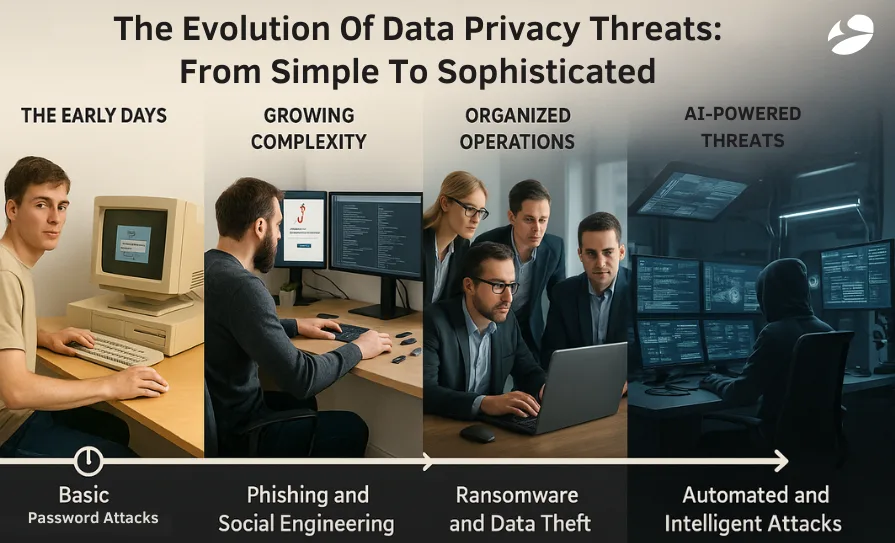
Rising data privacy threats include growing data volumes, sophisticated cybercriminals, high breach costs, and complex compliance regulations.
The Exponential Growth in Data Collection Volume
Remember when a gigabyte felt massive? Now companies collect that much data before their morning coffee kicks in. Data from every click, scroll, and abandoned shopping cart is like points that pile up faster than the unread emails that accumulate after a long weekend.
The current average amount of data an enterprise handles is 347.56 TB, and although this figure seems very precise, half of it is located nowhere and has no reason for existence.
Sophistication of Cybercriminals and Evolving Attack Methods
The time when hacking was mainly the pastime of teenage computer nerds dressed in hooded sweatshirts, eating Doritos in their parents’ basement, is long gone. Present-day cybercriminals work with greater sophistication and technical skill than most modern businesses, and they even offer customer support and satisfaction guarantees.
Cost Implications of Data Breaches
A single data breach now costs more than building a small space program, averaging $4.88 million per incident, according to IBM. That’s not counting the therapy bills for your legal team or the premium coffee required to survive regulatory audits. The real kicker is that fixing the breach costs ten times as much as preventing it would have—something any forward-thinking AI Development Company understands well—yet hindsight always seems to come with a premium price tag.
Organizations using AI-powered privacy detection—often delivered as part of broader ai/ml development services—report 65% fewer compliance violations. More importantly, they save approximately $2.3 million annually by proactively preventing data breaches, regulatory penalties, and remediation costs, making the investment measurable, defensible, and strategically sound.
That’s not marketing fluff; that’s the difference between explaining a successful security strategy to the board versus explaining why customer data is trending on Twitter.
Complexity of Navigating Multiple Privacy Regulations (GDPR, CCPA, HIPAA)
The number of privacy laws keeps increasing like rabbits on steroids, and every law comes with its own set of compliance requirements. And there is no unified approach here: the GDPR wants one thing, the CCPA demands another, and the HIPAA regulations are so intricate that even deciphering them would take one back to the time of ancient Sanskrit.
Meeting the requirements of all of them at the same time is like spinning fire chainsaws while balancing on a unicycle over a red tape-covered tightrope.
The Challenge of Maintaining Real-Time Compliance
Static compliance is dead; regulations now change faster than Milan fashion trends. What’s compliant today might land you a fine tomorrow, and AI compliance monitoring barely keeps pace with the regulatory mood swings.
Manual tracking is about as effective as using a sundial to time a Formula One race, which explains why AI-powered data privacy solutions have become the Swiss Army knife of modern compliance management.
Are you still manually tracking compliance across multiple jurisdictions while regulations change faster than you can update your spreadsheets? It’s time to explore how AI can transform your privacy management from reactive firefighting to proactive protection.
Let’s Build Your Privacy Shield with Custom AI Services
Proactive protection beats reactive damage control. We’ll create AI solutions that detect risks, automate compliance, and scale with your business. Stop hoping—start protecting.
How Do AI-Powered Privacy Risk Detection Tools Work?
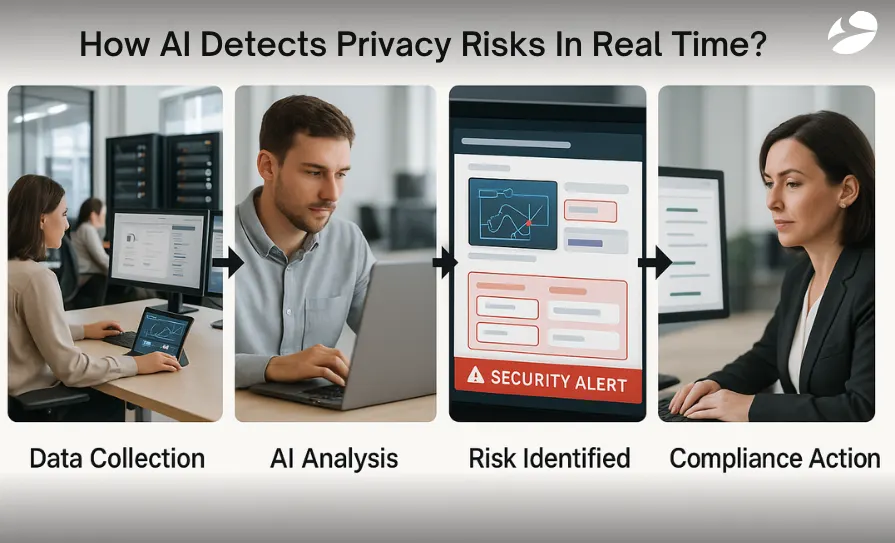
As data privacy risks continue to evolve, AI-powered tools offer a proactive approach to identifying and mitigating threats before they escalate. These tools help businesses stay ahead of the curve in an increasingly complex regulatory environment.
Automated Data Collection Monitoring
AI-powered data privacy tools can be thought of as highly paranoid security guards who do not even fall asleep, take bathroom breaks, or scroll social media while on duty. These systems are like hawks watching mice in a wheat field; they monitor every byte of data flowing in and out of the organization, often built on AI Development Company expertise and advanced ai/ml development services that enable real-time threat detection, adaptive learning, and intelligent response without human intervention.
They collect only the necessary information securely, and at the same time, they automatically flag the intern who thought it was wise to store passwords in the file cleverly named “definitely_not_passwords.txt.”
Risk Detection and Alert Systems
AI algorithms analyze data flows with the obsessive attention of someone counting their change at a vending machine that just ate their dollar. They identify unsecured storage faster than employees find free donuts in the break room, catching improper data sharing before it becomes tomorrow’s headline nightmare.
Real-time alerts pop up with remediation suggestions that actually make sense, unlike those cryptic error messages everyone pretends to understand. Backed by ai/ml development services, we at BiztechCS can implement custom alert systems tailored to your specific business needs and risk tolerance levels—because one-size-fits-all works great for rain ponchos, not for data security.
Regulatory Compliance Monitoring
AI monitoring of compliance performs continuous alignment checks against worldwide privacy regulations and, at the same time, handles GDPR, CCPA, and their lexical soup cousins very comfortably. The system automatically updates you on new regulatory requirements, sparing you the burden of tracking every legislative change across 195 countries.
We at BiztechCS can develop compliance dashboards that provide real-time visibility into your compliance status across multiple jurisdictions, turning regulatory chaos into something resembling organized chaos.
AI Expert Tip: When implementing AI compliance monitoring, start by mapping your data flows across all touchpoints before deploying detection algorithms. At BiztechCS, we’ve found that organizations that invest 2-3 weeks in comprehensive data mapping achieve 45% more accurate threat detection and reduce false positives by 60%. This upfront investment saves months of recalibration later and ensures your AI learns from complete data patterns rather than partial snapshots.
Vulnerability Scanning Capabilities
AI-powered scanning hunts for encryption weaknesses like a bloodhound with a PhD in cryptography and trust issues. Access control assessments run deeper than philosophical debates about free will, examining who can touch what data and whether they should even know it exists. Data storage mechanisms get analyzed with the thoroughness of a tax audit, except this one you actually want to pass.
We at BiztechCS, as an AI Development Company, can integrate advanced vulnerability scanning modules that adapt to your specific infrastructure, because your unique mess requires a unique solution. Leadership teams frequently wonder: “How do we handle false positives without drowning our security team in meaningless alerts?”
Modern AI systems achieve 94% accuracy in threat detection, learning from each false positive as a chess grandmaster would study past games. The machine learning algorithms distinguish between genuine threats and Karen from HR downloading cat videos during lunch, reducing alert fatigue by 70%. This ensures that actual threats don’t slip through like water through a pasta strainer.
What Are the Key Components of an Effective AI Privacy Solution?
An effective AI privacy solution combines multiple critical components that work together to protect sensitive data and ensure compliance with evolving regulations.
Data Access Control Systems
Authorization management in AI-powered data privacy systems works like a nightclub bouncer who actually remembers faces and never accepts bribes, even when offered lifetime supplies of energy drinks.
The system decides who gets VIP access to sensitive data and who gets stuck outside in the rain, preventing internal breaches before Bob from accounting decides to take home the entire customer database as a retirement gift.
These controls stop data hemorrhaging from the inside out, because statistically speaking, your biggest threat isn’t some hacker in a foreign country but Steve from IT who still uses “password123” for everything.
User Consent Management
Cookie consent automation handles those annoying privacy popups that everyone hates, but nobody can legally ignore, like digital vegetables on your website’s dinner plate. The system manages opt-in regulation compliance across different jurisdictions, each with its own special interpretation of what “consent” means, turning legal jargon into actual functionality.
Audit trails get maintained with the meticulous detail of a serial killer’s diary, except these records keep you out of regulatory prison instead of putting you in actual prison. We at BiztechCS can develop comprehensive consent management platforms that seamlessly integrate with your existing website infrastructure, making compliance as painless as a root canal with really good anesthesia.
Data Encryption and Security Layers
Modern encryption layers stack up like a paranoid person’s door locks, except these actually work against determined intruders instead of just slowing down the pizza delivery guy. AI compliance monitoring—powered by ai/ml development services checks encryption levels against set regulatory standards and, at the same time, adapts to new threats faster than bacteria do to antibiotics.
The security architecture is designed with multiple layers of protection, for putting all your eggs in one basket is only advisable when you are making an omelet, not when you are guarding sensitive data.
Privacy-by-Design Implementation
Privacy-by-Design is the practice of embedding data protection in your systems from the start, rather than adding it later like duct tape on a leaking pipe. This strategy considers privacy a basic feature rather than an expensive afterthought that shows up uninvited, like your mother-in-law during the holidays.
Every new process, product, or system gets built with privacy considerations from day one, proving that yes, you can teach an old enterprise new tricks if the alternative is regulatory fines that could fund a small country’s space program.
Does your current privacy framework feel like it’s held together with duct tape and good intentions? Building a Privacy-by-Design foundation doesn’t have to mean starting from scratch—we can help you transform your existing systems into compliance powerhouses.
How Can Biztech Help Build Scalable AI Data Privacy Solutions?
Biztech leverages advanced technologies to design data privacy solutions that grow with your business, ensuring seamless scalability and continuous protection as your data needs evolve
Biztech’s Specialized Approach
BiztechCS builds cloud-based, AI-powered data privacy solutions that treat your data like a Swiss bank treats money, minus the questionable ethics, and with better customer service. Our systems support everything from e-commerce platforms processing more transactions than a liquor store on Black Friday. They also power content platforms hosting enough data to make the Library of Congress jealous.
BiztechCS can implement AI-driven tools that safeguard data with the determination of a helicopter parent watching their kid’s first date. The beauty lies in the versatility; whether you’re running an online service or a platform that makes Amazon look like a corner shop, we can cover your needs.
BiztechCS can customize approaches for any industry, because data breaches don’t care whether you sell socks or spacecraft. We can develop specialized frameworks that adapt to your specific nightmare scenario, because every organization has its own unique way of accidentally exposing customer data.
Ensuring Scalability
Cloud-native architecture ensures that your privacy solution is highly flexible and can quickly adapt to changing demands without sacrificing performance or running out of patience during compliance audits. The microservices architecture allows each component to function independently, so when one component is updated, the entire system doesn’t completely collapse like a house of cards during a hurricane.
C-suite stakeholders consistently ask: ‘What’s the realistic implementation timeline, and will it disrupt our operations?’ The honest answer beats sugarcoating – initial deployment takes 6-8 weeks for mid-size operations, with minimal disruption that’s less noticeable than your Monday morning system updates.
The phased approach means you’re protecting critical data within the first two weeks while the full system integration happens in the background, like a ninja performing IT maintenance.
BiztechCS can engineer solutions that automatically modernize based on traffic and data volume, growing during busy times and decreasing when things are calm, just like your stress levels after going through a regulatory review and coming out victorious.
We can ensure systems grow alongside your website without requiring complete overhauls every time your user base doubles. AI compliance monitoring continues to protect data, whether you have 10 users or 10 million, maintaining the same paranoid vigilance regardless of scale. BiztechCS can implement continuous protection that adapts as user data grows, ensuring that your millionth customer gets the same privacy protection as your first.
By the time you reach that millionth customer, the AI will have learned from 999,999 previous interactions. As a result, it becomes considerably smarter at catching shenanigans.
Which Industries Benefit Most from AI Privacy Risk Detection?
AI privacy risk detection is transforming industries that handle large volumes of sensitive data, helping them navigate complex regulations and safeguard customer trust.
E-Commerce Sector
E-commerce platforms handle more sensitive financial data than a divorce lawyer’s filing cabinet, with payment details and shipping information flowing through systems like water through a colander.
PCI-DSS and GDPR compliance requirements turn into a twisted game of regulatory Twister where one wrong move lands you in a world of hurt, fines, and customer fury that makes Black Mirror episodes look cheerful.
We at BiztechCS can implement specialized e-commerce privacy solutions that protect transaction data while maintaining a seamless user experience.
Nothing kills customer trust faster than seeing their credit card details on a dark web marketplace. Those details being sold for less than a cup of coffee only makes the situation worse.
A question that keeps e-commerce executives up at night: ‘How does privacy protection translate to competitive advantage?’ Companies with robust AI privacy systems report 40% higher customer retention rates and 25% higher conversion rates among privacy-conscious consumers.
When customers see you take their data seriously, they reward you with loyalty that’s harder to break than a Nokia 3310, turning privacy from a compliance burden into a marketing superpower.
Healthcare Platforms
Healthcare platforms protect medical records with the intensity of a dragon guarding its gold, except the dragon has to follow HIPAA compliance requirements that read like they were written by sadistic lawyers on their worst day.
AI-powered data privacy is essential when safeguarding patient privacy involves everything from embarrassing rashes to mental health records that nobody wants plastered across the internet.
One success story shows a 40% reduction in compliance incidents after implementing proper AI tools, proving that machines are better at keeping secrets than humans who still gossip about that weird thing they saw in the break room.
Social Media and Content Platforms
Social media and content platforms keep an eye on user-generated content like worn-out parents watching kids with permanent markers, knowing that disaster strikes the moment they turn their heads.
Consent management at large compasses turns into a circus act where you’re juggling millions of users’ preferences while riding a unicycle made of privacy regulations across 195 different countries.
AI compliance monitoring helps these platforms stay compliant with data protection laws that change faster than trending hashtags. This enables them to remain compliant while users post everything from cat videos to conspiracy theories. One such theory is about why their toast always lands butter-side down.
What Are the Best Practices for Implementing AI in Privacy Risk Detection?
Implementing AI in privacy risk detection requires adopting best practices that ensure continuous compliance and proactive threat detection. These practices also facilitate seamless integration into existing systems.
Regular Privacy Audits
Integration of automated audit systems works like having a permanently caffeinated accountant who counts every data point instead of beans, except this one never asks for vacation days or complains about the coffee quality.
Background operations run smoother than a con artist’s pickup lines, checking compliance without disrupting your actual business operations or causing your website to load like it’s 1999 on dial-up.
We at BiztechCS can develop automated audit workflows that run continuously without impacting website performance.
These workflows conduct periodic compliance checks to catch problems before they become regulatory nightmares. This helps prevent legal teams from staying awake at night, counting potential fines instead of sheep.
Stakeholders rightfully wonder: ‘How do we measure the effectiveness of our AI privacy implementation?’ Success metrics go beyond avoiding fines – look for an 80% reduction in manual compliance tasks and 90% faster incident response times. Compliance audit scores will also improve, making regulators actually smile (a rare phenomenon, like spotting Bigfoot).
The dashboards provide real-time KPIs that executives can actually understand without needing a decoder ring or three espressos.
Machine Learning Optimization
Senior management often questions: ‘What expertise and resources do we need internally to maintain these AI systems?’ The beauty is that you need fewer resources than maintaining a decent office coffee machine – AI systems self-optimize with minimal human intervention.
One privacy analyst can oversee what previously required a team of five, and they don’t even need a PhD in machine learning, just basic technical literacy and the ability to read dashboards without panic attacks.
AI-powered data privacy systems learn from historical data like that friend who remembers every embarrassing thing you’ve ever done, except these memories actually serve a useful purpose in predicting future threats.
The system adapts to emerging threats faster than bacteria develop resistance to hand sanitizer, constantly evolving its defenses against creative new ways hackers find to ruin everyone’s day.
Prediction accuracy improves over time like a wine that doesn’t turn to vinegar. It gets better at spotting anomalies and potential breaches before they happen. This ensures your data isn’t sold in bulk on forums where people have usernames like “xXDataThief420Xx.”
AI Expert Tip: Train your AI models using adversarial testing scenarios specific to your industry’s threat landscape. At BiztechCS, we simulate attack patterns from the last 24 months of industry-specific breaches during the AI training phase. This targeted approach increases detection accuracy by 35% compared to generic security models and helps the system recognize subtle variations of known attack patterns that generic solutions miss.
Comprehensive Consent Management
Automation of consent processes transforms the mind-numbing task of tracking user preferences into something that actually works, unlike those “unsubscribe” links that somehow multiply your spam emails.
Secure storage of consent records creates an ironclad paper trail that would make even the most paranoid auditor weep tears of joy, maintaining legal compliance documentation that stands up to scrutiny better than alibis in crime dramas.
We at BiztechCS can create custom consent management solutions that align with your specific regulatory requirements. AI compliance monitoring must account for the fact that every jurisdiction has its own interpretation of what “consent” means. This turns simple yes/no questions into philosophical debates about free will and user autonomy.
Closing Lines
AI-powered data privacy tools have evolved from nice-to-have toys into must-have survival gear, like bringing a parachute to a skydiving lesson instead of just hoping gravity takes a day off.
The choice between proactive privacy protection and reactive damage control is like choosing between wearing a bulletproof vest or just hoping the shooter has terrible aim.
One option clearly beats the alternative. The other leaves you explaining to shareholders why their data is being auctioned off to the highest bidder.
AI compliance monitoring transforms the regulatory compliance circus from a death-defying high-wire act into something more manageable, though admittedly still terrifying enough to require professional help.
Waiting for a breach to happen before fixing privacy issues is like waiting for the house to burn down before installing smoke detectors—except the fire spreads across the internet and everyone films it for posterity. BiztechCS can help transform your data privacy approach from a prayer-based system to an actual strategy that works better than crossing fingers and sacrificing goats to the compliance gods, powered by ai/ml development services that proactively identify risks, automate compliance checks, and strengthen security before problems turn into public disasters.
The real question isn’t whether you need AI-powered privacy protection. The question is whether you want to implement it now or after your data becomes tomorrow’s cautionary tale at security conferences. There, speakers will use your breach as the “what not to do” example.
Ready to transform your data privacy from a compliance checkbox into a competitive advantage? Let’s discuss how AI-powered solutions can protect your data, delight your customers, and keep regulators off your back—all while you focus on growing your business.



 5 min read