
 389
389
Which Platform Wins the Odoo vs Salesforce Debate for Your Business?

 5 min read
389
5 min read

Selecting a business platform is much like choosing a spouse; if the chemistry is off, the divorce will cost you half of everything and leave you crying in a boardroom.
The stakes in the Odoo vs Salesforce debate are high — choosing the wrong platform can derail strategic transformation and waste millions. That risk is underscored by Gartner’s projection that by 2027, more than 70% of recently implemented ERP initiatives will fail to fully meet their original business-case goals (source).
This reality highlights how easily ERP projects can fall short despite significant investment. As a result, vendor selection, scoping, and change management are more critical than ever when comparing systems like Odoo and Salesforce.
This is not just a software update; it is a fundamental shift in how the gears of an organization turn. Settling for the wrong ERP vs CRM software is a fast track to burning through capital faster than a startup in a bull market.
While Salesforce continues to dominate the CRM landscape, it leads all vendors with approximately 20.7% of the global CRM market share in 2024, according to IDC’s Worldwide Software Tracker. Meanwhile, Odoo has been steadily gaining traction as a versatile open-source alternative (source). It has a modular ecosystem, so you do not have to pay for a million features you will never use.
The choice between Odoo and Salesforce is not just about looking at the sales presentation; it is about a thorough examination of each platform’s limitations and future outlook. Deciding whether to invest in Odoo or Salesforce requires a clear understanding of your internal technical bandwidth and long-term growth trajectory.
This comparison aims to strip away the shiny marketing veneer and reveal which platform truly aligns with the business’s operational DNA, not just which has the more appealing logo.
The decision to select one of these two major players does not so much refer to software but rather to the question of which kind of corporate turbulence you are ready or willing to endure.
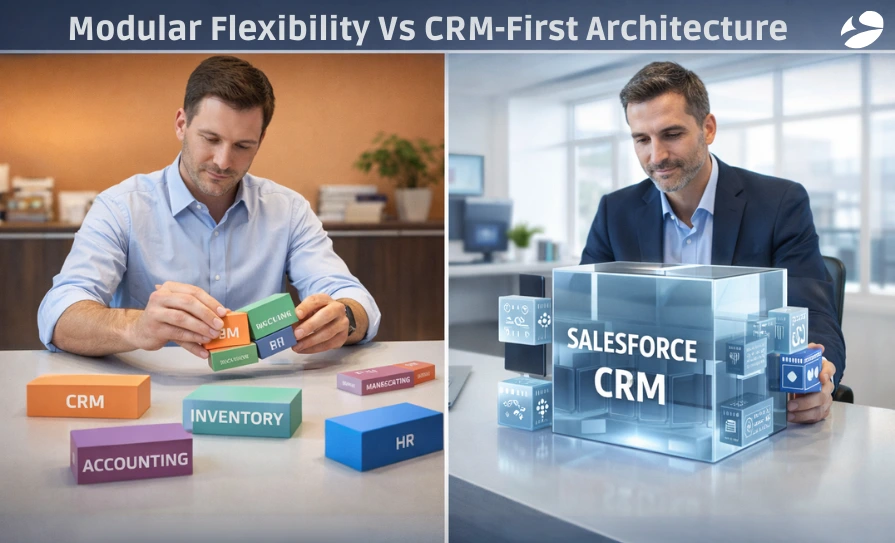
Odoo is the tech equivalent of a Lego set for people who actually like reading the instructions. This open-source ERP platform abandons the “one size fits all” lie that most software vendors sell.
It uses a modular structure that lets you install only the business applications you actually need. One day, you are managing a simple warehouse. Next, you are adding manufacturing, accounting, and an e-commerce store with a single click. This flexibility offers a level of customization and scalability that grows with you.
It prevents the typical nightmare of having to outgrow your system every 3 years. It is essentially a DIY dream for anyone who wants a tailored fit without the bespoke price tag.
Salesforce is the high-maintenance celebrity of the cloud-based CRM platform world. It famously ditched on-premise hardware before “cloud” was even a buzzword in the valley. The platform is centered on sales, marketing, and customer relationship management, with close attention to detail.
It has an international reach that allows your team to close deals from a beach in Bali or a basement in Berlin. However, while it is the undisputed heavyweight champion of lead tracking, it often requires a small army of certified admins to keep it from becoming a “Frankenstack” of disconnected tools.
It is the gold standard for high-velocity sales teams who prioritize a polished, world-class interface over everything else.
While the competition struggles to keep up, this platform plays the role of the ultimate overachiever by offering a suite that actually listens to your demands.
Odoo offers a breath of fresh air with its open-source availability. It significantly lowers customization and integration costs. You are not shackled by the typical “luxury tax” of proprietary giants. The flexible pricing options ensure you only pay for what you actually use.
This avoids the financial sinkhole of paying for dormant features. It is the perfect antidote for those who are tired of burning through budgets on rigid licensing fees.
The platform’s design is not only easy to navigate but also feels very natural. The platform keeps the system simple and easy to use, rather than having very complicated, cluttered menus.
The system’s flexibility in catering to different business needs will mean the team spends most of their time working rather than getting confused. It is built to be approachable for everyone. You get a sleek interface that does not require a manual the size of a phone book.
Odoo is indeed the “ultimate glue” for the tech stack. The software ensures seamless integration between third-party tools and the external services the company uses.
By having a single, centralized database that all departments share, the death of the “data silo” monster has finally arrived. No one is left out; everyone is well-informed. Your systems finally start talking to each other without needing a high-priced translator.
Real-time data and reporting give you a very clear picture of your operations. Task automation removes the boring parts of the process while you gain valuable insights into operations.
This results in rapid changes and more intelligent decisions based on facts rather than intuitions. Your data is no longer kept in a dusty archive; it is a sharp competitive weapon. You can uncover a bottleneck before it escalates into a full-blown crisis.
The modular ERP architecture is a playground for growth. You can start small and bolt on new capabilities as you scale. With open-source code access, custom development is not a restricted black box. You have the freedom to tailor every pixel and process. It is software that actually bends to your will, rather than forcing you to change your entire business model.
Odoo is a true all-in-one solution that covers everything from sales and CRM to inventory and HR. It drastically reduces dependency on multiple systems that usually refuse to cooperate. You get a 360-degree view of your entire organization from a single login.
It simplifies your life by putting finance, projects, and marketing under one roof. No more juggling fifteen different passwords just to see your profit margins.
Is your team currently drowning in a sea of disconnected spreadsheets and fragmented tools? Transitioning to a unified modular system like Odoo or Salesforce doesn’t have to be a headache when you have the right roadmap for implementation.
If you are ready to pay the premium for a blue-blooded pedigree, this platform stands as the undisputed champion of turning customer chaos into a well-oiled sales machine.
Salesforce is the pioneer that convinced the world to stop buying expensive servers and start trusting the cloud. Its infrastructure is built for massive growth, handling thousands of users without breaking a sweat. You get to slash IT and hardware costs because the heavy lifting happens on their end. It is a system that expands as fast as your ambitions. You never have to worry about outgrowing your digital home.
Customer data may be chaotic, but Salesforce manages to keep it under strict control. It has a central storage place where each interaction is recorded, monitored, and evaluated. This focus on customer relationship management ensures no lead falls through the cracks. You get a unified view of your audience that actually makes sense. It turns raw information into a coherent story that drives sales.
If you enjoy manual data entry, Salesforce is not for you. It automates sales, marketing, and customer service processes with ruthless efficiency. By taking the “human” out of repetitive tasks, operational efficiency improves across the board.
Your team can focus on high-value strategy instead of moving rows in a spreadsheet. It is the ultimate tool for doing more with less effort.
There is a reason this platform is the industry-leading gold standard. The CRM features are so precise that they are described as surgical, aimed at maximizing engagement and customer loyalty.
It is at par with the competition in terms of elegance and sophistication, but very hard to beat. Every functionality is precisely altered to help you win the sale sooner. It is built by people who understand the psychology of a sale.
Making decisions on a “hunch” is a recipe for disaster. Salesforce provides advanced analytics and KPI tracking that reveal the truth behind the numbers. You get data-driven decision-making tools that forecast trends with eerie accuracy.
It connects the dots between departments to show you exactly where the money is. Your reports will finally be as smart as the people reading them.
The “do-it-yourself” nature of this open-source beauty sometimes resembles a thorn, to be sure. Its “do-it-yourself” character can often lead you into areas plagued by troubleshooting and awkwardly designed interfaces.
The mobile version gives the impression of being a square peg in a round hole. The desktop version is a mega machine, while the mobile app is often a step behind, packed with no less important features. User on the go encounters clunky navigation as part of a frustrating game of hide-and-seek. Performance lags can turn a quick check into a long ordeal. It is hardly the smooth ride promised by modern standards.
Reaching out for help can sometimes feel like you are just shouting into a void, unless the situation involves wading through long forum threads to find the answer. Other than that, you are very much dependent on the community or your limited technical know-how to troubleshoot.
For those without a coding background, this DIY support model is a total nightmare. It is a classic case of getting what you pay for when things go south. High-level hand-holding is simply not part of the package.
Odoo tries to be a jack of all trades but ends up a master of none in niche sectors. There is a glaring lack of prebuilt solutions for highly specialized industries. This gap forces you into a rabbit hole of expensive, custom development. You might spend more time building the tool than actually using it to run the business. It is a blank canvas that requires too much paint.
When you feed it massive datasets, the system tends to choke like a marathon runner in a smog storm. Heavy customization only adds fuel to the fire, significantly slowing response times.
When the database starts to grow, the first thing to die is speed. It cannot handle the extremely high-volume processes. A few spinning wheels of death can be expected during peak hours.
Beneath the polished surface of the world’s most popular CRM lies a brutal reality check for your treasury. This platform is a master of sales, but it will gladly bleed your budget dry while demanding a degree in rocket science just to navigate the dashboard.
Opening the invoice for Salesforce feels like paying a ransom for your own data. The subscription and licensing fees are legendary for making bank accounts weep. Small businesses often find themselves priced out before they even finish the demo. It is a premium club where the entry fee alone could fund a small island. You are essentially paying for the brand as much as you are for the bytes.
The ‘ Sales king’ statement does not describe the ERP module as surprisingly thin. It is okay for lead tracking, but when deep production or stock is needed, it is a struggle. Sometimes, small teams find themselves drowning in a pool of features that they will never use. This leads to a disorganized workspace that makes even simple tasks difficult. It is a specialized tool masquerading as a general one.
Setting up this monster is not a couple of days’ project. The implementation process is usually very long and full of delays. You will probably have to bring in a whole bunch of pricey consultants just to switch on the lights. It is a complex puzzle that only someone with specialized knowledge can solve. Without having staff devoted to it, the system remains an expensive, inactive paperweight.
The system is so complicated that when users are new to it, they often feel like they are flying a spacecraft. Intensive training sessions that tire staff are necessary. The interface is hard to navigate, but it becomes easier over time, which takes months.
Mastery comes gradually, not instantly. A lot of blank looks and annoyance can be expected from the staff during the transition.
| Comparison Point | Odoo | Salesforce |
| Primary Focus | Full ERP suite with CRM as one module | CRM-first platform with extended ecosystem |
| Core Strength | End-to-end business management (ERP, accounting, inventory, HR, CRM) | Advanced sales, marketing, service, and customer data management |
| Target Business Size | SMBs to mid-market (can scale to enterprise with effort) | Mid-market to large enterprises |
| Cost Structure | Lower entry cost; open-source + modular pricing | Premium, subscription-based pricing |
| Scalability | Scales well operationally, may require technical tuning | Highly scalable with cloud-native architecture |
| Customization & Flexibility | Very high; open-source allows deep code-level customization | High via configuration, AppExchange, and Apex (less code freedom) |
| Implementation Complexity | Moderate; depends on scope and modules chosen | High; often requires certified partners |
| Ecosystem & Integrations | Growing ecosystem; strong internal module integration | Massive global ecosystem with thousands of third-party apps |
| Ideal Use Cases | Businesses needing ERP + CRM in one platform at a lower cost | Businesses focused on customer experience, sales automation, and analytics |
Choosing between Odoo vs Salesforce is not a life-altering philosophical debate, though your budget might feel the trauma either way. If your operations resemble a scattered jigsaw puzzle of inventory and invoices, Odoo acts as the glue that finally holds the picture together without demanding your firstborn child in licensing fees.
Conversely, Salesforce is the shiny, high-octane rocket ship designed for those who want to track every customer sneeze with AI-driven precision, provided you have the deep pockets to fuel it. Selecting the right ERP vs CRM software boils down to whether you need an all-in-one Swiss Army knife or a specialized laser-guided scalpel. Evaluate your long-term goals before you marry a platform that makes your IT team want to move to a deserted island.
If you still find yourself staring at the screen like a deer in headlights, we can help you navigate this digital minefield before you accidentally blow the annual budget on features you’ll never use.
We at BiztechCS stop the bleeding of wasted budgets and half-baked software dreams. As an Odoo Ready Partner and Salesforce Summit Partner, we hold the keys to the kingdom while others are still guessing the password.
Whether we are settling the Odoo vs Salesforce debate or untangling the ERP vs CRM software mess, we provide implementation, customization, and support that actually work. We cut through the noise to deliver a return on investment that keeps the sharks at bay.
We build systems that fit perfectly, so nobody has to settle for expensive, digital paperweights anymore.
Still unsure which platform aligns with your operational DNA? Don’t let the fear of a “software divorce” stop your company’s growth; let’s find the match that actually works for your unique goals.

Artificial Intelligence (AI)
 48
48

By Devik Gondaliya

Artificial Intelligence (AI)
47
By Devik Gondaliya

Artificial Intelligence (AI)
97

By Nandeep Barochiya