

Why Do Modern Brands Need AI-Powered Sentiment Analysis to Survive in Today's Market?
 5 min read
5 min read
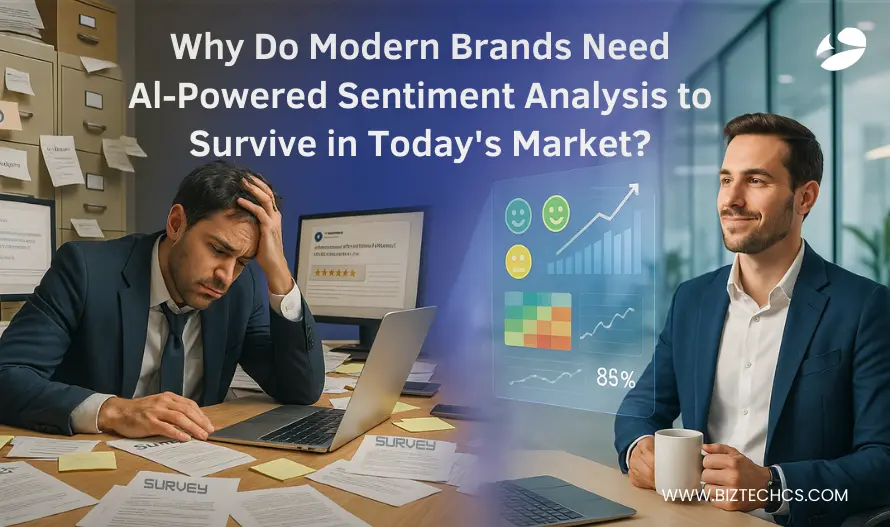
Every single day, businesses wade through a staggering volume of customer data — globally, around 402.74 million terabytes of new data are created each day (source). That’s roughly 400 quintillion bytes — enough to fill millions of Blu-ray discs (or, put differently, enough to bury brands that don’t know how to listen).
Most companies attempt to analyze this treasure trove with the finesse of a blindfolded person trying to solve a Rubik’s Cube. Customer emotions? Those mysterious signals hidden between angry tweets and five-star reviews that many companies pretend to understand while secretly panicking behind closed doors. Enter AI-powered sentiment analysis — the corporate world’s new favorite crystal ball that actually works.
Gone are the days of guessing whether customers love you or just tolerate you like that relative who overstays at Thanksgiving. Real-time sentiment monitoring now tells you exactly when your brand becomes the punchline instead of the hero.
This content dissects how customer sentiment insights transform raw emotion into actionable strategy. You’ll discover how AI-driven brand strategy turns emotional chaos into a competitive advantage.
But here’s what executives often ask first: “What’s the actual ROI of implementing AI sentiment analysis compared to our current feedback systems?”
The answer lies in the numbers — companies using AI-powered sentiment analysis report a 25–40% reduction in customer churn and 30% faster issue resolution times, translating to millions in retained revenue and operational savings. When an AI Development Company implements these systems correctly, the impact compounds even further. When you can predict and prevent customer defection before it happens, the investment pays for itself within the first quarter.
We’ll explore brand-sentiment analysis tools that decode customer feelings faster than a therapist with a PhD. From social-media meltdowns to support-ticket frustrations, we’ll show how smart companies turn emotional intelligence into bottom-line results. Because understanding your audience isn’t just good business anymore — it’s survival.
Feedback techniques that were used over the years have turned out to be similar to asking your ex for advice six months after the breakup in the corporate world. Focus groups yield 50 sparse opinions, while on the side, 50,000 patients take to the internet to express their displeasure. Thus, the slowly moderated discussions become as ineffective as a teapot made of chocolate.
The executive desks receive the survey results, but the competition that listens to customer sentiments in real time has already taken the market by storm, with three new competitors. The huge amounts of unstructured social media data that have emerged make those quarterly surveys look like tablets from the Stone Age.
They capture only about 0.01% of customers’ voices, even though customers have been very vocal in the digital space.
Today’s customers are used to faster brand responses than they are to their morning coffee. However, the majority of companies still analyze feedback as slowly as continental drift. Without intelligent automation powered by modern ai/ml development services, this gap between real-time customer expectations and traditional feedback methods widens even further — and kills brands faster than a viral TikTok exposé.
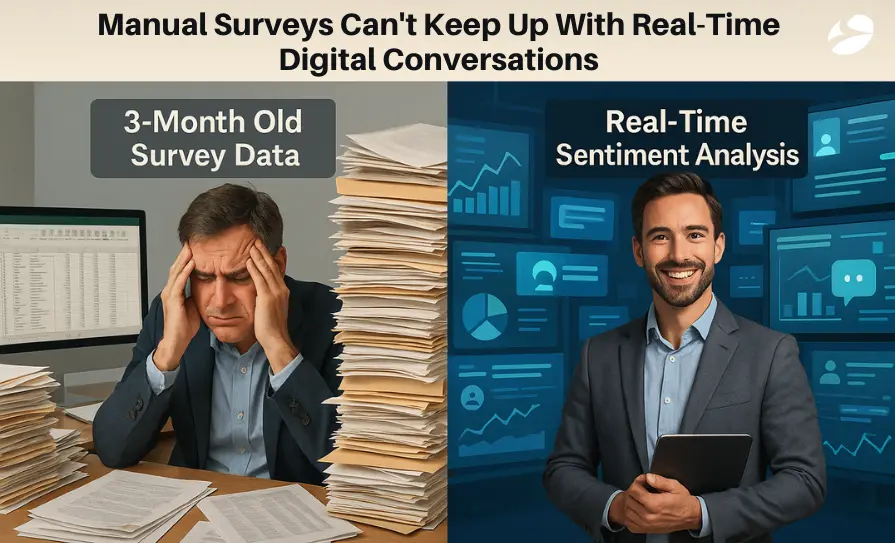
AI sentiment analysis is not replacing older methods just because it is the latest technology. It is phasing them out because it is much more tedious to wait three months to find out that customers are not happy with your new product.
The application of AI sentiment analysis quite literally enables machines to read between the lines better than a coworker who is just passive-aggressive and decodes Slack messages — a capability that has become even more powerful with modern ai/ml development services enhancing accuracy and context understanding.
Both Natural Language Processing and Machine Learning act like a forensic team, dissecting every customer comment. They extract the emotional DNA that humans miss while doing their tenth spreadsheet of the day.
The system detects tones across a range from pure rage to subtler disappointment and even sarcasm. It can catch nuances most humans might miss, like a stealth bomber silently passing overhead at midnight.
Context understanding shows that AI can tell when the phrase “great job” actually means “you’ve ruined everything” based on the surrounding words. Human analysis often misses those cues while drowning in coffee and denial. Spotting trends through pattern recognition is done across millions of data points simultaneously, while human analysts are still arguing over the meaning of a single angry tweet.
Manual analysis can handle up to 100 reviews per day when analysts do not take lunch and do not develop carpal tunnel syndrome. Still, brand sentiment analysis tools will have already digested 100,000 comments before your morning standup ends.
The shift from manual to AI-driven brand strategy is like changing from carrier pigeons to quantum teleportation, only the pigeons were also blindfolded and terrified of heights.
AI sentiment analysis breaks down emotional data in a structured, almost mechanical way—yet what happens behind the scenes is far more fascinating than it looks on the surface.
AI sentiment analysis is like a digital dragon collecting customer opinions from all over the internet and hoarding them. The brand’s data is collected from social media, apps, websites, forums, and news where customers express their emotions about your brand.
BiztechCS team can develop custom data connectors for any platform your brand uses, whether it is mainstream social media or industry-specific forums where your niche customers are complaining in technical jargon.
The algorithms classify comments as positive, negative, or neutral more quickly than a casino would classify winners from losers, with better accuracy. The training model for these systems is to give them millions of examples until they learn that “this product is fire” and “this product is on fire” are different things.
The classification accuracy improves consistently as the system learns from its mistakes, unlike that colleague who never fails to use the reply-all button on corporate emails.
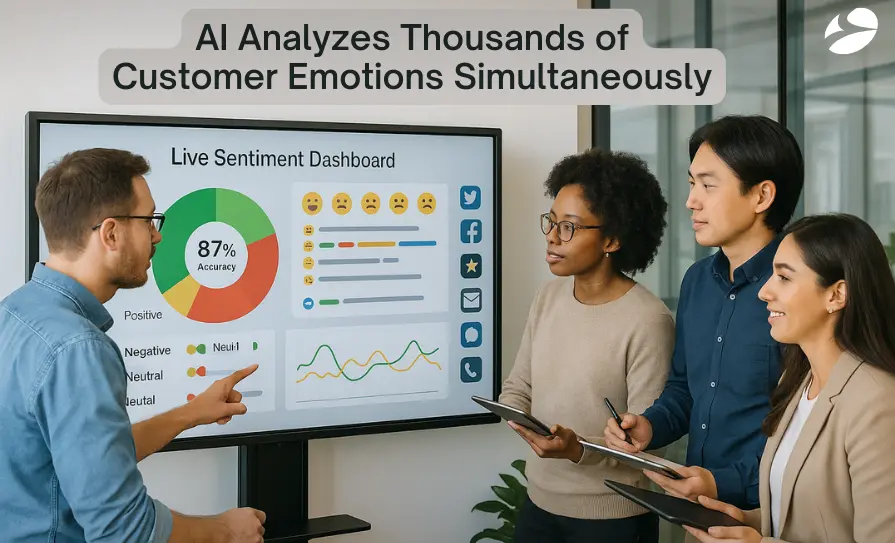
The basic good-or-bad sorting of customer sentiment insights dives deep into the emotional spectrum. It can detect whether customers are so upset they’d rather switch brands or simply mildly annoyed, like someone stuck in traffic.
The system spots delights, surprises, frustrations, and that unique mix of emotions that customers feel when an opponent launches something better.
Through BiztechCS, we can surely build up-to-date emotion detection models that discern subtle differences in customer feedback. They can also recognize the full range of mixed emotions and complex feelings, turning customer psychology into something that resembles quantum physics.
Real-time sentiment monitoring tracks how customer feelings evolve from product launch euphoria to post-purchase regret faster than you can say “buyer’s remorse.” The system correlates sentiment shifts with business events. This reveals whether that marketing campaign generated buzz or simply confused everyone like abstract art at a hardware convention.
These patterns show exactly when sentiment nosedives, usually right after your competitor announces a better feature.
Brand sentiment analysis tools transform raw emotional data into dashboards so clear that even executives who still print emails can understand them at a glance. Alert systems ping teams faster than office gossip when sentiment drops below danger levels, giving you time to respond before the situation becomes a PR nightmare.
C-suite leaders frequently wonder: “How accurate is AI sentiment analysis, and can we trust it for critical business decisions?” Modern AI systems achieve 85-95% accuracy in sentiment classification, significantly outperforming human analysis at scale. The key isn’t perfection but consistency — while humans might achieve 70% accuracy and fatigue after 100 reviews, AI maintains its accuracy across millions of data points, providing reliable trend detection that boards can confidently use for strategic planning.
The visualization makes complex emotional patterns as digestible as a pie chart, except this pie might be thrown at your brand’s face if you ignore the warnings.
Modern brands face an avalanche of customer opinions every minute, and AI sentiment analysis steps in to turn that chaos into clarity before small issues turn into headline-worthy problems.
Real-time sentiment monitoring keeps an eye on your brand’s reputation 24/7, like a paranoid security guard who actually catches problems instead of napping on the job. The system spots reputation threats faster than bad news travels through office WhatsApp groups, alerting teams before one angry customer becomes a viral movement.
Gone are the days when your brand became a meme for all the wrong reasons three days after the internet had already moved on to destroying someone else.
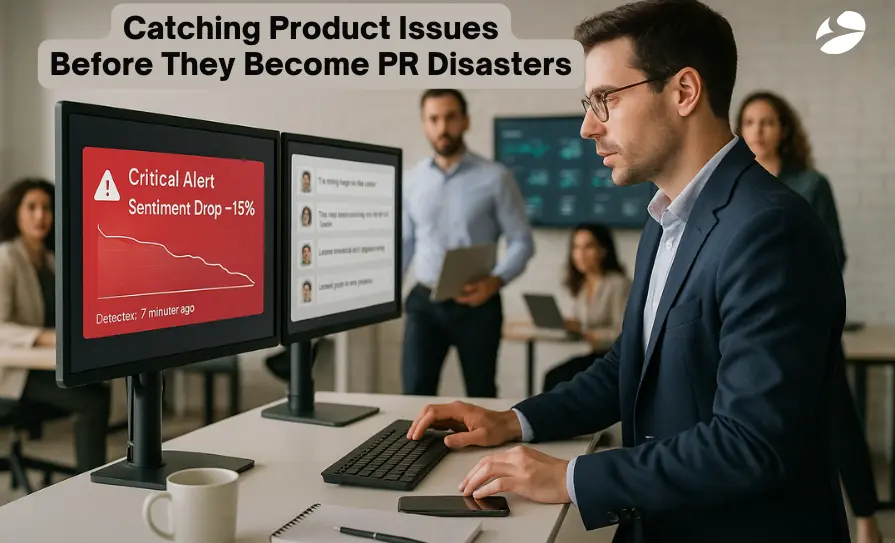
AI-powered sentiment analysis acts like a smoke detector for PR disasters, except it actually works before the whole building burns down. The system identifies brewing crises when they’re still manageable campfires, not California wildfires requiring federal intervention and celebrity fundraisers.
It catches negative sentiment patterns early enough that damage control means fixing the problem, not hiring expensive consultants to explain why the problem wasn’t really your fault.
Is your brand one viral complaint away from becoming tomorrow’s cautionary tale? The difference between a minor issue and a PR nightmare often comes down to response time.
Processing millions of product reviews becomes as easy as breathing, if breathing involved understanding whether customers love your product or just tolerate it like airplane food.
Customer sentiment insights reveal which features customers actually use versus which ones they ignore harder than terms and conditions. The system digests feedback from every channel simultaneously, painting a picture clearer than your competitor’s secretly funded negative review campaign.
Brand sentiment analysis tools legally spy on competitor sentiment, like hiring a private investigator who works at the speed of light and never sleeps. The system tracks how customers feel about rival brands, revealing weaknesses to exploit faster than corporate espionage but without the prison time. This intelligence shows exactly when competitors stumble, giving you the perfect moment to strike while they’re busy explaining their latest scandal.
An ai/ml development services brand strategy determines which displeased customers require immediate attention and which likes are just venting and pose no real threat.
Senior leaders often ask: “How quickly can we see measurable improvements in customer satisfaction scores?” Companies typically observe initial improvements within 2-3 weeks of implementation, with satisfaction scores increasing by 15-20% within the first two months. The immediate impact comes from catching and resolving high-priority issues that previously slipped through manual review processes, while longer-term gains emerge from pattern recognition that helps prevent recurring problems.
The technology assigns emotional intensity to customer service tickets. And when it’s built by an AI Development Company, it can even detect urgency with remarkable accuracy. Hence, the person about to leave the company in anger gets support first, while the one complaining about the font has to wait.
This practice of prioritization protects the company from small issues turning into extensive lawsuits or from being tagged by the public with hashtags trending for all the wrong reasons.
Sentiment analysis can capture the audience’s actual emotions, whether the latest campaign has genuinely sparked excitement or just the usual confusion that comes with modern art exhibitions.
The system monitors individuals’ emotional reactions across different demographics. This uncovers whether your message is too good to be true or is crashing your website harder than during Black Friday sales.
Real data replace the arguing between survival-or-death feelings about the campaign’s success, though sometimes the negative feeling of doom was actually right.
Building an effective sentiment analysis system isn’t about plugging in generic AI—it’s about crafting a solution tailored to your brand’s voice, data ecosystem, and real-world challenges.
The initial assessment starts with understanding your business better than your therapist understands your childhood trauma, except we actually provide solutions instead of just nodding sympathetically.
BiztechCS digs deep into your requirements, studying how your customers communicate their joy, rage, and everything in between across every digital channel you’ve ever ignored. The requirement gathering phase involves mapping your entire customer feedback ecosystem. This ranges from the obvious social media complaints to the passive-aggressive support tickets that keep your team awake at night.
BiztechCS can design a tailored sentiment analysis framework that aligns with your specific industry terminology and customer communication patterns. This works whether your customers speak in technical jargon or emoji hieroglyphics.
We build the foundation strong enough to handle your current chaos and future disasters you haven’t even imagined yet. The framework becomes your emotional intelligence headquarters, processing feelings faster than a speed-dating event at a tech conference.
Cloud-native architecture ensures your AI-powered sentiment analysis rolls out more smoothly than your competitor’s panic when you launch a better product. The microservices approach breaks down the system into manageable pieces that work together like a well-oiled machine. It avoids the chaos of a tech stack held together by prayers and deprecated code.
Each component scales independently, so when Black Friday hits, your system handles the traffic surge while others crash harder than cryptocurrency during a tweet storm. BiztechCS can implement an auto-scaling infrastructure that grows with your data volume, ensuring consistent performance whether you’re analyzing hundreds or millions of mentions.
The architecture adapts to demand spikes faster than employees adapt to return-to-office policies. Real-time sentiment monitoring stays lightning-fast even when half the internet decides to share opinions about your brand simultaneously.
API development transforms your existing systems from isolated islands into a connected continent where customer sentiment insights flow freely between platforms.
A common concern from IT leadership: “Will implementing sentiment analysis require replacing our existing tech stack?” Absolutely not. Modern sentiment analysis solutions are designed to complement, not replace, your current systems. BiztechCS specializes in creating API bridges that seamlessly connect with everything from 20-year-old legacy CRMs to cutting-edge marketing platforms, typically requiring zero changes to your core infrastructure.
The integration works so smoothly that your legacy systems won’t even realize they’ve been dragged into the modern era, like teaching your parents to use smartphones without them noticing.
BiztechCS can integrate sentiment analysis seamlessly with your CRM, marketing automation, and business intelligence tools, creating a unified ecosystem where every platform speaks the same emotional language. Data flows between systems faster than office rumors do, and this information actually helps your business instead of destroying morale.
Your teams access sentiment data wherever they work, eliminating the excuse of not knowing customer feelings. The integration eliminates data silos more effectively than corporate restructuring, but without the layoffs and awkward farewell parties.
Industry-specific model training teaches the AI your sector’s weird language quirks, like knowing that “robust solution” means barely functional in tech-speak. Multi-language support ensures the system understands customer complaints, whether they’re cursing you in English, Spanish, or that special dialect of corporate buzzword bingo.
BiztechCS can develop custom NLP models trained on your industry’s specific vocabulary, ensuring accurate sentiment detection for technical or specialized terms that would confuse generic systems. The models learn your industry’s euphemisms for disaster, understanding when “interesting approach” actually means complete failure. Brand sentiment analysis tools adapt to regional expressions and cultural nuances, catching sarcasm that varies from New York’s brutal honesty to Southern passive-aggressiveness wrapped in sweet tea.
The customization goes deeper than surface-level tweaks, creating an AI-driven brand strategy that speaks your industry’s language fluently while detecting emotions others miss.
From safeguarding brand reputation to reshaping product strategy, sentiment analysis is already powering real business results across industries.
A major retail brand discovered its reputation was tanking faster than a lead balloon when AI-powered sentiment analysis caught 10,000 negative mentions spreading like wildfire across social media in just three hours.
The solution implemented real-time alerts that notified crisis teams before situations escalated from manageable complaints to full-blown boycott movements featuring creative hashtags nobody wants trending.
Results showed a 73% faster response time to negative sentiment, preventing four potential PR disasters and saving approximately $2.3 million in damage-control costs that would’ve gone to crisis management consultants driving Ferraris.
What would preventing just one PR crisis be worth to your brand? Companies using custom sentiment analysis report saving millions in damage control—ROI that makes CFOs actually smile.
One tech AI Development Company adjusted its campaign messaging in real time when customer sentiment insights revealed its “revolutionary” tagline triggered more eye rolls than excitement, scoring -47 in sentiment compared to competitors’ +82.
A/B testing with sentiment feedback showed that changing from corporate jargon to plain English increased positive responses by 156%, proving customers prefer honesty over buzzword bingo. ROI jumped 89% after ditching the tone-deaf messaging that made customers feel like they were being sold snake oil by robots wearing suits.
Real-time sentiment monitoring identified 3,400 feature requests hidden in complaint threads where customers creatively explained what the product should do instead of crashing every Tuesday.
Pain-point discovery revealed that users spent more time working around bugs than using features, leading to a complete redesign that addressed problems rather than adding more broken features on top.
Innovation opportunities emerged from analyzing competitor sentiment, showing precisely what made their customers miserable enough to consider switching, basically providing a roadmap written by the enemy’s own troops.
Business strategists consistently ask: “What if our competitors are also using AI sentiment analysis — how do we maintain our advantage?” The competitive edge comes from implementation speed and depth of customization. While competitors might use generic solutions, custom-trained models understand your specific industry nuances, customer base, and brand voice.
Additionally, the first-mover advantage in sentiment analysis compounds — the earlier you start learning from data, the more sophisticated your predictive capabilities become, creating a widening gap competitors struggle to close.
Brand sentiment analysis tools now route tickets based on emotional intensity, sending the customer threatening legal action to senior agents while the person complaining about button colors gets the intern.
Proactive issue resolution kicks in when sentiment patterns indicate brewing storms, like when multiple customers start using words typically reserved for sailors and divorce lawyers. ai/ml development services prevents 67% of escalations by identifying and addressing issues before customers reach the special level of fury that produces viral LinkedIn posts about terrible service experiences.
AI-powered sentiment analysis transforms businesses from emotionally blind organizations stumbling through customer relationships into mind-reading enterprises that know exactly when customers love them or plot their demise.
The competitive advantage goes to early adopters who understand customer emotions while their rivals still count angry tweets manually like medieval accountants using abacuses. Real-time sentiment monitoring means catching problems before they become case studies in business school textbooks titled “How Not to Run a Company.”
Future advancements promise predictive capabilities that spot customer dissatisfaction before customers even realize they’re unhappy, like having a crystal ball that actually works rather than an expensive desk decoration. Corporate boards often pose the critical question: “What’s the risk of not implementing AI sentiment analysis in the next 12 months?” The risk is quantifiable — businesses without real-time sentiment monitoring lose an average of 23% more customers to competitors who can respond instantly to market sentiment shifts.
In today’s environment, where a single viral complaint can tank stock prices overnight, flying blind without sentiment analysis isn’t just risky — it’s corporate negligence.
The choice becomes simple: adopt an AI Development Company now or watch competitors steal your customers while you’re still reading survey responses from last quarter.
Waiting for the perfect moment to implement customer sentiment insights is unrealistic. It’s like waiting for the perfect moment to install smoke detectors — technically possible but incredibly stupid.
Ready to stop guessing what your customers really think about your brand? Every day without AI-powered sentiment analysis is another day your competitors gain ground on understanding and serving your market better.

Odoo
 27
27

By Uttam Jain
Artificial Intelligence (AI)
101

By Nandeep Barochiya
Artificial Intelligence (AI)
98
By Nandeep Barochiya