
The Evolution of PrintXpand: From an Idea to an Industry Platform
Revolutionize your printing experience with the right digital printing tools at your disposal. Access our fast, customizable, and easy-to-use web to print software solution and boost your printing business sales like never before.

Every powerful product has a backstory, and PrintXpand’s story began inside the everyday chaos of print operations. Customers were frustrated with endless email loops, unclear proofs, and order processes that felt longer than the actual print run.
Print businesses faced overwhelming difficulties because they needed to handle manual work while waiting for approvals and dealing with specifications that changed more frequently than their project deadlines. The production floor experienced inefficiency because workers treated efficiency as a term used only in meetings, not in their actual work.
The real bottleneck in the business operations process, which led to delayed approvals and higher error rates, stemmed from ongoing exchanges between customers and print teams. These repeated interactions also eroded profit margins through the slow accumulation of costs.
That friction pushed a serious question to the front of every discussion. What if customers could design their own products online and submit press-ready files without the usual chaos? The idea presented a bold challenge to standard workflows by requiring organizations to address the discomfort that arises when their current processes are suddenly disrupted.
Recognizing that this shift demanded more than incremental adjustments, we saw the need for a purpose-built solution. It had to support customization, automation, and operational clarity without overwhelming existing systems.
We developed PrintXpand to eliminate movement barriers, establish order in disorganized work environments, and convert unorganized operational processes into effective business systems. What began as a focused solution gradually evolved through real use cases and industry feedback.
In this blog, the evolution of PrintXpand unfolds from its early vision to the platform it is today, and how it continues to solve the print industry’s everyday operational battles.
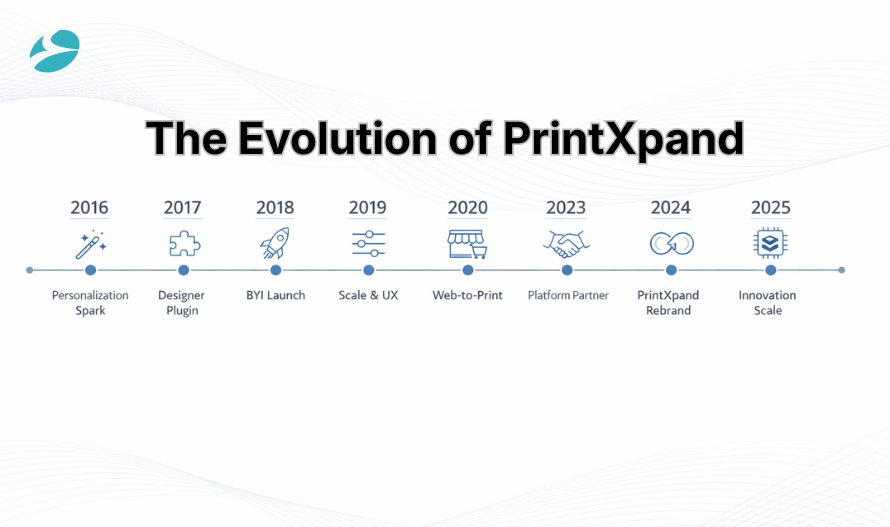
2016: The Spark — Personalization Meets eCommerce
The journey took its first real step in 2016, in the Magento 1 era, when eCommerce customization was still crawling while the industry claimed it was sprinting. A customer approached us with a requirement that sounded neat in presentations but messy in execution.
Shoppers wanted to personalize apparel using their own text and images and order those designs online without endless coordination. At that time, most online stores were selling fixed designs and celebrating them as technological breakthroughs. Personalization existed, but mostly in sales pitches rather than in functioning workflows.
We built a tailored solution aligned with this exact requirement and successfully implemented it for that first customer. The process demanded rigorous testing, workflow adjustments, and operational alignment that stretched beyond comfort zones. But the implementation held its ground in real-time usage, not just in staged demos.
Why did this matter?
- It proved that online product personalization was not a passing trend but a growing expectation.
- It showed that customers valued creative control as much as the final product.
- It exposed how traditional print workflows were unprepared for this behavioral shift.
- It validated that structured web-to-print technology could convert complexity into a revenue opportunity.
That early implementation became more than a delivery milestone. It became the first concrete signal that customers no longer wanted to just buy products off the shelf. They wanted to create them, own them, and quite frankly, they expected the technology to keep up.
2017: From Concept to Product — Advanced Product Designer
2017 marked our shift from a promising concept to a larger product vision. Early traction around customization capabilities made it clear that this space held far greater potential than a limited implementation approach. Recognizing that opportunity was critical.
Under the leadership of Maulik Shah, we set out to build this capability into a structured, scalable product. Our focus expanded from addressing isolated requirements to building a solution that the wider print ecosystem could rely on.
The result was Advanced Product Designer, launched as a Magento 1 plugin. The system enables customers to create customized products in real time within standard eCommerce workflows.
We conducted active market testing for two years, developing product features through close observation of user behavior and incorporating feedback from live environments to continuously enhance performance.
What did this phase reveal to us?
- Customization demand was steady and commercially sound.
- Print businesses were ready to adopt personalization at scale.
- Customer creativity was shaping purchasing decisions in real time.
- Web-to-print technology was evolving from an optional add-on into an operational requirement.
What stood out most was the shift in buyer mindset. Customers were no longer impressed by static catalogues. They expected the freedom to create, modify, and visualize before buying — and that expectation was only growing stronger.
Are your customers still navigating fixed product journeys while the market moves toward real-time personalization and creative control?
Late 2017 – 2018: Birth of Brush Your Ideas (BYI)
The period from late 2017 to early 2018 marked the transition from experimental to dedicated product development. Growing adoption made one thing clear to us. This capability could not remain confined to a single plugin lifecycle.
We transformed it into a dedicated product venture called Brush Your Ideas. The vision expanded from feature delivery to building a long-term customization ecosystem that print businesses could rely on without operational anxiety.
Our focus sharpened across multiple fronts, each driven by real market signals rather than product ambition alone.
Where did we invest our effort?
- Advanced decoration capabilities to support complex design requirements beyond basic text and image placement.
- Migration readiness from Magento 1 to prevent customers from being trapped in aging infrastructure.
- Expanded compatibility with Magento 2 and platforms like WooCommerce, widening adoption across different commerce environments.
- Core architecture restructuring to introduce API support, enabling the product to integrate with diverse business systems and storefronts.
The larger industry signal behind this move
Customization businesses were scaling, but their technology foundations were not keeping pace. They needed a solution that was stable under pressure, flexible across platforms, and capable of supporting long-term operational growth without constant reinvention.
2019: Building for Scale — UX, Pricing & Architecture
2019 became the year when product maturity demanded structural discipline. As Brush Your Ideas gained traction across diverse customization businesses, we began noticing a familiar pattern. Adoption was strong, but expectations for usability were rising just as fast. Scaling customers were no longer satisfied with capability alone.
They wanted clarity, speed, and operational comfort built into the experience. Complex decoration workflows were increasing, and even minor inefficiencies were snowballing into production delays. Support queries were becoming more process-driven than feature-driven, which signaled a deeper usability gap.
The organization needed structural changes to achieve growth because the existing systems operated with insufficient capacity.
Where did we strengthen the foundation?
- A redesigned UI and UX that simplified navigation, reduced learning curves, and made complex decoration workflows feel manageable.
- A clearly defined pricing model that replaced ambiguity with transparency and aligned value with business scale.
- An add-on-driven architecture that allowed businesses to expand capabilities without overloading their core setup.
The operational shift enablement
Print businesses were scaling at different speeds and in different directions. They needed modular solutions that could grow alongside them without dragging unnecessary complexity into daily operations. This evolution ensured the product adapted to business growth rather than forcing businesses to adapt to the product.
It allowed companies to activate capabilities in response to immediate demand rather than committing to oversized systems from day one. Investment planning became more controlled, and operational risk was reduced significantly.
The main advantage for organizations that wanted to grow their customized services was that they could do so without interrupting their current manufacturing processes.
2020: A Turning Point — COVID and the Web-to-Print Leap
The year 2020 brought an unexpected turning point, which required everyone to adjust their plans. The COVID pandemic forced traditional print operations to shut down, causing physical storefronts to halt operations instantly and manual order processing to become unstable.
Walk-in orders disappeared, approvals stalled, and production pipelines began running on uncertainty instead of schedules. The urgency for digital transformation was no longer strategic planning material. It was survival math.
We saw print businesses scrambling to move sales online while still managing customization, proofs, and production workflows behind the scenes. Isolated tools were not enough in that environment. To address this, we launched a web-to-print storefront tightly integrated with Brush Your Ideas, connecting product design, online ordering, and backend order management into one continuous system.
Bringing storefronts, tools, and workflows into one system reduced fragmentation and minimized manual coordination. The combined ecosystem did not just support online selling. It stabilized operations during one of the most unpredictable business phases the industry had faced.
What did this shift signal for the industry?
- Standalone customization tools were no longer sufficient for evolving print operations.
- Print businesses needed fully functional online storefronts, not just design interfaces.
- Automated workflows became critical for managing orders without manual dependencies.
- Integrated systems were required to connect design, ordering, and production into a single flow.
- Operational continuity had to be maintained even when physical sales channels shut down.
2023: Expanding the Vision — Beyond Tools to Partnership
2023 marked another strategic shift in our journey. As our customers scaled their customization operations, the conversations began changing in tone and depth. They were no longer asking only about features or integrations.
They were asking how to streamline fulfillment, reduce operational gaps, and future-proof their digital investments. It became evident that print businesses were no longer looking for isolated solutions. They were looking for long-term technology alignment.
In early 2023, we expanded our vision beyond product capabilities and positioned ourselves as an end-to-end technology partner for print businesses. This shift was deliberate and grounded in years of implementation insight.
How did this translate into action?
- Launch of our Print on Demand solution in late 2023, enabling businesses to manage on-demand production with structured workflows and centralized control.
- Companies should implement advanced automation across their order processing systems, design validation processes, and backend operations to minimize the need for human workers.
- The architects developed system improvements to enable their business operations to handle increasing demands for flexibility while maintaining continuous efficiency.
The larger industry movement behind this evolution
The print industry was steadily transitioning toward platform-driven and integrated ecosystems. Businesses needed a connected infrastructure that aligned storefronts, customization tools, production workflows, and fulfillment under a single strategic framework rather than scattered technology components.
2024: Reimagining the Brand — Brush Your Ideas Becomes PrintXpand
2024 became the year when our identity finally caught up with our ambition. The name Brush Your Ideas did not suit our growing product range and deeper customer connections. The product that started as a customization solution has developed into a complete technology framework that supports various print business operations.
A new mission required a brand that could convey its purpose clearly, without the need for further explanation.
The company adopted the name PrintXpand in early 2024 as our new brand, which represents business growth and market presence rather than a single operational aspect. The transition was not cosmetic. It signaled the formal arrival of a platform built to support the end-to-end digital print business model.
Key milestones that shaped this phase
- The launch of PrintERP enables businesses to create customized print management solutions that include all aspects of their production process, inventory control, and operational monitoring needs.
- The platform provides enhanced business support for print companies that operate both direct-to-consumer and business-to-business print markets through its unified system, which supports multiple sales channels.
The industry reality driving this transformation
Print businesses needed tools that could expand their operations beyond their current, disconnected tools, which forced them to create temporary solutions. The organization required a single system to manage all aspects of its operations including customization, storefronts, production management, and order processing.
2025: Advancing the Platform — Innovation at Scale
PrintXpand transformed from a platform into a complete print commerce ecosystem in 2025. By this stage, customer expectations had evolved far beyond basic customization and storefront enablement.
Print businesses were managing complex supplier networks, multi-segment buyers, and experience-led purchasing journeys. Standing still was not an option, and incremental upgrades would not have carried the weight of industry demand.
Our focus shifted to innovation that could operate at scale while remaining commercially practical.
Where has the platform advanced?
- The promotional products industry needs supplier integrations that enable companies to easily obtain products while maintaining synchronized product catalogs.
- The advanced workflows for B2B and B2C operations enable businesses to implement different pricing models and manage approval processes alongside their bulk order requirements.
- Expansion of the Product Designer into 3D, AR, and AI-powered previews, and support for multiple printing methods across product categories.
Headless Commerce as a Competitive Differentiator
We launched Headless Web-to-Print storefronts for both B2C and B2B environments as part of our commitment to delivering faster, more flexible, and experience-driven buying journeys.
By decoupling the front end from the core commerce engine, we enabled businesses to build highly personalized digital storefronts while also strengthening SEO performance and improving digital discoverability across channels.
This move was shaped by the competitive reality we were seeing across the industry. Print businesses were no longer competing solely on price sheets. Speed, customer experience, automation depth, and digital buying convenience have become the primary differentiators in winning and retaining business.
With a headless approach, we empowered our customers to innovate at scale—launching agile, high-performing commerce experiences without compromising operational efficiency.
Today: PrintXpand
PrintXpand provides businesses with its complete print commerce platform, which serves multiple industries, including Apparel, Promotional Products, Commercial Print, and Packaging. The company developed its custom business solution into an integrated system that manages all aspects of digital print production.
The platform provides businesses with tools to create personalized products through web-to-print storefronts that link to print-on-demand services, enterprise resource planning systems, and automated workflows, helping them operate their online sales, production, and business growth processes without interruptions.
More importantly, this evolution has been shaped by real industry challenges rather than theoretical product roadmaps. Every capability has been refined through live implementations, customer feedback, and shifting market expectations.
The objective has remained consistent. Help print businesses move faster, operate with clarity, and expand without technological bottlenecks. And like the industry it continues to serve, PrintXpand remains in motion, adapting, advancing, and preparing for what the next phase of print commerce demands.
If your print operations are gearing up for their next phase of growth, the technology behind them should evolve just as fast. The right platform can define how far—and how efficiently—you scale.