
Custom AI Chatbot Development: How It Works, What It Costs & When to Build One

 5 min read
5 min read
$41B
Projected global conversational AI market by 2030 (Grand View Research, 2025)
74%
Frontline employees now regularly using generative AI, up 20+ points in two years (BCG, AI at Work, 2026)
280x
Drop in LLM inference cost for GPT-3.5-level performance since 2022 (Stanford HAI, 2025)
Almost every guide to custom AI chatbot development is written by someone who sells custom builds, which is why they all conclude that you should build. So here’s the opposite end of that argument. Most businesses should not build a custom chatbot. They should rent one off the shelf, and only reach for a custom build when a real limit forces the issue.
That’s the honest frame this whole piece is built on. Below is how a custom chatbot actually works under the hood, what it really costs, and, most importantly, how to tell whether your situation is one of the few that genuinely calls for a custom AI chatbot rather than a subscription. BiztechCS builds these systems, so this guide is candid about when not to build one.
A modern chatbot isn’t one thing. It’s a stack of layers, and understanding them is what makes the cost and the build-versus-buy question make sense.
At the front is the channel, the place where the conversation actually happens. That might be a website widget, a WhatsApp thread, or something baked right into your own product. Behind it sits the language layer, and this is where the last few years changed everything. Older bots were intent-based, meaning you hand-wrote every intent and every scripted reply and then spent your life maintaining lists of phrases the bot might hear. A modern chatbot leans on a large language model instead, so it can handle a question nobody thought to script.
The layer that matters most is retrieval. Left alone, a language model will answer confidently from thin air, so a serious chatbot is grounded in your own material through retrieval-augmented generation, or RAG. Before it replies, it goes and pulls the relevant facts out of your documents and systems and answers from those. That grounding is the single biggest defense against a bot inventing a policy you don’t have. Around it sit the pieces that make it usable in the real world. Integrations let the bot actually do things in your CRM or order system instead of only talking about them. Guardrails block unsafe or off-limits answers. And the moment it’s out of its depth, it hands off to a human cleanly, with the whole conversation carried across so nobody has to start over.
To make that concrete, picture a customer asking to change the delivery address on an order. A grounded, integrated chatbot recognizes the request and checks who’s asking. It looks up the real order through an integration, confirms the change is still allowed, and makes it. Anything looks off, and it hands over to a person instead. A scripted bot, by contrast, would offer a menu and hope. The gulf between those two experiences lives almost entirely in the retrieval and integration layers, not in the chat window everyone actually sees.
It’s also worth knowing the four rough generations of this technology, because vendors blur them. A rule-based bot follows a decision tree and breaks the moment you step off the script. An NLU bot understands natural language and handles context. A generative bot writes fluent, flexible replies. And an agentic one goes further still, reasoning and taking action across systems rather than only conversing. Most good business deployments today are a deliberate hybrid: strict rules for the predictable, precise tasks, and the model for everything ambiguous.
Chatbot development cost is genuinely all over the map, because a “chatbot” can mean a $99-a-month widget or a half-million-dollar platform. The honest way to think about it is buy versus build.
Buying off the shelf is cheap to start. Simple tools run from tens of dollars a month, and even capable SaaS platforms sit in the hundreds to a few thousand a month, depending on your tier, with some now charging per resolved conversation rather than a flat fee. Building custom is a different order of commitment. The range stretches from a few thousand dollars for a basic FAQ bot right up to well into six figures for a deeply integrated or agentic system, with a grounded RAG assistant sitting somewhere in between (the ladder below lays out the tiers). A realistic figure for a proper custom build is somewhere around $90,000 to $250,000 in the first year, spread over three to six months.
Two things quietly move that number. Integrations are the big one, since every connection into a live system adds real work and can push a budget up by a third or more, and compliance requirements do the same. The other is the part people forget: chatbot development cost is never a one-time hit. A bot needs monitoring and the occasional retrain, and its content has to be kept current every month, because one left alone slowly rots. One piece of good news, though, is that the price of the underlying model calls has dropped enormously, over 280-fold in two years, which has made custom builds meaningfully more affordable than they were.
So how do the two paths compare over time? Buying is cheaper for the first year or so, often markedly. But subscription and per-conversation fees keep compounding every month, while a custom build is mostly a one-off cost plus that upkeep. Somewhere between six and twelve months of decent volume the two lines usually cross, and past a couple of years a system you own tends to be the cheaper one. That crossover point, not the sticker price on day one, is the number that should really drive the decision.
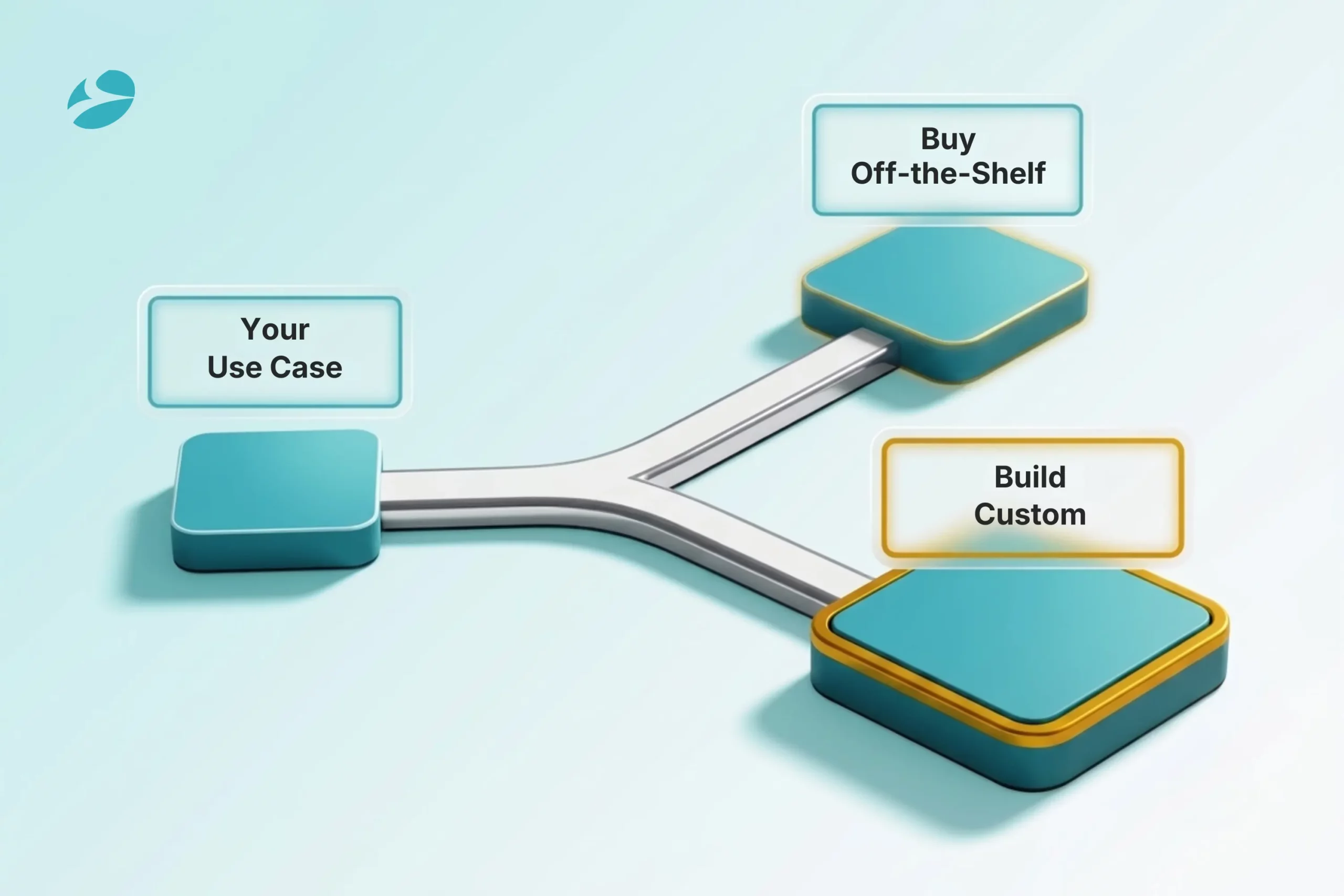
Here’s the decision, stated plainly. Buy off the shelf when your need is standard, a support FAQ, a booking assistant, the kind of thing platforms have already solved by training on millions of examples. Buy when you want it live in weeks, when your volume is modest, and when the chatbot is a helpful feature rather than the thing that sets you apart.
Build custom when the chatbot is genuinely core to your business, when it has to reach deep into several internal systems and take real actions, when it must be grounded in proprietary data, when privacy or compliance rules out sending your data through someone else’s platform, or when you need full control of the experience. And do not build custom just because building feels more serious. If a subscription tool would cover you, a subscription tool is the right answer, and a firm that won’t tell you so isn’t advising you.
Now the part that actually decides it, because the economics shifted under everyone’s feet. Model prices fell hard, which made the build cheaper, while the platforms moved toward charging per resolved conversation, which makes renting quietly more expensive as you grow. Put those together and the real trigger to build isn’t a feeling about control. It’s math. When your monthly bill for resolutions, or the ceiling on how deeply a platform will integrate, has turned the off-the-shelf option into the pricier one, that’s your signal. The smart path for most companies is to prove the idea on a platform first, learn exactly what you need, and build custom only once the volume and the integration depth make the numbers say so.
If you’re not sure where you sit on that line, that’s exactly the sort of question a good generative AI development services partner should answer with numbers rather than enthusiasm. The honest ones will happily model your conversation volume, your integration needs, and your break-even, and then tell you to stay on a platform if that’s genuinely what the math says.
The biggest risk isn’t technical, it’s over-building: commissioning a six-figure system when a hundred-dollar tool would have quietly done the job. Because buying and building often show similar first-year returns, a custom build only really pays off later and at scale, so if you can’t see that scale coming, don’t spend for it yet.
The next risk is the ongoing cost nobody quotes you. Content upkeep, evaluation, retraining, and monitoring add up, and they dwarf the “build it once” picture people carry in their heads. Then there’s hallucination: a generative bot without proper grounding will state things that simply aren’t true, which is a brand and legal problem, not a quirk, and the fix is the RAG and guardrails described earlier. And finally, measure honestly. Service teams currently say AI resolves roughly 30% of customer service cases without a human, and expect that to reach 50% by 2027; the higher containment numbers some vendors advertise today take heavy grounding and constant evaluation to get anywhere close to that projection. If nobody is tracking real deflection against real cost, you don’t have a result, you have a demo.
One quieter risk sits on the buy side, too: lock-in. A platform that looks cheap today can put its prices up, or swap the model underneath you, or simply shut down. Lifting a mature chatbot off it is rarely painless. That’s a fair reason to keep your content and your data portable whichever path you pick, so the decision stays yours later rather than the vendor’s.
1
Buy when your use case is standard and you want it live fast. Build when the chatbot is genuinely core to your business, or has to reach deep into your systems, or has to run on private data you can’t send elsewhere. For most companies the smart move is to prove it on a platform first, then build custom only once the volume or the integration depth makes the numbers favor it.
2
RAG, or retrieval-augmented generation, grounds the model in your own content so it answers from your actual documents and data rather than making things up. It’s the single most important safeguard against a chatbot confidently inventing wrong answers, which is exactly why any serious custom build uses it.
3
A straightforward build can be a few weeks. A proper custom AI chatbot with real integrations and grounding usually takes three to six months to reach production. What sets that timeline is never the model. It’s the integration work and the data cleanup behind it, plus the testing it takes before you can trust the thing in front of real customers.