
 11
11
How to Choose the Right Odoo Development Company for Your Project
 5 min read
68%
Of ERP implementations fail to meet their stated objectives, with budget overruns averaging 215% of initial estimates
$10.6M
Average financial cost of a failed ERP implementation, before accounting for lost productivity and competitive setback
70-80%
Of your total Odoo investment occurs after the initial contract: implementation, customization, training, support, and version upgrades
98%
Client retention rate at BiztechCS across 19+ years of Odoo development and implementation engagements
Finding an Odoo development company takes five minutes. You’ll have a shortlist by lunch. Finding the right one is where most companies spend months and still get it wrong.
Every agency has certifications, a portfolio deck, and a line about end-to-end Odoo development services. The options aren’t the problem. Most buyers evaluate on the wrong things: a website, a partner badge, a PDF case study from three years ago.
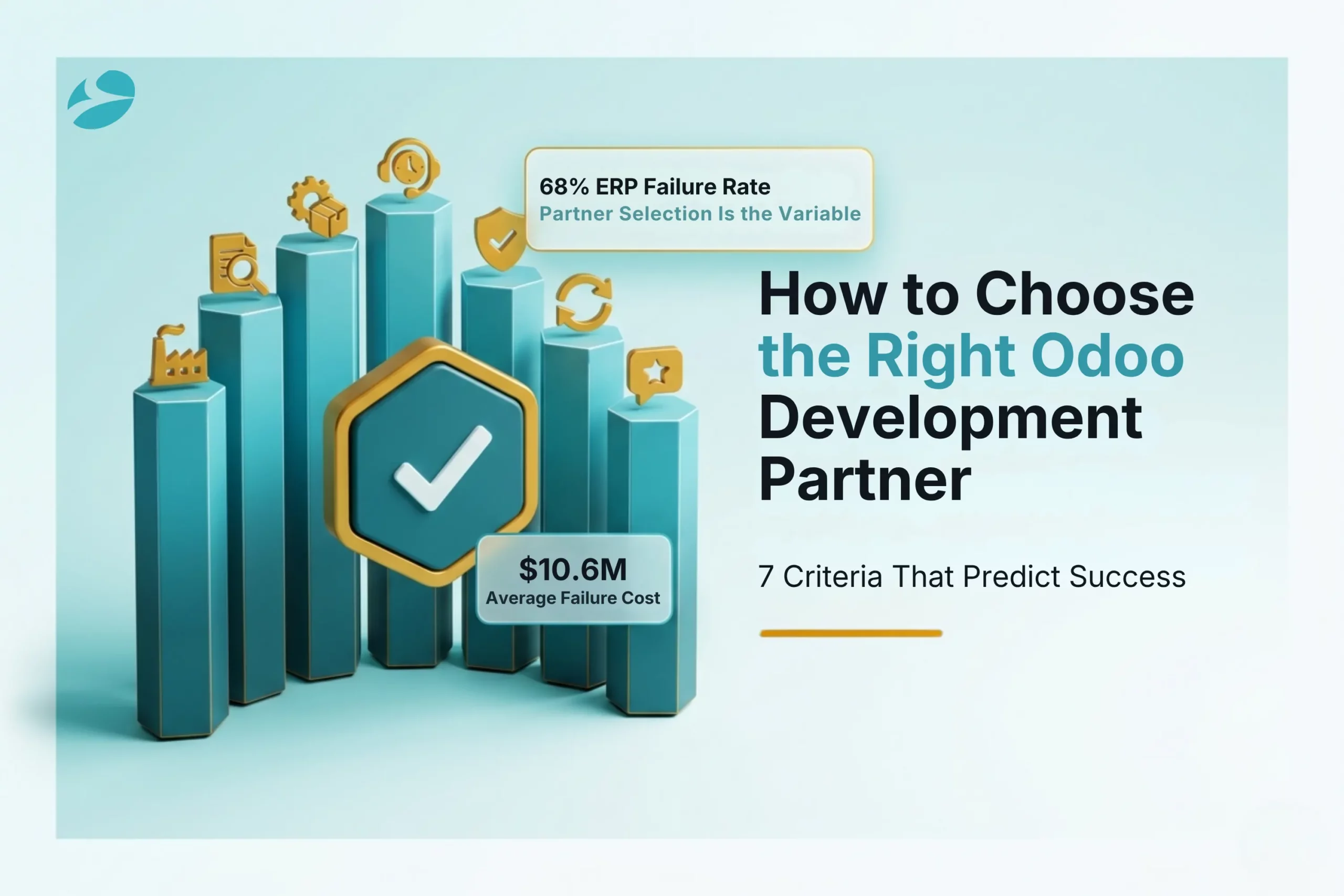
68% of ERP implementations fail to meet their stated objectives, with budget overruns averaging 215% of initial estimates. When things go badly wrong, the financial damage averages $10.6 million — before lost productivity. In most cases, it traces back to the partner. Not the platform. The team running it.
Whether you’re looking to hire Odoo developers for a targeted module build or bring in a full implementation partner for a company-wide rollout, this guide gives you a practical framework for making that evaluation correctly — before you’ve committed to anyone.
By the time you’re comparing Odoo development companies, the platform decision is largely settled. Odoo is a mature ERP with 12 million users across more than 100 countries. It will handle what you need it to handle.
The real question is who deploys it.
Two companies can run identical Odoo configurations and end up with completely different outcomes based on which Odoo implementation partner did the work. One gets a system that fits their workflows. The other ends up with manual workarounds on three core processes, a six-month cleanup backlog, and no clear path to fixing it. Same software. Different results.
There’s a cost structure most buyers miss too. 70-80% of your total Odoo investment occurs after the initial contract: implementation, Odoo customization work, user training, adoption support, and version upgrades. The partner who looks cheapest at proposal time often becomes the most expensive decision you make over a five-year horizon. That’s not a coincidence.
The tier system is real. Most buyers just don’t know how to read it.
Odoo’s official partner program runs four levels: Ready, Silver, Gold, and Enterprise. A Ready Partner holds at least one certified employee and activates a minimum of 10 new Odoo Enterprise users per year. Gold requires an 80% client retention rate, 6 or more certified employees, and at least 300 new activations annually. Tiers are reviewed quarterly — partners who fall short lose their designation, account manager access, and commercial benefits. It’s not a badge you earn once and keep.
The tier system isn’t a perfect quality proxy, but it’s measurable. A company that has maintained Ready or Gold status for nine consecutive years has passed a very different ongoing test than an agency that picked up certification last quarter. That’s not just a credential. That’s nine years of quarterly review.
When evaluating any Odoo development company, ask directly: how long have you held your current tier, and how many certified Odoo employees are on staff today? A partner with 25 certified experts and nine consecutive years of tier status is a categorically different engagement from a general IT shop that picked up an Odoo badge last year.
Most articles about choosing an Odoo development company run through generic vendor criteria: experience, portfolio, communication, support. Those aren’t wrong. But they’re not specific enough to separate a partner who delivers from one who quietly becomes a costly, slow-moving problem.
Here’s what actually predicts outcomes.
General Odoo experience and relevant industry experience are not the same thing. Not even close.
If you run a manufacturing business, a partner with 200 manufacturing deployments has already hit the BOM and production scheduling problems you’re about to face. A generalist with 30 retail projects hasn’t. That difference shows up in the first month.
Before scoping anything, ask them to walk you through two implementations in your industry. What were the hardest workflow problems? How did they solve them? Push for specifics — not “we optimized their procurement process” but what the actual problem was and exactly what changed. If they can answer that without hesitation, they’ve done this before.
How a partner handles discovery tells you almost everything about how they’ll handle delivery.
A reputable Odoo implementation partner won’t quote a fixed price from a two-paragraph email. They ask for process maps, system exports, and meetings with your department leads before scoping anything. Their discovery phase is an investment in accuracy — and in building a number they’ll actually stand behind. Partners who quote fast are quoting low. They’ll recover the margin through change orders.
Ask to see their discovery process in detail. How long does it run? Who participates on their side? What does the output look like? A solid answer includes a statement of work with functional scope, acceptance criteria per module, and a defined change-control process. No discovery doc means no accountability structure later.
Not every Odoo development company can write custom modules. Some are configurators — they implement standard modules and adjust settings. Others have senior Odoo developers who build custom modules, extend the ORM, and integrate with the external systems your business depends on. These are genuinely different capabilities, and the gap between them matters.
Know which one you need. Standard workflows can be handled well by a configuration-first partner. Unique workflows, legacy system integrations, and compliance-driven data handling typically require real custom development. And you usually can’t tell the difference from a sales call alone.
Ask what percentage of their projects involve custom module development versus configuration only. Then ask for a description of custom work they’ve built — not screenshots, but an explanation of what the business needed and why no ready-made module handled it.
Most of the real work starts after go-live. Bugs you couldn’t anticipate in testing show up once actual users run actual transactions. Training gaps appear. Processes need adjusting. And Odoo releases a major version every year, which means upgrade decisions keep coming.
Ask every candidate to describe their post-go-live model. Retainer or ticket-based? What’s the SLA for a production issue that breaks a core workflow? How do they handle major version upgrades for clients running custom modules?
If their answer is a generic helpdesk inbox from day one, that’s not support. That’s a handoff. The people who built your system should still be reachable six months later when something breaks in production. Most aren’t.
Most buyers focus on Odoo features and skip this entirely. Your Odoo deployment will hold financial records, HR data, customer information, and operational data. The security posture of the company accessing your system matters — a lot.
ISO 27001 is the standard that counts here. A certified Odoo development company has passed an independent audit of its information security management systems. Most Odoo companies don’t hold it. Ask before you bring sensitive operational data into their project scope. This question alone will narrow the field fast.
Odoo releases a major version every year. A partner who builds heavy customization without an upgrade path plan becomes a long-term liability you’ll end up stuck on an old version when your business needs to move forward.
Ask how they handle version upgrades for existing clients. What’s the process? What does it typically cost? How many of their current clients are running the most recent Odoo version? Vague answers here tend to show up as real problems two years after go-live.
Ask for two or three client references in your industry with a similar project scope. When you call them, don’t ask for a testimonial. Ask specific questions: did the project come in on time and on budget, did the partner surface scope surprises early, and how responsive is support today — not at go-live, but two or three years later?
A strong Odoo development company connects you to references without hesitation. One that only offers contacts from projects that finished last month is usually telling you something without saying it outright.
None of these are automatic deal-breakers. But each one warrants a direct conversation before you sign.
Quoting before asking questions. Fixed-price Odoo development services based on a two-paragraph brief almost always means underquoting to win the deal, then recovering the margin through change orders. The initial budget advantage disappears fast.
No dedicated project manager on their side. Implementations need a single point of accountability. If all project communication routes through a shared inbox or a junior account executive, ask who is actually accountable for delivery when something goes wrong. Get a name.
Offshore team bait-and-switch. Some companies sell you a relationship with a senior team and deliver through a low-cost offshore team you never meet. Meet the actual people who will build your system before you sign anything.
Vague about version upgrades. If the conversation about upgrade planning makes them uncomfortable, that’s information. Partners who haven’t thought this through leave clients stranded on old Odoo versions.
Can’t describe a past failure. Every serious Odoo implementation partner has had a project run over schedule or hit a go-live issue. A company that says their projects always go smoothly either hasn’t done enough of them or isn’t being straight with you.
Use these in every evaluation conversation, whether you’re looking to hire Odoo developers for a specific module build or engage a full implementation partner:
If the answers are specific — with numbers, names, and real examples — you’re in the right conversation. If they’re general, expect the engagement to match.
Here’s what the better end of the market actually looks like.
A serious Odoo implementation partner starts with two to four weeks of structured discovery. Not a kickoff call. Actual workshops with your team, process mapping of your current workflows, and a gap analysis of where standard Odoo fits versus where custom development or Odoo customization is needed. The output is a documented statement of work: clear scope, realistic timeline, acceptance criteria per module. No verbal briefings, no assumptions carried forward. No discovery doc means no accountability structure later.
The build runs in phases. A serious partner shows you working software early — not after six months of development — so misalignments surface before they compound. Each phase has a demo and a sign-off. That’s how scope stays under control.
Go-live includes hands-on training and a hypercare period (typically two to four weeks) where the team is on short notice for production issues.
Post-go-live support is scoped separately, with a clear retainer or defined support hours per month. Not “reach out any time.”
If the company you’re evaluating doesn’t work this way, ask why. Some departures are legitimate. Most aren’t.
Odoo
 14
14

By Uttam Jain
Artificial Intelligence (AI)
Development
45

By Nandeep Barochiya
Odoo
65
By Uttam Jain