

Machine Learning App Development: Common Challenges and How Experts Solve Them
 5 min read
5 min read
60%
Of AI projects will be abandoned through 2026 when not supported by AI-ready data, the primary failure driver that connects every challenge in this article, from data quality gaps and team misalignment to integration failures and undefined success metrics
80%
Of machine learning engineering effort is spent on data preparation, cleaning, and validation, not model development, making data infrastructure the primary cost driver and the most common cause of project delays for teams that did not audit their data before sprint one
78%
Of organizations are using AI in at least one business function as of 2025, but the gap between piloting and full production deployment remains wide, most ML initiatives stall between working prototype and scalable system, reinforcing the need for production-first development practices
$390.9B
Global AI market size in 2025, projected to reach $3.5 trillion by 2033, the opportunity is substantial, but only for organizations that deploy ML applications that actually reach production and sustain performance over time
Most teams who set out to build ML-powered applications start from the right place, a real business problem, a dataset that looks usable, and a clear outcome in mind. The problem is not motivation or intent. It is that machine learning app development has a consistent gap between “it works in the demo” and “it works in production” that most project plans do not account for.
Gartner predicts that through 2026, 60% of AI projects will be abandoned when not supported by AI-ready data, the primary failure driver this article addresses. Not because the models were wrong. The models that do not ship fail for reasons that have very little to do with model performance: data that looked sufficient but was not, team structures that created handoff gaps at integration time, integration assumptions that did not hold, and success metrics that were defined after the model was already trained.
This guide covers the five challenges that actually cause ML projects to stall, not the ones that sound technical in a pitch deck, but the ones that show up in the second sprint and the sixth month. For each, we describe how experienced teams identify the problem early and structure around it before it becomes expensive.
This failure rate is not a fluke. It has held up across industry surveys even as tooling has improved, frameworks have matured, and ML talent has become more widely available. Better tools have not solved the underlying problems because the underlying problems are not tool problems.
Three patterns account for most failures:
The first is that teams treat data readiness as something they can verify in a week. They check that a database exists and contains the right tables, confirm that it can be exported, and declare the data situation fine. What they miss is whether the historical record actually captures the decision they are trying to model, whether the labels are reliable, whether edge cases are represented, whether the data is recent enough to reflect current patterns. A dataset that looks complete can teach a model the wrong thing entirely.
The second is team structure. Machine learning app development requires three distinct skill sets, data engineers who design and maintain the pipelines that move data from source systems to the model and back, ML engineers who train and validate models, and domain experts who can assess whether the model’s output makes sense in the business context. Most organizations have one of these clearly, a partial version of a second, and hope for the third. The gaps show up at integration time and during production validation, when there is no one who can answer both “is this technically correct?” and “does this make operational sense?”
The third is integration assumptions. ML teams often scope their work from the data side, not the system side. The model gets built against a static export from a database, and only later does the team discover that serving real-time predictions through the existing architecture requires an API redesign, a new data pipeline, and changes to a legacy system that has not been touched in years. None of these failures are dramatic. They are slow-moving and expensive, which makes them harder to catch before they compound.
Industry surveys consistently put data preparation at 70–80% of ML engineering effort. The remaining 20–30% is the model work, architecture selection, training, evaluation, hyperparameter tuning. This ratio surprises teams who budget based on what they think they are building (a model) rather than what they are actually building (a reliable data pipeline that feeds a model).
The data problem breaks down into three components that each require distinct work.
Volume is the most discussed and the least nuanced. Teams ask “do we have enough data?” but do not define “enough” relative to the complexity of the pattern they are trying to model. A straightforward binary classification on tabular data might train adequately with 10,000 records. A computer vision model for quality inspection might need 50,000 labeled images per defect class. The right volume is problem-dependent, and the answer matters before the project starts, not after sprint two.
Quality is more insidious. Noisy labels, records where the outcome is mislabeled, timestamped incorrectly, or recorded inconsistently across different source systems, teach the model the wrong pattern. A model trained on dirty data achieves good evaluation metrics on the training distribution and fails on real inputs. The failure is silent: the model returns confident predictions that are wrong in ways that do not surface until production.
Coverage determines whether the model generalizes. A fraud detection model trained on historical data from 2022–2024 has never seen the fraud patterns that emerged in late 2025. A churn prediction model trained during an aggressive growth phase has no signal for behavior during a retention period. Models that underperform in production often were not trained on the distribution they would see after launch, and no amount of architecture tuning fixes a coverage problem.
Expert teams treat data as a first-class engineering problem: dedicated data audit before project kickoff, data engineers building and validating pipelines in sprint one, and a clear feasibility gate before model training starts.
Machine learning app development is not a single discipline. It needs data engineers (who design and maintain the pipelines that move data from source systems to the model and back), ML engineers (who train, evaluate, and optimize models), and domain experts (who can validate whether the model’s outputs reflect real-world reasoning). These are distinct skills, and they overlap less than most project plans assume.
In practice, most organizations have at most two of these clearly covered. A pattern we see often: the ML engineer is strong, domain knowledge is available internally but not formalized as part of the project team, and the data engineering capacity is not there at the scale the project needs.
The gaps show up in specific, predictable places. When the model is ready for evaluation and no one on the team can assess whether its error patterns are acceptable in the business context, the project pauses while that question gets escalated and answered. When the model needs to be integrated into a live system and the data pipeline that fed training does not translate cleanly to production inference, the timeline stretches by weeks. When domain experts review model outputs post-launch and flag predictions that look statistically reasonable but are operationally nonsensical, retraining is required.
The solution is not to hire all three roles for every project, it is to map the gaps explicitly before the project starts and plan for augmentation. External ML specialists can cover the model engineering gaps. A data engineer embedded in the project from sprint one prevents the pipeline handoff problems. Domain expert review cycles built into every sprint catch output issues before they compound.
ML models are typically developed against static datasets in local environments or cloud notebooks. The development workflow is clean and controlled: load the data, train the model, evaluate on a held-out test set, iterate. What this workflow does not build is the infrastructure that serves the model in production.
A production ML application needs real-time inference endpoints (the model needs to respond to live requests, not batch jobs run overnight), version control for model artifacts (so rollback is possible if a newly trained model underperforms), monitoring hooks (to track prediction distributions and flag drift), and API contracts with upstream systems that may be constrained or deprecated independently of the model.
Legacy systems add another layer. A CRM that can export historical data as a CSV every 24 hours is not the same as a system that can stream feature data to a model inference endpoint in real time. An ERP with batch-processing architecture creates different integration constraints than a microservices-based platform. Teams that model the data without modeling the system architecture discover these constraints at integration time, when the cost of adjusting is highest.
Production-ready ML teams build the deployment infrastructure before the model achieves its final performance level. API design, logging infrastructure, containerized inference, and integration points are part of sprint one. The model improves in subsequent sprints. The production plumbing does not get rebuilt each time the model changes.
Accuracy is the most commonly reported model metric and one of the least informative ones for business applications. A fraud detection model that labels every transaction as “not fraud” achieves 99% accuracy on a dataset where 99% of transactions are legitimate. By accuracy alone, it looks like a strong model. It catches zero fraud.
The failure mode is common: teams optimize for the metric that is easy to compute rather than the metric that reflects the decision the model is making. Precision (of everything the model predicted positive, how many were actually positive?) and recall (of everything that was actually positive, how many did the model catch?) matter differently depending on the cost of false positives versus false negatives. A model for medical pre-screening has a very different acceptable recall threshold than a model for marketing outreach prioritization.
Beyond statistical metrics, there is the question of business lift: does the model’s output actually improve the decision it is meant to support? A churn model that correctly identifies 75% of churners only matters if the retention team acts on the output and those customers have a higher retention rate than they would have had without the model. If the business process does not change, even a technically excellent ML model produces no measurable outcome.
Expert teams define the success metric before writing a line of model code. What is the minimum precision the business will accept? What recall is operationally required? What lift over the current baseline, a simple rule, a human judgment call, a statistical heuristic, makes the model worth the operational overhead it creates? Getting these answers first makes the evaluation framework useful rather than decorative.
Deployment is not the end of the project. It is the beginning of the maintenance problem.
A model trained on data from a specific time window learns the patterns that existed during that window. Customer behavior changes. Product catalogs evolve. Fraud tactics shift. Seasonality disrupts historical baselines. The relationship between inputs and the correct output, what ML practitioners call concept drift, changes in ways the model was never trained to handle.
The consequence is gradual, silent performance degradation. A machine learning application that launches at 91% accuracy on its target metric can drop to 78% within six months without any alert triggering, because no one built the monitoring system to detect the shift. The business sees decisions that were previously improving start to plateau. If the link between model output and business outcome is measured infrequently, the degradation may not be diagnosed as a model problem for months.
Production-grade deployment includes automated monitoring on both input data distributions and model output distributions. When either shifts beyond a defined threshold, it triggers a review or an automated retraining cycle. The retraining pipeline, how new data is collected, validated, used to retrain, evaluated, and deployed, is built alongside the initial model, not added later. Expecting to handle drift “when it comes up” consistently results in teams scrambling to diagnose a production problem they have no infrastructure to investigate.
The common thread across all five challenges is that they are predictable. Data quality problems exist in the data before the project starts. Team skill gaps are visible in the project team before work begins. Integration complexity is in the system architecture before a notebook is opened. None of these are hidden, they are just not looked for in most project kickoffs.
Expert ML teams structure projects around this predictability:
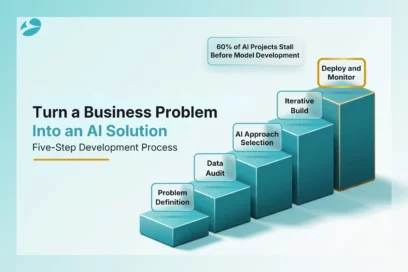
Sprint 0, Data and system audit before any model work. A dedicated sprint to assess data quality, volume, coverage, and recency; to map the production system architecture; and to identify integration constraints before they get coded around. This sprint produces a feasibility assessment, a data engineering plan, and an integration architecture sketch. Projects that skip sprint 0 consistently hit these same issues in sprint 3 or 4, at a point when changing course is far more expensive.
Sprint 1, Baseline model and production plumbing in parallel. The first development sprint builds both a simple baseline model (to establish performance targets) and the production infrastructure (containerized inference, logging, API design, monitoring hooks). Neither is complete at the end of sprint one, but both exist. This prevents the common pattern of discovering production infrastructure requirements when the model is already in final tuning.
Iterative improvement with production validation gates. Subsequent sprints improve the model while validating against the production environment. Evaluation is not just “does accuracy improve?”, it is “does this version pass integration tests, handle production data distributions, and remain within latency requirements?” Both questions need to pass before the sprint closes.
Monitoring before launch, not after. Drift detection, retraining triggers, and performance dashboards are operational before the model goes live. The monitoring system is tested alongside the model in the staging environment. A model that launches with no monitoring is running without a feedback loop, and problems only get diagnosed when someone notices the business metric declining.
These questions matter more than any technology choice:
1
The 60% failure rate cited in industry research is not primarily a technology problem. Most ML projects that do not make it to production fail for organizational and structural reasons: insufficient data quality, team gaps at integration time, success metrics that do not map to business outcomes, and production infrastructure built as a retrofit after the model is complete. These failure points are predictable enough that a structured data and system audit before sprint one will catch most of them.
2
For a well-scoped project with sufficient clean data: sprint 0 (data and system audit) takes two to four weeks; sprint 1 (baseline model plus production plumbing) takes three to four weeks; iterative improvement and validation sprints take six to twelve weeks; production launch and monitoring setup takes two to four weeks. Total: three to five months for a first production deployment. Projects that skip the audit sprint consistently run 40–60% longer because they hit data and integration issues that a sprint 0 would have surfaced.
3
Model drift is the performance degradation that happens as real-world data changes after deployment. Two types matter: data drift (the statistical distribution of inputs changes over time) and concept drift (the relationship between inputs and the correct output changes, fraud patterns evolve, churn drivers shift). Both require monitoring infrastructure built before launch, automated statistical tests on input and output distributions, with defined thresholds that trigger retraining or a manual review when crossed. Without monitoring, performance degrades silently for months before anyone diagnoses it.
4
Standard software executes explicit logic, if X, then Y. Machine learning app development produces systems that learn decision logic from data rather than encoding it explicitly. Data quality and pipeline work precede model development and typically consume more engineering effort than the model itself. Success is probabilistic rather than binary. The system degrades over time as data distributions shift, requiring ongoing retraining rather than just bug fixes. The team structure is different, data engineers, ML engineers, and domain experts rather than just software engineers, and so is the testing methodology and the maintenance model.
5
A proof-of-concept or MVP-scope ML application typically ranges from $30,000 to $80,000, sufficient to validate feasibility and deliver a working baseline model. A production-ready mid-scale application with proper MLOps infrastructure, monitoring, and integration typically runs $80,000 to $200,000. Enterprise-scale systems with multiple models, real-time inference at high volume, and complex integrations often exceed $200,000. These ranges assume reasonably clean, accessible data, significant data quality work adds to both timeline and cost, and this is why the sprint 0 data audit matters: it surfaces those costs before development begins.
Artificial Intelligence (AI)
 21
21

By Nandeep Barochiya
.NET
Artificial Intelligence (AI)
74
By Nandeep Barochiya
Artificial Intelligence (AI)
112
By Nandeep Barochiya