

How AI Development Solutions Are Reshaping Healthcare, Fintech, and Retail
 5 min read
5 min read
$2.52T
Worldwide AI spending in 2026, a 44% year-over-year increase, marking the shift from enterprise AI pilots to production-scale deployment across every major industry, with healthcare, financial services, and retail among the highest-spend verticals
75%
Of U.S. health systems are now using at least one AI application, up from 59% in 2025, with more than half of those organizations reporting 2x ROI on deployed solutions, confirming that healthcare AI is no longer experimental but operational
40%
Of enterprise applications will feature task-specific AI agents by 2026, up from less than 5% in 2025, representing the fastest technology adoption shift across financial services, retail operations, and enterprise workflow automation in the past decade
$130B
Projected AI in retail market size by 2033, growing from $18.4B in 2026 at a 32.4% CAGR, driven by personalization engines, demand forecasting systems, and dynamic pricing solutions that are already delivering measurable revenue impact for early adopters
$2.52T. That is Gartner’s figure for worldwide AI spending in 2026, up 44% year over year. But the more meaningful signal is not the dollar amount. It is what drove the jump: organizations are no longer deciding whether to invest in AI. They are deciding where to deploy next, and how fast.
The first wave of enterprise AI was fundamentally about prediction, will this patient be readmitted, is this transaction fraudulent, which product will this customer buy. Prediction is valuable but passive. Someone still has to read the output and act on it. What is shifting now is the action part. By 2026, Gartner forecasts that 40% of enterprise applications will include task-specific AI agents, up from under 5% in 2025, systems that do not just surface a recommendation but execute a response autonomously, in milliseconds, without waiting for human confirmation at every step.
That distinction matters for anyone evaluating AI development solutions today. A fraud detection model is a prediction asset. A fraud response agent is an operational system. They carry different infrastructure requirements, different compliance postures, and fundamentally different expectations for human oversight. What an AI development partner needs to understand about your environment depends heavily on which category you are building in.
Healthcare moves slower than fintech or retail on AI, deliberately and for good reason. Patient data carries HIPAA constraints that limit how and where it can be used for model training. A model that performs well in testing cannot go live until clinical validation clears it. Regulators expect auditability, not just accuracy. Those barriers have produced more rigorously engineered systems than most other industries can claim, which partly explains why 75% of U.S. health systems now report using at least one AI application, up from 59% in 2025, and more than half of those organizations report 2x ROI on what they deployed.
The use cases driving that adoption share a common characteristic: they reduce the cognitive burden on clinicians without replacing clinical judgment.
Predictive patient analytics. Penn Medicine built a readmission prediction system that pulls from patient history, lab results, and discharge notes, then scores each patient for 30-day readmission risk before they leave the hospital. Care coordinators see the score and the intervention recommendations, the model does not decide anything. Over the cohort where it was deployed, readmission rates dropped 30%. The design choice matters: the system is advisory. A clinician remains accountable for the decision.
Ambient clinical documentation. OSF HealthCare put an AI system in the room during physician-patient conversations. It listens. When the appointment ends, the clinical note is already drafted in the EHR, no dictation, no manual entry, no documentation session after the patient leaves. Physicians got 1.5 to 2 hours back per shift. Across a multi-hospital system, that is thousands of hours of physician time redirected to patient care each month. Better note completeness improved billing accuracy and reduced audit exposure. But the primary draw was simpler: physicians stopped dreading documentation.
Diagnostic imaging assistance. Radiologists were among the first clinicians to deal directly with AI hype, and among the first to watch the correction play out. Early vendor claims positioned imaging AI as a diagnostic replacement. What actually got deployed, and what has lasted, is narrower: flagging potential abnormalities for the radiologist to review, reordering queues so urgent cases surface first, pulling prior imaging automatically for comparison. The workflow support use case is held. The replacement narrative did not. For health systems, the practical value is that a radiologist can handle more volume when cognitive triage work is handled upstream by the model.
Clinical decision support. Clinical decision support is the most complex healthcare AI category to actually ship. These systems cross-reference a patient’s clinical profile against treatment protocols, drug interaction databases, and published outcome data, then surface recommendations for the care team. The clinical validation requirement is extensive, EHR integration is often non-trivial, and a treatment recommendation sits much closer to a clinical decision than a readmission score does, which raises the regulatory exposure substantially if the model behaves unexpectedly.
Done carefully, it is where the strongest long-term returns are. Rushed, it is the highest compliance risk in the building.
The pattern that holds across all four use cases: successful AI development solutions in healthcare are built for auditability first. If no one can explain why the model produced a given recommendation, it does not go live in a clinical environment.
Statistical models for fraud detection have been running at banks and payment processors since the early 2000s. The category itself is not new. What shifted is throughput and scope: production fraud systems now evaluate hundreds of behavioral signals per transaction, device fingerprints, velocity patterns, counterparty history, behavioral biometrics, in under 200 milliseconds. Regulatory reporting that once occupied dedicated analyst teams increasingly runs through the same AI layer.
Real-time fraud detection. PayPal’s fraud system handles roughly 40 million transactions daily. Each one gets scored against parallel signal streams: behavioral patterns, device fingerprints, velocity checks, counterparty risk. False positives, legitimate transactions flagged as fraud, dropped more than 50% compared to the rule-based predecessor. That metric tends to get less attention than catch rate, but it should not: every legitimate transaction declined is lost revenue and a candidate for churn. Cutting false positives has as strong a business case as catching fraud does.
The PayPal example illustrates why evaluating fintech AI development solutions on catch rate alone is insufficient. A model catching 99% of fraud at a 20% false positive rate may be worse for the business than one catching 95% at 3%. Both metrics need to be defined before development starts.
Credit risk and underwriting. Traditional credit scoring uses a narrow variable set and produces a single number. AI-powered underwriting models can incorporate alternative data, rental payment history, subscription behavior, cash flow patterns from connected accounts, to build risk profiles that are both more accurate and more inclusive. Upstart, which applies machine learning to loan underwriting, reported approval rates 27% higher than traditional models at the same loss rate, reaching borrowers that conventional scoring had systematically excluded.
Algorithmic portfolio management. JP Morgan’s LOXM trading algorithm uses reinforcement learning to execute equity trades at optimal prices, learning from each execution to improve future performance. The system reduced market impact costs on institutional trades by navigating order timing and sizing in ways that rule-based execution could not anticipate. This category requires deep integration with trading infrastructure and significant compliance review, regulators want to understand what the model is optimizing for and under what conditions it would behave unexpectedly.
Regulatory compliance automation. Compliance reporting is where AI in fintech has had its least visible but most consistent traction. A mid-size bank might file thousands of regulatory documents annually across multiple frameworks. Models trained on historical filings and regulatory text can draft those reports, catch discrepancies before submission, and route reviews by risk level, sending only the genuinely complex ones to senior analysts. Institutions that built this capability during the 2022–2024 compliance automation wave are not walking it back. The headcount case was too clear.
If you are evaluating AI development solutions for financial services, compliance architecture matters as much as model accuracy. Both US and EU regulators have been consistent on one point: the institution owns the decision, not the vendor who built the model. That framing has real design consequences. Explainability requirements, audit logging, and model governance controls are not optional features to add later, they belong in the system architecture from the start, before any model gets trained.
Retail was the first industry to prove at scale that AI creates direct, measurable revenue impact. The most-cited proof point, that 35% of Amazon’s revenue flows from its recommendation engine, has been repeated so many times it sounds like background noise. But the mechanism is worth understanding, because it is exactly what mid-market retailers are now deploying with purpose-built AI development solutions.
Personalization and recommendation. Walmart’s 2022 deployment is worth studying because the difficult part was not what most people assume. Collaborative filtering, purchase history analysis, contextual signals like local weather and nearby events, those recommendation components are standard. Any competent team can assemble them. Eighteen months of the project went into data infrastructure: pulling purchase history from 4,700 stores into a single platform capable of serving personalized homepage results in under 100 milliseconds at production load. Add-to-cart rates in the exposed cohort went up 15%. Nobody writes a case study about the ingestion pipeline that made that possible, but that was the project.
Demand forecasting and inventory optimization. Home Depot’s demand forecasting system integrates weather data, historical purchase patterns, seasonal trends, and promotional calendars to predict demand at the store and SKU level, typically two to four weeks out. For a retailer with 2,300+ locations, a 5% improvement in inventory accuracy represents hundreds of millions in working capital efficiency, fewer stockouts on high-velocity items, less carrying cost on the slow movers.
Dynamic pricing. AI-powered pricing systems adjust in real time based on demand signals, competitor pricing, inventory levels, and margin targets. The ROI is real, typically 2 to 5% margin improvement on covered categories, but it is also the application where retailers most often need guardrails built into the system from the start. Customers notice price swings. Category exclusions, price floors, and ceilings are not optional additions. They belong in the production model alongside the pricing logic.
The retail AI market projection, $130B by 2033, is an envelope for applications that share almost nothing technically. Personalization pipelines are recommendation systems. Shrinkage detection runs on computer vision at the shelf level. Demand forecasting is time-series modeling against supply chain signals. AI agents for returns and customer queries are NLP infrastructure. Choosing a development partner on “retail AI experience” without specifying the use case is not much more useful than hiring a surgeon for “medical experience.” What transfers is use-case-specific knowledge, not just vertical familiarity.
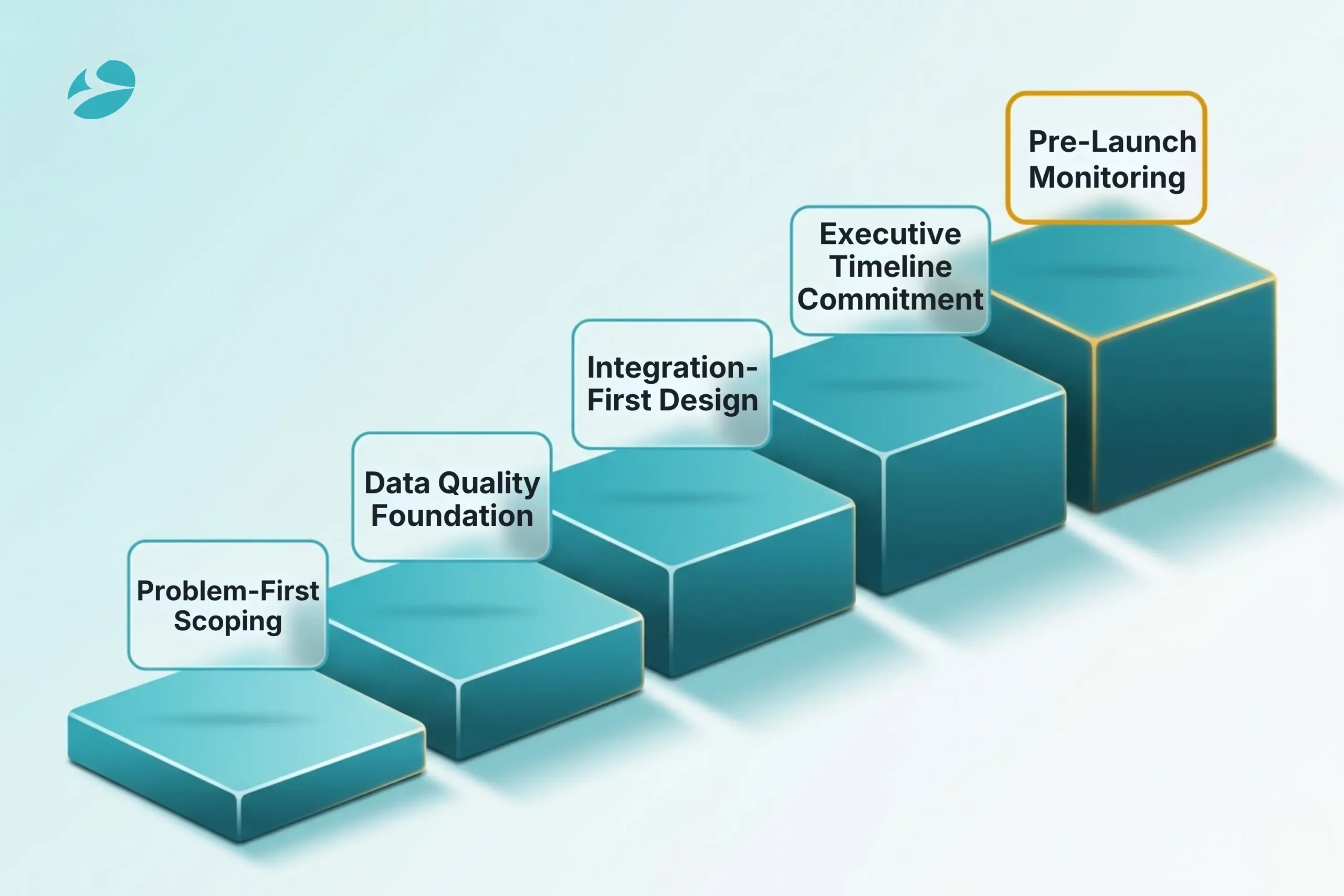
Across healthcare, fintech, and retail, organizations that move from pilot to production share consistent behaviors. None of them are industry-specific. They are the universal characteristics of AI development solutions that actually work.
They start with a specific problem, not an AI strategy. The organizations that stall are typically those that have committed to “becoming AI-driven” without defining what that means operationally. The ones that ship define the outcome first: reduce 30-day readmissions by 15%, reduce false positive fraud flags by 30%, reduce inventory carrying cost by 8%. The AI development solution is the tool. The measurable outcome is the objective.
Data quality before model development. Data readiness is where most AI projects die, and it is rarely the part that gets adequate budget. The model performance is visible, you can test it, benchmark it, demo it. The data quality problem is invisible until the model hits production conditions and stops generalizing. Organizations with the strongest AI outcomes have typically spent 60 to 70% of total project time on data audit, cleaning, and engineering before model development starts. That is not a planning failure. It is a realistic picture of what the work actually requires.
Integration designed from day one. Integration is consistently where timelines slip, not because it is technically novel, but because it gets sequenced wrong. Organizations that treat it as a final step underestimate how different the requirements are between a healthcare EHR, a core banking system, and a retail POS. Connecting to the systems that humans actually use is where production AI lives or dies.
Executive commitment for the realistic timeline. Most AI deployments that hit strong ROI take 9 to 18 months from project start to measurable production impact. Organizations where the executive sponsor expects 90-day results almost always pivot before the model has enough production data to stabilize, or they declare victory on a pilot metric that does not reflect what the business actually needed. Realistic timeline expectations, established at the start of the engagement, are a leading indicator of project success.
Monitoring infrastructure built before go-live. Models degrade. Patient populations change, fraud patterns shift as fraudsters adapt, consumer preferences evolve. An AI development solution deployed without drift detection and retraining infrastructure is not a production system, it is a snapshot with a go-live date. A model that launches at 90% accuracy and quietly drifts to 75% over six months is generating wrong outputs for every user during that slide. If no alert fires, no one notices until something breaks visibly. Monitoring needs the same engineering rigor as the model itself. Building it after go-live means it almost never actually gets built.
The quality of AI development solutions varies significantly across vendors. Technical capability with a specific model type is necessary but not sufficient, you also need domain knowledge in your vertical, integration experience with your technology stack, and a clear approach to the compliance requirements your industry imposes.
How do you assess data readiness before development begins? A partner without a formal data audit process is planning to discover your data problems during model development, which is the most expensive possible time to find them.
What is your approach to integration with existing systems? Ask for examples in your specific EHR, core banking system, or retail platform. Integration complexity is where most AI development timelines slip.
Can you share documented outcomes from deployments in this vertical? Most vendors can show you a pilot result. Fewer have a 12-month production story, model still running, still performing, business impact verified rather than projected. Ask for both numbers when evaluating any AI development partner: the launch metric and what it looked like a year later. If the answer only covers the launch, that gap is worth noting.
How do you handle regulatory requirements specific to our industry? HIPAA in healthcare, SR 11-7 in financial services, GDPR and CCPA in retail, your AI development partner should speak specifically about how their development process addresses the requirements in your vertical. Generic “we take compliance seriously” language is not an answer.
What does your post-deployment monitoring and retraining process look like? If the engagement ends at deployment, ask why. A production AI solution without an active monitoring plan is not a solution, it is a snapshot that will degrade without anyone responsible for maintaining it.
Evaluating AI development solutions? BiztechCS engagements begin with a structured assessment of use case, data readiness, and integration requirements, before model development starts. 19+ years in enterprise technology delivery. ISO 27001 certified.
1
Healthcare, financial services, and retail have the most mature AI deployments with documented ROI, for different reasons. Healthcare benefits from AI in high-volume, pattern-recognition tasks where speed and consistency matter. Financial services benefits from real-time fraud detection, credit risk modeling, and compliance automation. Retail benefits from personalization, demand forecasting, and dynamic pricing. Industries with large volumes of historical data, repeated decisions, and clear outcome metrics tend to see the strongest returns.
2
Timeline varies significantly by use case and data readiness. Fraud detection in fintech typically delivers measurable impact within 3-6 months, because the signal is clear and the ground truth is available quickly. Demand forecasting in retail tends to show results in 4-8 months as the model aligns with inventory cycles. Clinical applications in healthcare often take 6-12 months due to clinical validation requirements and EHR integration complexity. Across all industries, the data audit phase is the biggest variable, organizations with clean, accessible historical data move significantly faster.
3
Regulated industries have two layers of data requirements: technical and compliance. Technically, AI models need sufficient labeled historical data, consistent data quality, and coverage of edge cases. The compliance layer adds constraints: healthcare data must conform to HIPAA de-identification standards before it can be used for model training; fintech data used for credit decisions must comply with fair lending regulations that prohibit certain protected characteristics as model inputs. Regulators increasingly require that AI-driven decisions can be audited and explained, building for explainability from the architecture stage, not as a retrofit, is the most practical approach.
4
The build-vs-partner decision depends on three factors: talent availability, time to value, and strategic intent. Building in-house makes sense if you have mature ML and data engineering talent, proprietary data that gives you a competitive moat, and a long-term plan to build AI as a core organizational capability. Partnering makes sense if you need to move in 3-6 months, lack data engineering depth, or are piloting a use case before committing to a full team. The most common pattern for mid-market enterprises is to pilot with a development partner, validate the business impact, then build internal capability to maintain and extend the system.
5
Responsible AI development solutions address compliance at four points: data sourcing (ensuring training data is legally obtained and properly consented), data processing (applying HIPAA, GDPR, or CCPA de-identification as required by jurisdiction), model design (avoiding protected characteristics as inputs in regulated decision contexts), and deployment (logging predictions for audit, building explainability into the model architecture). Healthcare organizations focus on HIPAA and FDA guidance on AI/ML-based software as a medical device. Financial services firms focus on SR 11-7 model risk management guidance and fair lending regulations. Retail organizations primarily focus on GDPR and CCPA for personalization and consent management.
Artificial Intelligence (AI)
 67
67

By Nandeep Barochiya
ERP
Odoo
75

By Uttam Jain
ERP
Odoo
87
By Uttam Jain