

What Happens When Artificial Intelligence Becomes Your Personal Presentation Coach?
 5 min read
5 min read
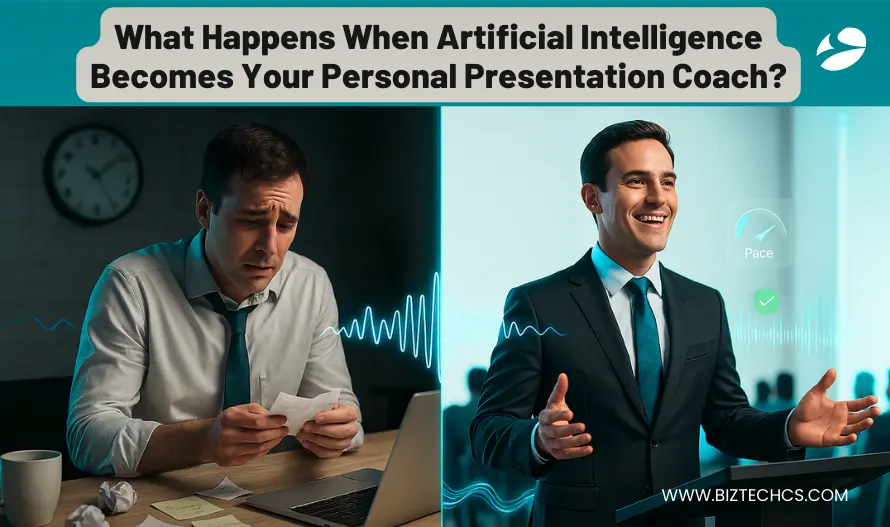
Your palms are sweating, knees weak, arms heavy. No, this isn’t an Eminem song. It’s your five-minute quarterly presentation. Welcome to the corporate nightmare where grown adults forget their own names the moment a projector turns on.
Here’s the kicker: as many as one in three people report a significant fear of public speaking — and for many, it ranks among their top three deepest fears (source). Think about that for a second: the stress of walking through a slide deck can outrank some of life’s actual dangers. That’s how intense this fear can feel. People would rather face almost anything than explain Q3 revenue projections in a room full of colleagues.
Traditional public speaking training is about as effective as a chocolate teapot. You practice in front of mirrors, record yourself on your phone, or worse, rope in your spouse for feedback. Spoiler alert: they’re lying when they say you did great. The truth is, most conventional methods prepare you for public speaking like a YouTube tutorial prepares you for brain surgery.
But here’s where AI-powered voice feedback changes the entire game. These public speaking improvement tools dissect your speech patterns with surgical precision. No sugar-coating. No participation trophies. Just cold, complex data about every verbal tic you didn’t know you had. This guide reveals how speech-analysis ai ml development turns presentation panic into boardroom brilliance — without the $500 corporate workshop that serves stale bagels.
Even the most seasoned experts can unravel the moment all eyes turn their way, and the reasons run deeper than simple stage fright.
Picture your brain as that one colleague who panics when the Wi-Fi drops for two seconds. The moment you face an audience, your amygdala throws a tantrum like a toddler in a candy store, convinced those suits in row three are actually predators sizing up their lunch.
Fear of judgement mixes with imposter syndrome to create a cocktail nobody ordered but everyone’s forced to drink. You’ve negotiated billion-dollar mergers but suddenly forget how words work because your perfectionist brain demands TED-talk excellence while providing kindergarten-level motor skills. The cruel joke? Most professionals get less speaking practice than a monk gets at speed dating—ironically, even in a world where every AI ML development company keeps promising tools to “boost confidence and communication.”
Your bathroom mirror never asks tough questions. And your dog’s tail-wagging enthusiasm doesn’t translate into actionable feedback on your quarterly earnings presentation.
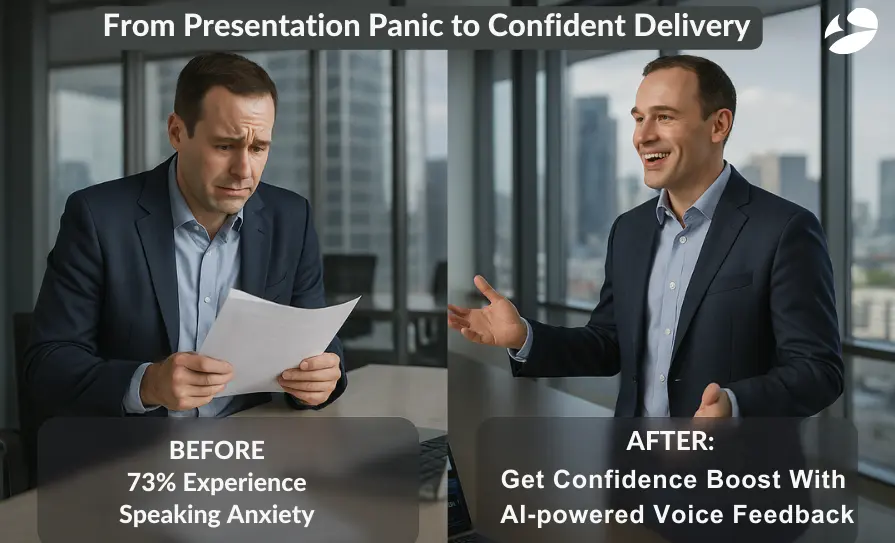
Traditional training feels like learning to swim by reading about water in a textbook. One coach says speak louder, while another whispers about authentic presence, leaving you more confused than a chameleon in a bag of Skittles.
Finding practice audiences requires bribing colleagues with fancy coffee or promising firstborn children, and even then, they develop mysterious illnesses five minutes before showtime. Professional coaches charge hourly rates that make lawyers blush, while workshops eat budgets faster than that one department that somehow always needs new laptops.
Without AI-powered voice feedback or real-time speech feedback tools, tracking progress becomes guesswork dressed up as methodology. Modern speech analysis AI and public speaking improvement tools offer what traditional methods can’t. They provide objective metrics that don’t care about your feelings but actually help you improve.
An AI public speaking coach won’t judge when you practice at 3 AM or roll their eyes at your fifteenth attempt at the opening joke. But here’s what C-suite executives always ask: “What’s the actual ROI compared to traditional coaching methods?”
The numbers speak louder than your nervous presenter: ai ml development coaching typically costs 70% less than human coaching while delivering 3x as many practice hours per month. Companies report a 40% reduction in training costs within the first quarter, and employees actually use the tools because they don’t require scheduling gymnastics or travel budgets that make CFOs weep.
Wondering if AI-powered voice coaching could slash your training costs while actually improving results? The numbers suggest it’s not just possible—it’s already happening.
When AI enters the coaching arena, it transforms voice training from a slow, subjective process into a powerful, instant, unbiased improvement engine.
Natural Language Processing dissects your speech patterns faster than office gossip spreads after someone gets fired. At the same time, human coaches take notes more slowly than dial-up internet loading a JPEG; speech analysis AI catches every “um” and “uh” like a hawk catching mice at a barn convention.
Machine learning algorithms spot your verbal tics with the precision of an accountant finding a missing penny in a million-dollar budget. And real-time speech feedback feels different when it arrives instantly rather than three days later in an email that starts with “Great job, but…”.
Numbers don’t lie, unlike that colleague who claims they “totally read” your 47-page report. AI-powered voice feedback measures your speaking pace, pitch variation, and filler words without the sugar-coating that humans add to their criticism sandwiches.
Your human coach might be having a bad day because their cat judged them at breakfast. Public speaking improvement tools, however, evaluate you with the emotional range of a spreadsheet that doesn’t care if you brought donuts to practice.
Your AI public speaking coach never sleeps, never takes a vacation, and never ghosts you after scheduling conflicts like that consultant who bills you for thinking about your project. Built with the intelligence you’d expect from an ai ml development company, it lets you practice your investor pitch at 3 AM without worrying about waking up someone who charges $500 per hour just to tell you to breathe deeply.
The cost of traditional coaching makes quarterly budgets cry harder than interns discovering what “other duties as assigned” really means. At the same time, machine learning scales better than your competitor’s promises during earnings calls.
Behind the scenes, sophisticated algorithms break down every sound you make to pinpoint exactly what’s helping—or sabotaging—your delivery.
Your pronunciation gets dissected with the surgical precision of a grammar Nazi on steroids, catching every syllable you butcher like it’s personally offended. Speech analysis AI scores your articulation. It also detects mumbling patterns that make you sound like you’re speaking through a mouthful of peanut butter at a board meeting.
The algorithm judges your clarity harder than your mother-in-law judges your life choices. The difference is that this one actually provides helpful feedback instead of passive-aggressive comments at dinner. L&D leaders often wonder: “How do we ensure data privacy when recording employee presentations?” Modern AI speech platforms use edge computing to process voice data locally, never storing actual recordings unless explicitly requested.
Encrypted analytics replace raw voice files, and compliance with GDPR, CCPA, and SOC 2 means your legal team can finally relax instead of drafting another 47-page data policy that nobody reads.
AI-powered voice feedback tracks your words per minute like a caffeinated auctioneer counting coffee beans, analyzing whether you’re speaking at presentation pace or funeral-march speed. Your emotional tone gets mapped more thoroughly than a teenager’s mood swings. Meanwhile, your confidence level is assessed with the ruthlessness of a venture capitalist evaluating your startup pitch — the kind of deep behavioral intelligence today’s leading ai ml development company solutions are built to deliver with precision.
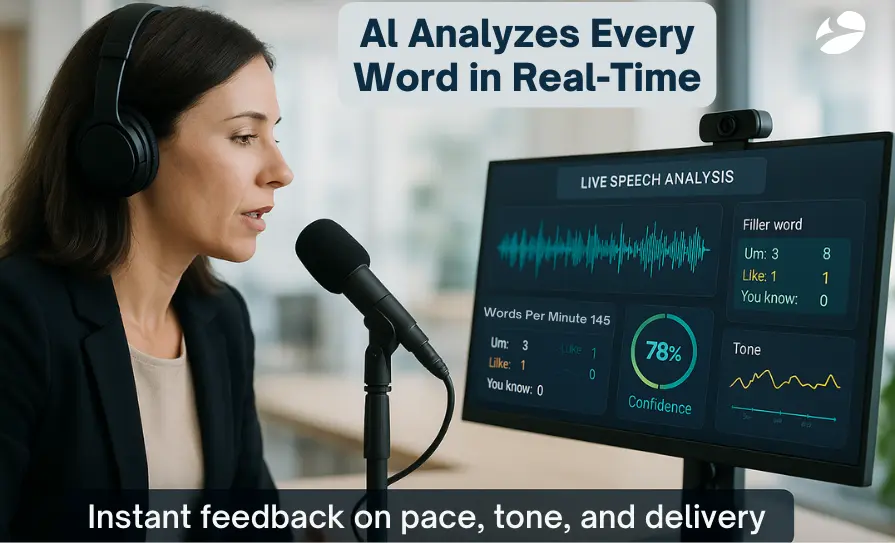
We can develop comprehensive AI voice feedback systems that seamlessly integrate all these components. Apparently, humans now need machines to tell them when their voices crack, like a pubescent teenager giving their first presentation.
Every “um,” “like,” and “you know” gets counted faster than a finance department rejecting expense reports, creating a shame scoreboard nobody asked for but everyone needs. Public speaking improvement tools track these verbal hiccups with the dedication of someone counting their ex’s Instagram likes at 2 AM.
The ai ml development public speaking coach suggests alternatives to your filler words, essentially teaching you to speak like an adult instead of a valley girl who got lost in a boardroom.
Video analysis judges your posture harder than a military drill sergeant with hemorrhoids, catching every slouch and fidget as if they were personal insults. Real-time speech feedback now includes whether your hand gestures look confident or like you’re trying to land planes while having a seizure.
Our expertise in NLP and machine learning allows us to build custom speech analysis engines that notice when your body language screams “help me”. At the same time, your words say “quarterly projections look promising.”
The real magic happens when AI pinpoints the exact tools that turn nervous rambling into confident, compelling communication.
Speech analysis AI adapts to your skill level like a personal trainer who knows exactly when you’re faking those push-ups. Progress tracking shows your improvement trajectory clearer than your company’s stock price tanking after a bad earnings call, except this chart hopefully goes up.
We can implement intelligent feedback systems that learn from each user’s unique speaking style and progression, because cookie-cutter advice works about as well as using the same password for everything.
Visual charts display your speaking patterns like an EKG for your presentation skills, showing exactly when your voice flatlined during that budget proposal. AI-powered voice feedback provides audio playback with annotations that point out every cringe moment like a director’s commentary nobody wanted, but everyone needs.
Written recommendations arrive less sugar-coated than performance reviews but are more useful than a consultant’s 200-slide deck that says nothing.
Public speaking improvement tools simulate different speech types from wedding toasts to investor pitches, because bombing at a board meeting hits different than bombing at your best friend’s wedding. Audience simulation creates virtual crowds that judge you silently, just like real audiences, without the awkward eye contact or phone-checking.
Our team can develop custom practice scenarios for specific industries, whether it’s sales pitches for corporate teams or keynote preparation for executives. We can also integrate gamification elements to make the learning process more engaging than mandatory compliance training.
Business leaders frequently ask: “Can we customize scenarios for our specific industry jargon and presentation formats?” Absolutely. AI models can be trained on your company’s actual presentation templates, industry terminology, and even regional dialects.
One pharmaceutical client trained their system on medical terminology, resulting in 85% fewer mispronunciations during FDA presentations – because nothing kills credibility faster than butchering drug names in front of regulators.
Turning cutting-edge speech technology into reliable, scalable products is where our expertise truly comes to life.
We specialize in developing AI-powered solutions that help individuals improve their public speaking skills better than a motivational poster ever could. Custom speech analysis AI for corporate training platforms gets built with the dedication of someone crafting their resignation letter after a bad quarterly review.
Whether you’re creating a platform for corporate training, personal coaching, or educational institutions, we can build scalable AI tools that provide real-time speech feedback and actionable insights. They’re designed for users who’d rather eat glass than speak publicly.
Industry-tailored feedback algorithms judge speaking patterns more accurately than your board judges your strategic decisions, minus the uncomfortable silence afterward.
Cloud-native microservices architecture handles thousands of simultaneous users like a bouncer at an exclusive club, except everyone actually gets in and receives personalized attention. Our cloud-native approach ensures that your AI-powered voice feedback tools can handle large numbers of users simultaneously while still delivering personalized feedback.
This allows the system to scale effortlessly. And it all happens as your user base grows faster than excuses during performance reviews.
Smart resource management processes voice data more efficiently than your HR department processes complaints, with automatic load balancing that actually works, unlike your work-life balance. CTOs consistently inquire: “How does this integrate with our existing LMS and communication platforms?” Our API-first approach means your AI voice coach plugs into Microsoft Teams, Zoom, Slack, or whatever digital ecosystem you’ve cobbled together over the years.
Single sign-on support prevents password fatigue, and usage analytics flow directly into your existing dashboards. Implementation typically takes 2-3 weeks, not the 6-month death march your last enterprise software deployment became.
Advanced NLP integration and custom ML model training create public-speaking improvement tools that understand human speech better than humans do in their own terms of service agreements. API development for third-party integration plays nicer with other systems than departments do during budget season.
Multi-platform deployment across web, mobile, and desktop ensures your AI public speaking coach follows users wherever they go, like that one email thread that won’t die. Except this kind of stalking actually improves their presentation skills.
Looking for a scalable AI voice coaching platform that integrates seamlessly with your existing tech stack? We build solutions that actually work with what you’ve got.
Across industries, professionals are already tapping into AI voice coaching to sharpen their communication and gain a competitive edge.
Sales teams use AI-powered voice feedback to perfect pitches with the obsession of a teenager perfecting their TikTok dance, except these moves actually generate revenue. Executives preparing for board presentations achieve a 30% improvement in effectiveness. This easily beats the usual strategy of praying to the PowerPoint gods while sweating in expensive suits.
HR professionals conducting training sessions finally sound engaging enough that employees stop faking emergencies to escape. And speech analysis ai ml development helps them deliver mandatory compliance training without sounding like they’re reading hostage demands.
Senior executives always want to know: “What measurable improvements can we expect in the first 90 days?” Real deployments show 45% reduction in filler words, 30% improvement in pace consistency, and a 60% increase in audience engagement scores within three months.
One Fortune 500 tech company saw its sales team’s close rate jump 23% after just eight weeks of AI coaching – turns out, confident delivery actually correlates with revenue, shocking absolutely no one except maybe that one VP who thought charisma couldn’t be taught.
Students preparing presentations now sound less like they’re reciting Wikipedia at gunpoint and more like they actually understood the assignment. Debate team members sharpen arguments faster than keyboard warriors in comment sections. Meanwhile, language learners fix pronunciation issues that once made native speakers’ ears bleed.
Teachers using public speaking improvement tools enhance lecture delivery to the point where students actually look up from their phones occasionally. It’s a miracle previously thought impossible by educational scientists worldwide.
Keynote speakers refine their craft with real-time speech feedback that’s harsher than Twitter critics but actually constructive. Speech coaches supplement their services with AI tools. They finally admit that machines might be better at counting “ums” than humans pretending to pay attention.
Content creators improve video presentations because, apparently, shouting at Ring lights doesn’t automatically make you charismatic. And workshop facilitators learn to engage audiences beyond the traditional method of bribing them with free lunch.
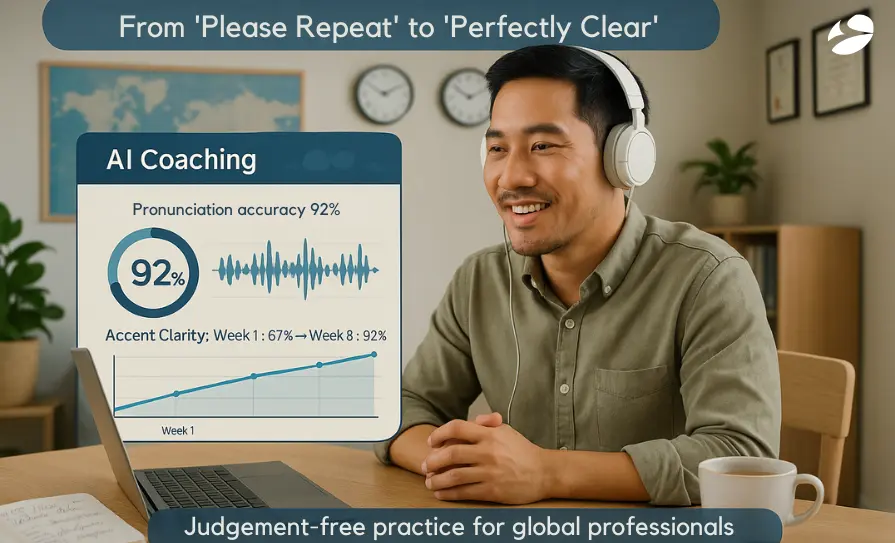
Non-native speakers improve their accent clarity without having to endure someone enunciating words as if they were teaching a particularly slow toddler. People with speech impediments get judgment-free practice that doesn’t involve well-meaning relatives making things infinitely worse with their “helpful” suggestions.
Job interview candidates use AI public speaking coach technology to nail responses without sounding like they memorized a script written by a robot having an existential crisis. However, the irony of using AI to sound less robotic isn’t lost on anyone.
The question every CFO eventually asks: “How do we measure long-term value beyond initial improvements?” Companies tracking 12-month data report sustained improvements with 89% of users maintaining their gains, unlike traditional training, where skills deteriorate faster than New Year’s resolutions.
Employee confidence scores increase 3.2x, internal promotion rates for trained speakers jump 41%, and presentation-related anxiety claims on corporate insurance drop by half – apparently, AI therapy is cheaper than actual therapy.
AI-powered voice feedback transforms sweaty-palmed executives into presentation predators who actually enjoy quarterly reviews instead of fantasizing about faking their own deaths to avoid them.
The journey from vocal trainwreck to boardroom Shakespeare happens faster than your competitors can say “market disruption.” And it all happens without the years of therapy and overpriced workshops that feel desperate and stale.
Speech analysis ai ml development provides the brutal honesty your colleagues won’t. It turns verbal disasters into competitive advantages that make promotion committees wonder where this confidence was hiding all along.
Those who master public speaking improvement tools don’t just survive presentations; they dominate rooms like they own the mortgage on everyone’s attention spans. The choice is simple: keep mumbling through meetings like you’re reading ransom notes underwater. Or let real-time speech feedback help you speak with the conviction of someone who actually knows what they’re talking about.
Because in the corporate jungle, the difference between prey and predator often comes down to who sounds less like they’re having an out-of-body experience during investor calls.
Ready to transform your team’s speaking anxiety into boardroom brilliance with AI that never sleeps, never judges, and always delivers results? The future of professional development is here.

Odoo
 31
31

By Uttam Jain

Artificial Intelligence (AI)
101

By Nandeep Barochiya
Artificial Intelligence (AI)
99
By Nandeep Barochiya