
Odoo ERP Software Development: How to Build a Solution Tailored to Your Business Needs

 5 min read
5 min read
70%+
Of ERP implementations will fail to fully meet their original business goals by 2027, and as many as 25% will fail catastrophically, according to Gartner's most recent ERP advisory
13M+
Users now run operations on Odoo across 175 countries, with 170,000+ active enterprise customers, €650M in billing revenue in 2025, and 42% ARR growth, making it the fastest-growing ERP platform globally
$534K vs $1.46M
Five-year total cost of ownership for an 80-user Odoo Enterprise deployment compared to SAP Business One a 63% gap driven by licensing, implementation, annual maintenance, and the cost of upgrade projects that Odoo's architecture avoids
55%+
On-time go-live rate for Odoo projects that follow a full 6-phase methodology versus those that skip discovery or compress testing the single biggest predictor of implementation success across 40+ documented deployments
According to Gartner’s assessment, more than 70% of ERP implementations will fail to fully meet their original business goals by 2027. As many as 25% will fail catastrophically, with cost overruns, abandoned rollouts, systems that went live but were never actually used.
Odoo is not immune to this statistic. The platform gives businesses more flexibility than SAP, NetSuite, or Dynamics. That flexibility is also where most Odoo projects go wrong when development scope is miscalculated, when the partner lacks a structured methodology, or when custom modules get built for requirements that configuration would have been handled for free.
What separates the projects that work is not the platform. It’s the development approach.
This article covers what Odoo ERP software development actually involves, the six-phase process that Panorama Consulting’s 2025 ERP Report links directly to on-time, on-budget delivery, realistic cost and timeline benchmarks, industry use cases with specific outcomes, and the five non-negotiables when evaluating a development partner.
The phrase means three different things. Confusing them is a direct source of scope and budget problems.
Configuration enabling and adjusting Odoo’s 100+ native apps without writing code. Tax rules, user roles, approval workflows, warehouse routing, email templates, report layouts. Configuration survives every Odoo version upgrade automatically. The ongoing maintenance cost is zero.
Custom module development, building new Python and XML modules that extend Odoo’s functionality. These modules live in separate packages and use Odoo’s inheritance system to add or modify behavior without touching core files. When built correctly, custom modules are upgrade-safe: they travel with the system across version changes rather than being overwritten by them.
Integration development connecting Odoo to external systems. Payment gateways, shipping carriers, ERP-to-ecommerce bridges, legacy database sync, EDI connections. Built through Odoo’s JSON-RPC controllers or REST API layer.
A full Odoo ERP software development engagement typically involves all three. The skill is knowing the right proportion of each. Over-spending on custom module development for requirements that configuration would cover is the most common budget problem in Odoo projects.
The starting question for any scoping conversation: what does this requirement actually need? Before custom development is specified for anything, configuration and Odoo Studio should be ruled out explicitly.
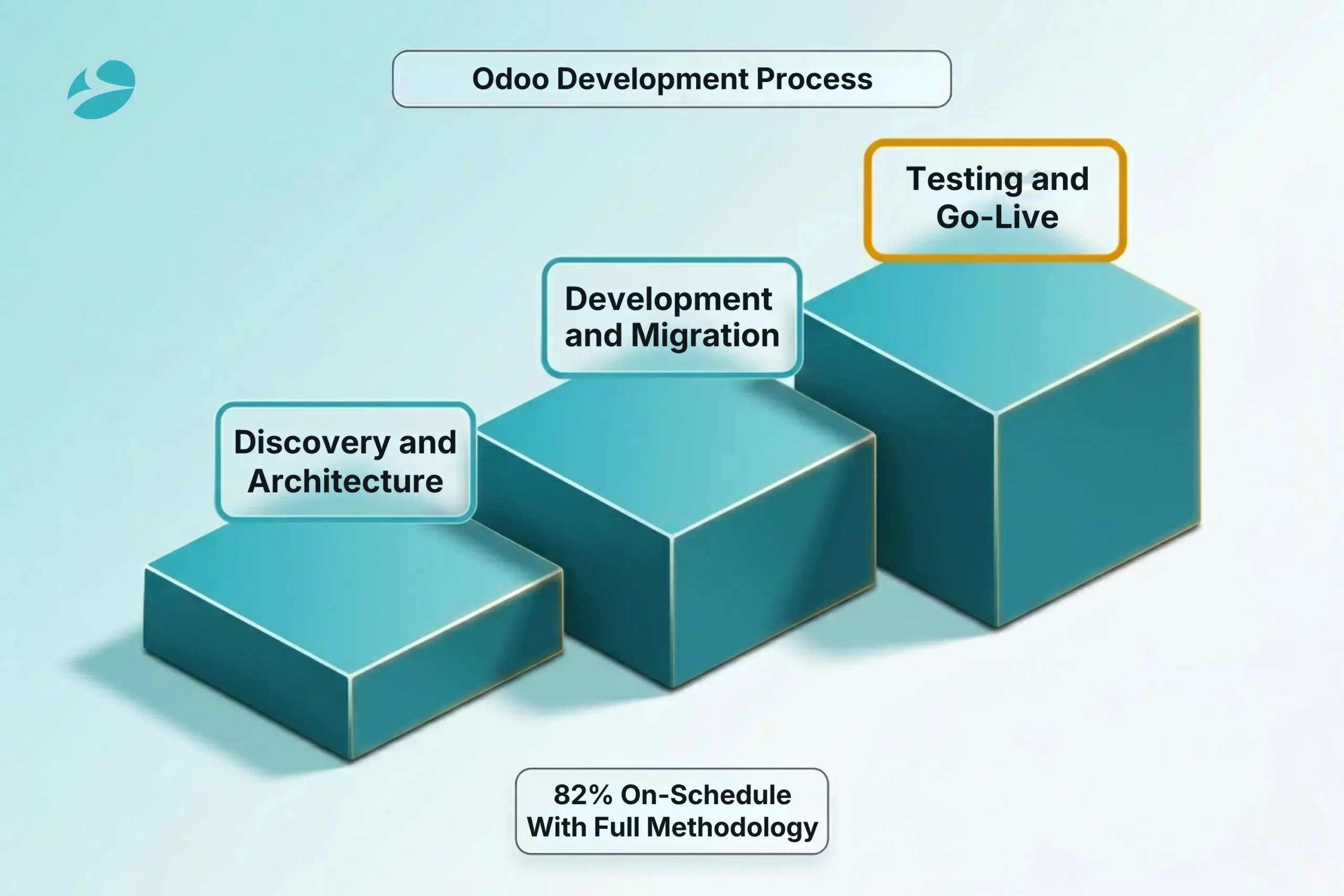
Data from 40+ Odoo deployments between 2019 and 2026 shows one consistent pattern. Projects that follow a full six-phase methodology, Panorama Consulting’s 2025 ERP Report identifies structured methodology as the single biggest predictor of ERP delivery success. More than half of structured projects stay within budget, versus 75% that historically overrun without one.
1
Structured workshops with every department head. Process mapping. A gap analysis between current workflows and Odoo’s native capabilities. Everything goes into a signed scope document. Verbal agreements don’t survive phase transitions.
Discovery typically takes two to four weeks. The critical deliverable: a scope document that identifies what each requirement needs: configuration, Odoo Studio, custom development, or integration. Getting this wrong is the most expensive mistake in the project. Requirements discovered in Phase 3 that should have been found in Phase 1 generate change orders and schedule extensions.
2
Module selection. Integration mapping. Data migration planning. Technical design document. User roles and permissions. Every significant technical decision is documented before development starts.
The architecture phase exists because development is cheap to redirect on paper and expensive to redirect in code. A two-week architecture phase that catches a fundamental design conflict is worth significantly more than the time it costs.
3
Native modules are enabled and configured first. Custom modules are built only after configuration has been fully exhausted. This phase runs in parallel sprints. Code review and automated unit testing apply to every custom module not as an option, as a requirement.
4
Extract, cleanse, transform, and load legacy data. In manufacturing specifically, data cleansing consumes 20–30% of total implementation effort. Product master data, historical transactions, open orders, contact records each category has its own validation requirements, and validation failures discovered at go-live are among the most disruptive events in an ERP project.
5
Unit testing confirms individual configurations and modules work correctly in isolation. Integration testing is where cross-module data flow gets validated. Does inventory update correctly when a sale is posted? Does the accounting entry match what the warehouse recorded? After that passes, UAT runs: actual end users working through real scenarios, not scripted demos. Skipping UAT in favor of internal QA alone is a predictable source of post-launch problems. The team that built the system cannot replicate how end users actually interact with it.
6
Cutover can go one of two ways: phased (department by department, lower risk, longer transition) or big-bang (everything switches on a set date). Either way, the four to eight weeks immediately after go-live are the highest-risk window in the project. Partners who move clients directly to standard support after launch no daily check-ins, no elevated response SLA, see significantly higher user abandonment in the first two months. That post-launch period is called hypercare, and skipping it is one of the most common reasons a technically successful go-live still ends badly.
Odoo ships with more than 100 native apps accounting, inventory, CRM, sales, purchasing, HR, payroll, project management, manufacturing, ecommerce, point of sale. For most mid-market businesses, that covers the full operational stack without a developer touching the codebase.
Custom module development makes sense in specific situations.
Industry-specific logic with no native equivalent. Engineer-to-order BOMs that standard manufacturing BOM structures don’t support. Multi-dimensional pricing matrices for industrial or specialty products. Custom quality checkpoint rules at arbitrary production stages. Jurisdiction-specific payroll calculations that differ meaningfully from Odoo’s standard payroll rules.
Proprietary system integration. A legacy ERP that cannot be retired yet. A bespoke warehouse management system built in-house. An industry-specific platform healthcare information systems, field service software, specialized logistics tools with a non-standard API.
Genuine competitive differentiation. A workflow that gives the business an operational advantage and cannot be replicated by any packaged app. It is also the narrowest of the three categories and the only one that genuinely justifies significant custom development spending.
In practice, the custom development work tends to cluster in a few areas. Manufacturing gets custom BOM logic and engineer-to-order workflows. Accounting gets multi-entity consolidation and custom approval chains. HR gets jurisdiction-specific payroll rules. CRM gets industry-specific pipeline stages and lead scoring. Ecommerce gets product configurators for made-to-order or configurable items.
One number worth keeping in mind: custom module development tends to absorb 30–40% of the total project budget. On top of that, every custom module carries annual maintenance of 15–25% of its original build cost a $25,000 module runs $3,750–$6,250 per year to keep current. A requirement that native Odoo settings already handle should never make it into the custom development backlog.
The business case for Odoo over SAP or NetSuite is partly a pricing argument. The deeper argument is architectural, and it has direct implications for long-term maintenance costs.
Odoo runs on Python for backend business logic, PostgreSQL for the relational database, and OWL (Odoo Web Library) the platform’s own component-based JavaScript framework for the web interface. Customizations are written in Python and XML.
The critical structural property: Odoo customizations use an inheritance model. When a developer extends Odoo, they create a separate module that inherits from the original. The core Odoo code is never modified. When Odoo releases a new version, the upgrade path is: update the core, then update custom modules to account for API changes. Custom code is not overwritten.
SAP’s ABAP-based customizations and NetSuite’s SuiteScript customizations do not have this property. SAP custom code frequently requires specialist re-validation after every major version upgrade a process that runs $40,000–$80,000 every two to three years for mid-market businesses. NetSuite’s model is cloud-only: no source code access, no deployment environment choice.
For Odoo users, this translates to something commercially significant: you are not locked to the partner who built your system. Any Python developer who understands Odoo’s framework can maintain and upgrade your custom modules. Python’s developer pool is large and globally distributed, which keeps rates competitive and avoids the specialist scarcity that makes SAP maintenance expensive.
Odoo Community is open-source under the LGPL license and free to use. Enterprise, what most mid-market businesses actually deploy adds around 20 additional modules: deeper manufacturing, accounting consolidation, IoT integration, Odoo.sh PaaS hosting, and an AI layer. Pricing runs $7.25–$10.90 per user per month, depending on the module set.
Timeline benchmarks across deployment scenarios:
| Deployment scenario | Typical timeline |
|---|---|
| 3–4 core modules, single entity, standard workflows | 10–16 weeks |
| Multi-module, multi-entity, significant data migration | 20–36 weeks |
| Small business, limited modules, minimal customization | 4–8 weeks |
For context: SAP Business One mid-market implementations typically run 6–12 months. NetSuite mid-market: 3–12 months. Panorama Consulting’s 2025 ERP report puts the industry average at 14.3 months. Odoo’s shorter timelines reflect fewer configuration dependencies, simpler licensing, and a faster partner ecosystem.
First-year total cost by deployment scale:
| Scale | Total cost range |
|---|---|
| Small (5–15 users, 2–3 modules) | $2,000–$30,000 |
| Mid-market (20–80 users, full ERP suite) | $50,000–$250,000 |
| Complex (100+ users, heavy custom development) | $250,000–$500,000+ |
Custom module development runs £4,000–£25,000 per module for UK-based certified partners. Partner rates: £600–£900 per day in the UK; $100–$175 per hour for certified North American partners.
Five-year total cost of ownership 80-user deployment:
| Platform | 5-year TCO |
|---|---|
| Odoo Enterprise | $534,000 |
| Oracle NetSuite | $1,395,688 |
| SAP Business One | $1,458,533 |
| Microsoft Dynamics 365 | $1,501,459 |
Source: ECOSIRE 5-year TCO analysis. The gap is not driven primarily by licensing. Odoo’s $7–$11/user/month is a factor. The larger contributors to the difference: implementation services costs (shorter for Odoo), annual upgrade and maintenance costs (higher for platforms where customizations must be re-validated), and specialist rates (SAP and NetSuite require certifications that limit the developer pool and keep rates high).
Manufacturing
The strongest argument for Odoo in manufacturing is MRP II depth: multi-level bill of materials management, work order routing, capacity planning, and configurable quality checkpoints at any production stage. Businesses using Odoo MRP report 25–35% reductions in manufacturing lead time and 40% improvements in MRP planning accuracy. Toyota South Africa and Lush Cosmetics run manufacturing operations on Odoo. The most common custom module in manufacturing: engineer-to-order BOM logic that standard Odoo manufacturing structures don’t natively support, and work order routing rules that require dynamic assignment based on machine availability.
Retail and eCommerce
As of February 2026, 121,868 live ecommerce stores run on Odoo. The operational argument for retail is the single-platform integration: inventory, point of sale, online store, CRM, and accounting all in one system. No daily export-import routines between three tools. No data reconciliation between a standalone POS and a separate accounting package. Where retail customization typically happens: loyalty schemes with complexity the standard Odoo loyalty module doesn’t accommodate, product configurators for made-to-order items, and inventory routing for businesses operating physical and online channels at the same time.
Healthcare
Healthcare is one vertical where standard Odoo falls short by design. Patient management, appointment scheduling, medical supply tracking, and billing workflows all need custom modules; the native apps were not built for clinical operations. EHR integration adds another layer: most health information systems require purpose-built JSON-RPC or HL7 connectors, which is its own development effort. Odoo Experience 2025 included dedicated healthcare sessions covering medical tourism workflow management and pharma supply chain. HIPAA and GDPR requirements mean data handling modules almost always need custom development regardless of how the rest of the system is built.
Professional Services
Professional services are probably Odoo’s strongest native fit. Project management, timesheets, and invoicing all share the same system: time-and-materials billing, fixed-fee, milestone billing without custom development. Firms that move from managing project tracking and accounting in separate tools typically see billing cycles shorten by 20–30%. Where customization does come in: resource allocation logic that goes beyond Odoo’s standard scheduling, client portal views built around specific deliverable types, and profitability reporting that rolls up project margins in the format the business actually uses for internal review.
There are 3,812 certified Odoo partners globally as of January 2026: 284 Gold tier, 691 Silver tier. Partner tier indicates team size and certified consultant count. It does not indicate whether your project will be staffed appropriately or delivered on schedule.
A Gold partner running 200 parallel projects may give a mid-market business less attention than a Silver partner running 20. Tier is a starting filter, not a selection criterion.
Five non-negotiables in partner evaluation:
Named certified Odoo consultants assigned before you sign. Not a promise that certified consultants “will be involved.” Named individuals, with their Odoo certification versions, committed to your project before the contract is executed.
Industry-specific case studies with measurable outcomes in your vertical. Not a logo wall. Documented results with numbers: lead time reduced by X%, billing cycle shortened by Y weeks, implementation completed in Z months. Ask for the contact details of the reference.
A written implementation methodology. Ask to see their discovery-to-hypercare process document. If they don’t have one in writing, the 55%+ statistic tells you what to expect.
A defined post-go-live SLA. Response times, escalation paths, who handles upgrade responsibility for custom modules, and what happens when Odoo releases a new version six months after your go-live.
Itemized pricing with a documented change-order process. “Fixed price” implementations frequently have scope exclusions that generate change orders. Understand what’s included and what triggers additional cost before signing.
The red flags that matter most:
Vague pricing without a discovery phase. Timeline estimates that don’t account for data migration. An implementation pitch that starts with customization recommendations before the partner has mapped your workflows. No post-launch support SLA attached to any named response time. Overpromising on timeline for a scope that doesn’t support it a 30-user full ERP deployment in six weeks is not a realistic commitment.
One practical way to evaluate before committing: run a paid pilot module. A single small custom module built during selection tells you most of what you need to know how the partner scopes requirements, how they write code, how they communicate when something is unclear, whether they push back when scope doesn’t belong in the system. That pilot typically runs $5,000–$15,000 and protects a $100,000–$300,000 full engagement decision.
1
Configuration uses Odoo’s built-in settings, tax rules, approval stages, user roles, warehouse routing to match business requirements without writing code. It survives every Odoo version upgrade automatically, with zero ongoing maintenance cost. Custom module development writes new Python and XML code to handle requirements that configuration genuinely cannot meet. That code must be independently maintained through every version upgrade at a recurring annual cost of 15–25% of the original build cost. Always exhaust configuration and Odoo Studio for UI and simple automation before specifying custom development.
2
For 3–4 core modules, a single business entity, and standard workflows: 10–16 weeks. Multi-module deployments with significant data migration and custom development: 20–36 weeks. Small businesses with limited scope can move faster 4–8 weeks in some cases. The two most common timeline extensions are data migration issues discovered during development (inadequate discovery) and scope additions after the architecture phase is signed off. Both are avoidable with a rigorous discovery phase upfront.
3
Yes, but native MRP has limitations that most discrete manufacturers will need to address through custom development. Standard Odoo supports multi-level BOMs, work order routing, capacity planning, and quality checkpoints at production stages. Engineer-to-order logic, multi-dimensional variant management, and highly configurable product rules typically require custom modules. Manufacturing businesses using Odoo report 25–35% reductions in lead time and 40% improvements in MRP planning accuracy. Toyota South Africa and Lush Cosmetics both run manufacturing operations on Odoo.
4
Custom modules built using Odoo’s inheritance system, living in separate packages, not modifying core Odoo files, migrate with targeted updates rather than full rewrites. A typical module migration to a new Odoo version takes 8–20 developer hours, depending on complexity. Customizations made by editing core Odoo files are overwritten at upgrade. Every Odoo version skipped increases migration complexity by approximately 1.5×. A partner who builds against the inheritance model protects your maintenance economics across the platform’s annual release cycle.
5
For an 80-user mid-market deployment, ECOSIRE’s 5-year TCO analysis puts Odoo Enterprise at $534,000 versus $1.46M for SAP Business One, $1.4M for Oracle NetSuite, and $1.5M for Microsoft Dynamics 365. The gap is not primarily licensing Odoo’s $7–$11/user/month is a factor, but the larger drivers are implementation services (shorter for Odoo), annual upgrade costs (higher for SAP and NetSuite due to specialist requirements), and customization maintenance costs (higher for platforms where custom code breaks on version upgrades). A five-year total cost view changes the comparison entirely.